

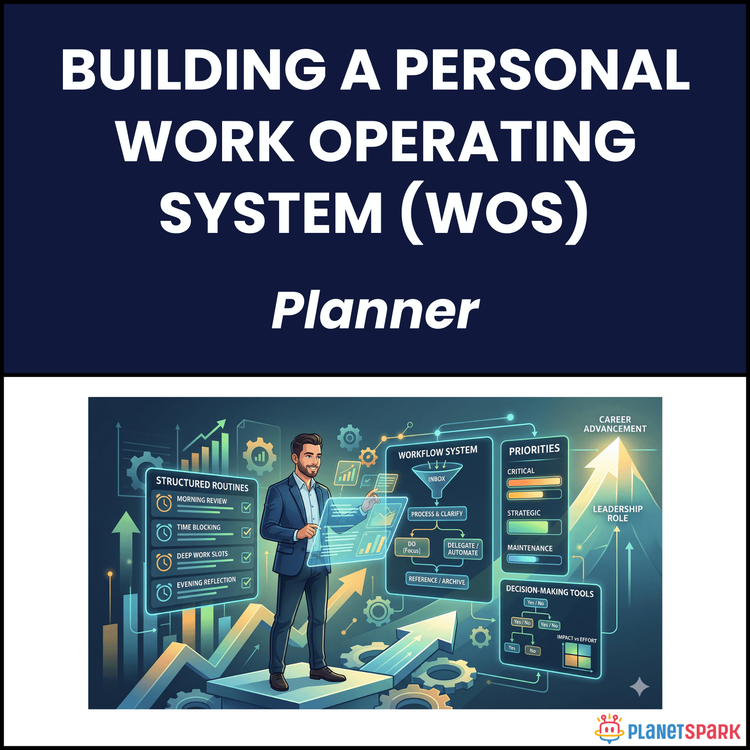
Building a Personal Work Operating System (WOS)
Building Your Personal Work Operating System (WOS): A Practical Planner for High-Performance Professionals
Have you ever felt overwhelmed by the demands of your workday, constantly reacting to urgent tasks and jumping from one to another without making real progress? If this sounds all too familiar, you're not alone. Many professionals struggle with the chaos of daily work without a clear, intentional system in place. It’s easy to fall into a routine of constant busyness, but without structure, it's hard to measure productivity and maintain consistency.
This is where a Work Operating System (WOS) comes into play. The "Building Your Personal Work Operating System (WOS)" resource is designed to help you break free from reactive work habits and move towards intentional, high-performance productivity. This practical guide helps professionals create a personalized system to manage their time, tasks, and energy, making it easier to achieve goals and maintain clarity in a chaotic work environment.
Who Is This Resource For?
This resource is ideal for:
- Career changers and professionals looking to streamline their workload
- Managers and consultants feeling overwhelmed by competing priorities
- Early to mid-career professionals (0-15 years experience) stuck in reactive modes
- Anyone who’s tired of working harder without seeing the results they want
Whether you’re looking to establish better work rhythms, improve your energy management, or tackle daily tasks more effectively, this guide is made for professionals who are ready to design their work systems intentionally rather than leaving their success to chance.
What Does This Resource Contain?
This resource is a practical, action-oriented planner that walks you through building a personalized Work Operating System. Inside, you’ll find:
- A comprehensive self-diagnostic audit to assess your current system
- A clear framework for defining the five core pillars of your WOS: Priorities, Rhythms, Tools, Energy, and Decisions
- Worksheets and actionable checklists to create routines and task flows
- A minimum viable tools stack (MVT) to simplify your work process without overwhelm
- Real-world examples of professionals successfully implementing their WOS
- A 30-day action checklist to get your WOS up and running
Every section is designed to be practical and immediately applicable, ensuring that you can start making improvements right away.
Summary of the Resource:
This resource helps you build a WOS, a personal infrastructure that aligns your time, tools, and intentions. By focusing on five key pillars—Priorities, Rhythms, Tools, Energy, and Decisions—you’ll create a structure that ensures you’re working intentionally, with clarity, and with purpose. The resource is easy to follow, with step-by-step guides, real-world examples, and worksheets that make building your system simple and actionable.
How Will This Resource Be Useful?
This resource will help you gain:
- A clear understanding of your daily priorities, ensuring you focus on high-leverage work
- Increased productivity through structured work rhythms, including daily, weekly, and quarterly reviews
- A simplified tool stack that eliminates distractions and decision fatigue
- Enhanced energy management by scheduling your most important tasks during peak cognitive hours
- A repeatable, sustainable system for ongoing improvement in how you work
By the end of this process, you’ll have a custom-designed WOS that aligns with your professional goals, minimizes chaos, and helps you perform at your best.
How Should You Use This Resource?
To get the most out of this guide, follow this phased approach:
1. Read through the guide once to familiarize yourself with the framework and overall structure.
2. Audit your current system using the provided worksheets, which will help you identify areas that need improvement.
3. Define your five WOS pillars by customizing them to your role, context, and goals.
4. Design your rhythms, including daily, weekly, and quarterly rituals, to create a structure for your work.
5. Build your minimum viable tools stack by simplifying your current toolset and committing to the essential tools.
6. Implement your WOS using the action checklist provided, and start applying your new system in a real-world setting.
Once you’ve built your WOS, revisit it periodically to reflect on your progress and make any necessary adjustments to ensure your system stays relevant as your career evolves.
Action Steps:
After accessing this resource, take the following immediate actions:
1. Block 30 minutes in your calendar to begin your Honest Audit (Module 1).
2. Complete the Time Audit and Energy Audit worksheets to gain insights into how you currently work.
3. Set up your WOS rhythms by scheduling your daily and weekly planning sessions.
4. Simplify your tool stack by eliminating unnecessary tools and streamlining your work systems.
5. Start your weekly review session (the most critical part of maintaining your WOS).
6. Revisit your WOS at least every quarter to ensure it’s still aligned with your evolving professional goals.
Creating your personal Work Operating System is a process, but the results are worth it. By adopting this structured approach, you will move from reactive chaos to intentional, high-performance work. With the right systems in place, you can take control of your time, tasks, and energy, setting yourself up for long-term professional success.
Book your free session today!