
Building a Transition System That Minimizes Career Downtime

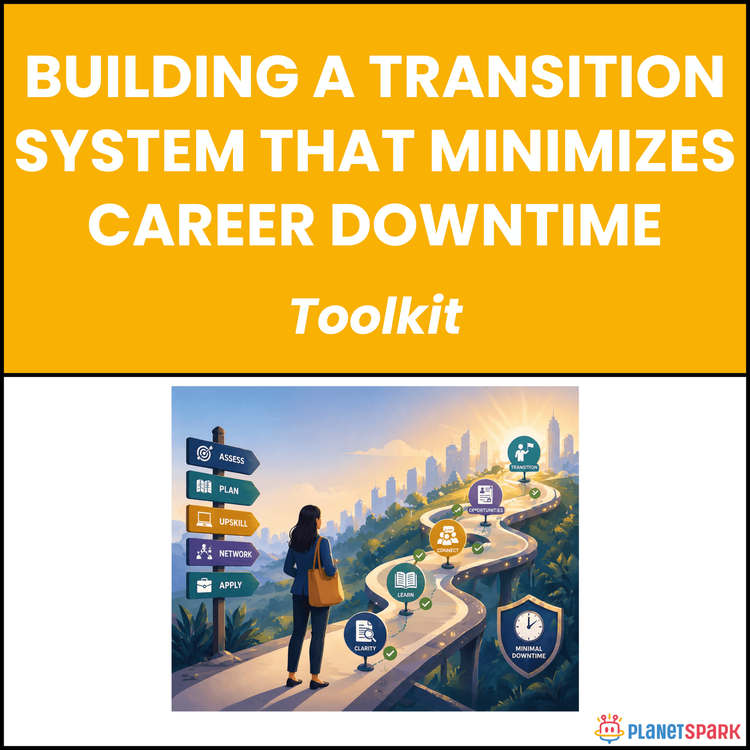
Building a Transition System That Minimizes Career Downtime
Creating a Career Transition System That Minimizes Downtime: A Practical Guide for Working Professionals
Career transitions are rarely as smooth as we expect. You resign, start exploring options, and suddenly weeks turn into months of uncertainty. Income pauses, confidence dips, and momentum slows down. For working professionals balancing responsibilities, this “in-between phase” is not just uncomfortable—it’s costly.
Most career advice focuses on resumes, interviews, or motivation. What’s often missing is a structured system that tells you exactly what to do, when to do it, and how to avoid unnecessary delays. That’s exactly where this resource comes in.
“Building a Transition System That Minimises Career Downtime” is designed to help you move from one role to the next with clarity, speed, and control—without losing momentum.
Who Is This Resource For?
This resource is especially valuable for:
- Professionals planning a job switch and wanting to avoid long gaps
- Career switchers moving into a new industry or function
- Managers and consultants transitioning into higher-responsibility roles
- Professionals considering freelance or consulting careers
- Anyone currently “in transition” and feeling stuck or directionless
If you’re someone who wants a structured, outcome-driven approach instead of trial-and-error, this toolkit is built for you.
What Does This Resource Contain?
This is not just a guide—it’s a complete transition system with actionable components you can apply immediately.
Inside, you’ll find:
A 5-phase Career Transition Framework:
- Diagnosis
- Positioning
- Active Search
- Negotiation
- Landing
A Positioning Audit Worksheet to define:
- Your core value
- Target role and industry
- Perception gaps
- Non-negotiables
Transition Infrastructure Setup including:
- Resume strategy (master + tailored versions)
- LinkedIn optimization
- Positioning statement
- Case study portfolio
- Reference network
A Transition Operating System:
- Opportunity tracker
- Daily 90-minute execution block
- Weekly review ritual
- Energy management system
The 3-Channel Outreach Strategy:
- Warm network activation
- Targeted direct outreach
- LinkedIn thought leadership
Offer Evaluation Framework covering:
- Compensation
- Growth trajectory
- Role scope
- Organizational health
- Exit opportunities
- Negotiation principles to secure better offers
- A First 90 Days Protocol to succeed after landing the role
- Real-world case study showing how a professional reduced transition time to 9 weeks
- Common mistakes and practical fixes
Summary of the Resource
This resource gives you a step-by-step system to manage your career transition like a structured project instead of a guessing game.
Instead of relying on luck or scattered efforts, you learn how to:
- Diagnose your current position
- Build the right assets before applying
- Access hidden job opportunities
- Execute outreach strategically
- Evaluate and negotiate offers effectively
- Succeed in your new role from Day 1
In short, it helps you reduce transition time while improving the quality of outcomes.
How Will This Resource Be Useful?
The biggest benefit of this resource is clarity.
It removes confusion about:
- Where to start
- What to prioritize
- Why your current approach may not be working
With this system, you can:
- Reduce career downtime significantly
- Avoid common mistakes like random applications or poor follow-ups
- Build confidence through structured action
- Increase interview and offer conversion rates
- Make better career decisions, not rushed ones
It shifts your approach from reactive to strategic—saving both time and energy.
How Should You Use This Resource?
To get maximum value, use it in a structured way:
Step 1: Read the full guide once
Understand the complete system and how each phase connects.
Step 2: Start with the Positioning Audit
Define your value, target market, and career direction before taking action.
Step 3: Build your infrastructure
Prepare your resume, LinkedIn, case studies, and tracking system.
Step 4: Activate outreach
Use the 3-channel strategy consistently every week.
Step 5: Track and review progress
Follow the weekly review ritual to stay on track and adjust strategy.
Step 6: Apply negotiation frameworks
Evaluate offers carefully and negotiate with confidence.
Step 7: Execute the 90-day plan
Once you land a role, use the onboarding framework to build early credibility.
Treat this resource as a working document—not something you just read once.
Action Steps
If you’re ready to take control of your career transition, start here:
1. Complete your Positioning Audit today
2. Create your opportunity tracker (spreadsheet or tool)
3. Identify 10 people in your network to reconnect with
4. Block 90 minutes daily for transition activities
5. Write your 3-sentence positioning statement
6. Draft your first LinkedIn post to build visibility
7. Review your progress at the end of the week
These small but structured actions will immediately shift your momentum.
Career transitions don’t have to be slow, uncertain, or overwhelming. With the right system, they become predictable, manageable, and far more effective.
The difference between professionals who stay stuck for months and those who transition in weeks is not talent—it’s structure, consistency, and clarity. This resource gives you all three.
If you’re serious about moving forward in your career without losing time, income, or confidence, this is the system to follow.