
Building Awareness Of Your Default Conflict Style

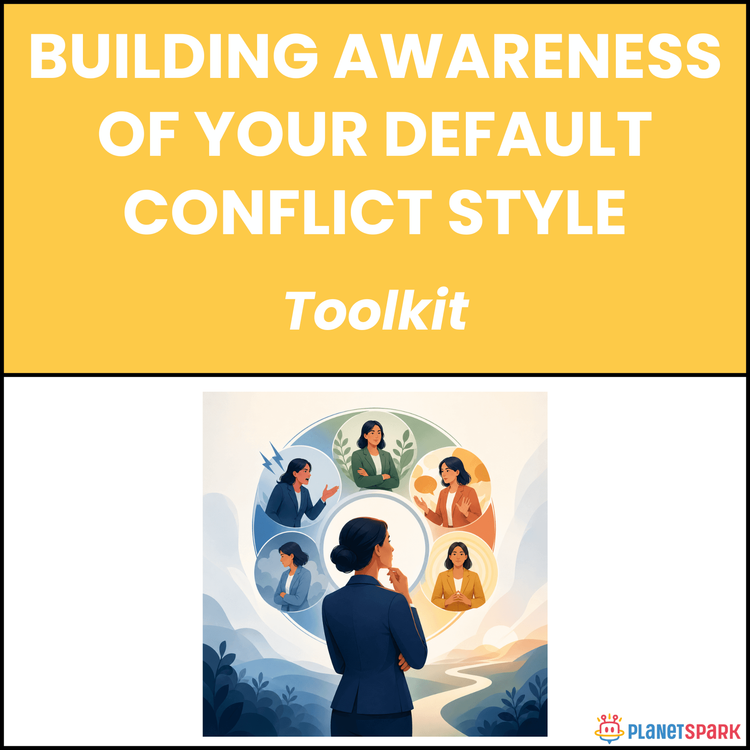
Building Awareness Of Your Default Conflict Style
A Practical Toolkit to Handle Workplace Conflicts Better
Most professionals think they struggle with conflict because they don’t know the right techniques.
“Stay calm.”
“Listen actively.”
“Find common ground.”
You’ve heard all of this before.
But in real situations — when a colleague dismisses your idea, when feedback feels unfair, or when tension rises in a meeting — you don’t get time to apply theory. You react.
That reaction, often automatic and unconscious, is your default conflict style. And it shapes your reputation, your relationships, and your career far more than any communication framework you’ve learned.
The “Building Awareness of Your Default Conflict Style” toolkit exists to help you understand that pattern — and more importantly, change it.
Who Is This Resource For?
This resource is designed for professionals who want to handle conflict more effectively, including:
- Career switchers adapting to new workplace dynamics
- Early to mid-career professionals navigating team relationships
- Managers and team leads handling difficult conversations
- Consultants working with multiple stakeholders
- Anyone who feels they “could have handled that better” after a conflict
If you often replay conversations in your head or feel stuck between avoiding conflict and escalating it, this resource is highly relevant.
What Does This Resource Contain?
This is a structured, hands-on toolkit focused on self-awareness and behaviour change. Inside, you’ll find:
- A clear explanation of what a default conflict style is and why it matters
- The five core conflict styles framework:
- Competing
- Collaborating
- Compromising
- Avoiding
- Accommodating
- A detailed self-assessment (Conflict Audit) using four lenses:
- Behaviour
- Emotion
- Thought
- Impact
- Reflection exercises to identify your real conflict patterns
- A deep dive into where your conflict style comes from (past experiences, culture, workplace)
- A situational fit matrix to understand when your style works — and when it backfires
- A decision-making framework:
- Context assessment
- Style match
- Deliberate choice
- A personal conflict style profile template
- Practical tools to help you consciously shift your behaviour in real situations
Every section is built to move you from unconscious reaction to deliberate response.
Summary of the Resource
In simple terms, this toolkit helps you:
- Identify how you actually behave in conflict (not how you think you behave)
- Understand why you respond that way
- Recognise the impact your behaviour has on others
- Learn when your default style helps vs hurts
- Develop the ability to choose your response instead of reacting automatically
It transforms conflict from something you “handle poorly” into something you can navigate strategically.
How Will This Resource Be Useful?
This resource delivers real, practical outcomes:
- Improves how you handle difficult conversations
- Reduces regret after conflicts
- Builds confidence in high-pressure interactions
- Strengthens professional relationships
- Helps you balance assertiveness and collaboration
- Improves how others perceive your communication and leadership
Instead of repeating the same patterns with different people, you start responding with clarity and intention.
How Should You Use This Resource?
To get maximum value, follow this structured approach:
Step 1: Start with a real conflict
Pick a recent situation that felt uncomfortable or unresolved.
Step 2: Complete the Conflict Audit
Use the four lenses (behaviour, emotion, thought, impact) to analyse what actually happened.
Step 3: Identify your default style
Map your behaviour to one of the five conflict styles honestly — not aspirationally.
Step 4: Understand the origin
Reflect on where this pattern comes from (past experiences, culture, workplace conditioning).
Step 5: Use the situational matrix
Evaluate whether your default style was appropriate for that situation.
Step 6: Practise deliberate choice
Use the framework (context → style match → choice) before your next conflict.
Step 7: Build your personal profile
Document your patterns and use it as a reference for future situations.
This is not a one-time exercise. The more situations you analyse, the sharper your awareness becomes.
Action Steps
Start applying this resource immediately:
- Write down one recent conflict you wish you handled better
- Complete the Conflict Audit for that situation
- Identify your default conflict style
- Note one way that style helped you
- Note one way it hurt the outcome
- Choose one alternative style to try next time
- Apply it in your next real interaction
Small shifts in behaviour can dramatically change outcomes over time.
Conflict is not a problem to eliminate — it is a skill to master.
The professionals who grow fastest are not the ones who avoid conflict, but the ones who understand themselves deeply enough to handle it well.
This toolkit gives you that self-awareness and control. The more you use it, the more intentional your responses become — until you’re no longer reacting, but choosing.