
Building Confidence in Workplace Communication

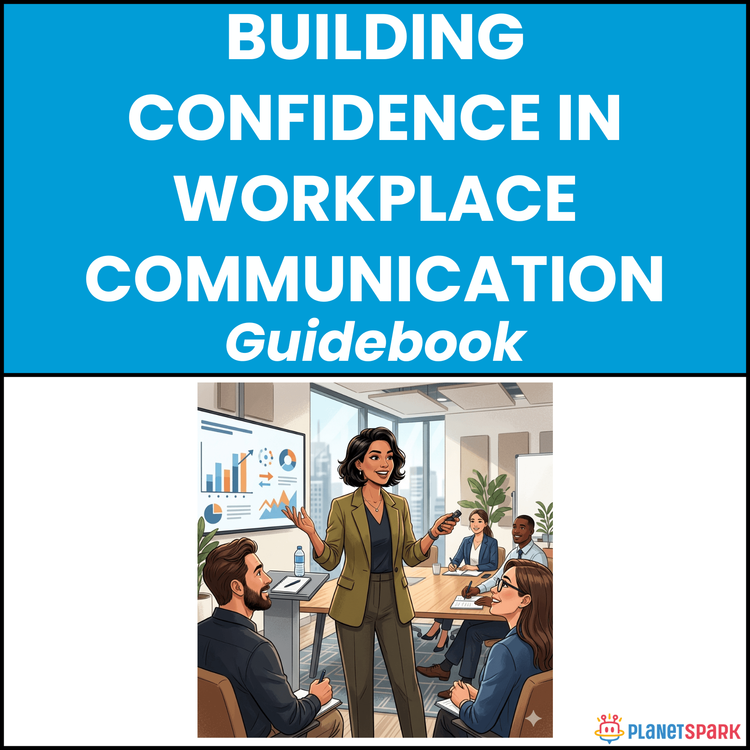
Building Confidence in Workplace Communication
Building Confidence in Workplace Communication: A Practical Guide to Speak Clearly, Stand Out, and Be Heard
Most professionals don’t struggle because they lack knowledge. They struggle because, in the moments that matter—meetings, presentations, difficult conversations—their communication doesn’t reflect their actual capability.
You may have experienced this yourself: knowing what you want to say, but not being able to express it clearly under pressure. Holding back in meetings despite having valuable input. Over-explaining, second-guessing, or softening your message to the point where it loses impact.
This is exactly the gap the “Building Confidence in Workplace Communication” guidebook is designed to solve. It helps you move from hesitation to clarity, from overthinking to structured communication, and from being overlooked to being heard.
Who Is This Resource For?
This guidebook is designed for working professionals who want to strengthen how they communicate in real-world situations.
It is especially useful for:
- Early to mid-career professionals who want to be taken more seriously at work
- Job seekers and career switchers preparing for interviews and stakeholder interactions
- Managers and consultants who need to communicate ideas clearly and persuasively
- Professionals who struggle with speaking up in meetings or handling high-pressure conversations
- Anyone aiming to grow into leadership roles but feels their communication is holding them back
If you’ve ever felt that your communication doesn’t reflect your true expertise, this resource is built for you.
What Does This Resource Contain?
This guidebook is not theory-heavy. It is structured, practical, and built around real workplace scenarios.
Here’s what you’ll find inside:
- A Communication Confidence Framework
Built around three core pillars: clarity, credibility, and composure
- Self-Assessment and Awareness Tools
Helps you identify your current communication patterns and blind spots
- Proven Communication Frameworks
- BLUF (Bottom Line Up Front) for clear, concise communication
- PREP (Point, Reason, Example, Point) for structured responses
- SCQA (Situation, Complication, Question, Answer) for storytelling and presentations
- Pre-Communication Planning Worksheet
A quick tool to structure your thoughts before any important conversation
- Credibility Language Upgrades
Replace weak, apologetic phrases with confident, professional alternatives
- Non-Verbal Communication Techniques
Practical guidance on eye contact, posture, pauses, and vocal delivery
- Composure Techniques for High-Pressure Situations
Tools like deliberate pause, reflective listening, and anchor statements
- Meeting Communication Strategies
How to contribute effectively, speak early, and build presence
- Difficult Conversation Framework (SBI-O)
A structured way to handle feedback, conflict, and sensitive discussions
- Professional Writing Principles
Clear rules for writing effective emails and messages
- Worksheets, Templates, and Checklists
Ready-to-use tools for meetings, conversations, and daily communication
- 30-Day Practice Tracker
Helps you build communication habits consistently
Summary of the Resource
This guidebook gives you a complete system to improve how you communicate at work.
Instead of vague advice like “be more confident,” it shows you exactly how to:
- Structure your thoughts quickly
- Speak with clarity and authority
- Stay composed under pressure
- Handle difficult conversations professionally
- Communicate in a way that reflects your actual capability
It is designed for immediate application, not passive reading.
How Will This Resource Be Useful?
The real value of this guide lies in how directly it impacts your day-to-day work.
By using it consistently, you will:
- Speak more clearly and confidently in meetings
- Reduce overthinking and hesitation before speaking
- Communicate your ideas in a structured, impactful way
- Handle challenging conversations without avoiding them
- Build credibility through both language and presence
- Improve how others perceive your competence and leadership potential
Over time, this leads to better visibility, stronger professional relationships, and faster career growth.
How Should You Use This Resource?
To get the most value, don’t try to consume everything at once. Use it in a structured, repeatable way.
Start with a full read-through
Go through the entire guide once to understand the big picture and key frameworks.
Identify your communication pattern
Use the self-assessment to understand whether you tend to understate, ramble, freeze, or avoid direct conversations.
Focus on one area at a time
Pick one core skill—clarity, credibility, or composure—and work on it for a week.
Use the worksheets before real situations
Before meetings, presentations, or difficult conversations, use the planning templates to structure your thoughts.
Apply frameworks in daily communication
Use BLUF for emails, PREP for speaking, and SBI-O for difficult conversations.
Revisit as your role evolves
As your responsibilities grow, come back to specific modules to refine your approach.
Action Steps
If you want to see immediate improvement, start here:
1. Use BLUF in your next email
Start with your main point instead of building up to it
2. Prepare your next meeting contribution
Write your opening sentence before the meeting begins
3. Replace one weak phrase
Swap “Sorry to bother you” with “I’d like to raise something important”
4. Practise the deliberate pause
The next time you’re asked a question, pause for 3 seconds before responding
5. Plan one difficult conversation
Use the SBI-O framework to structure it in advance
6. Track one communication win daily
Build awareness and reinforce progress
Consistent small actions like these create visible improvement within weeks.
Strong communication is not about personality. It is about preparation, structure, and practice. The professionals who grow fastest are not necessarily the most knowledgeable—they are the ones who can express their ideas clearly and confidently when it matters.
This guide gives you the exact tools to do that. Use them consistently, and you will close the gap between what you know and how you communicate it.
Book your free session today!