
Building Financial Resilience During Economic Uncertainty

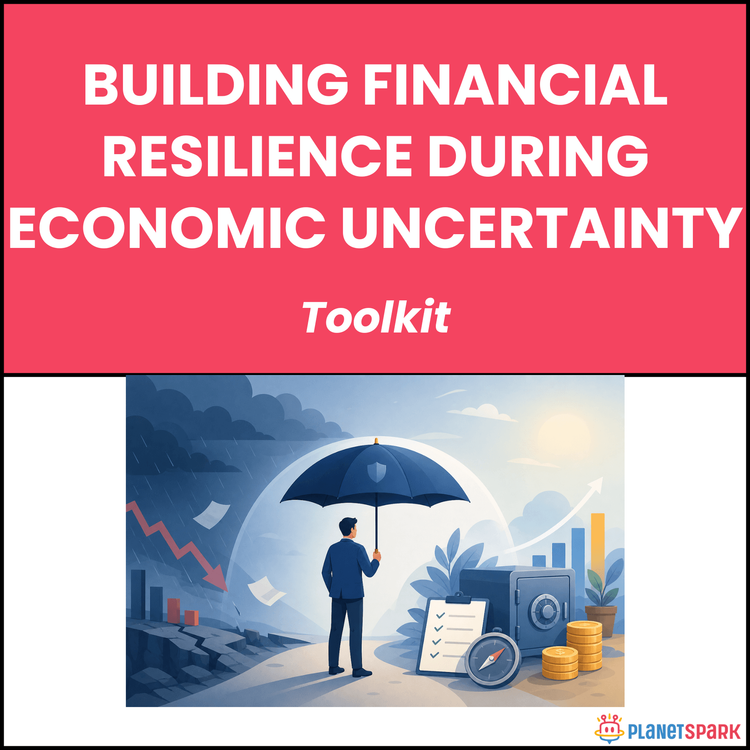
Building Financial Resilience During Economic Uncertainty
Building Financial Resilience During Economic Uncertainty: A Practical Toolkit for Job Loss, Income Drops, and Career Transitions
If your income suddenly stopped tomorrow, how long could you sustain your current lifestyle?
Most professionals don’t have a clear answer to that question. Not because they’re careless—but because they’ve never had the right system to think through it. When layoffs, salary cuts, or unstable freelance income hit, decisions are often made under pressure, without clarity, and far too late.
That’s exactly the gap this toolkit is designed to solve.
The “Building Financial Resilience During Economic Uncertainty” resource is a structured, scenario-driven toolkit that helps you move from panic to precision—within hours, not weeks. Instead of generic financial advice, it gives you ready-to-use templates for the exact moments that matter most: right after a layoff, during income instability, or while navigating a career transition.
Who Is This Resource For?
This toolkit is specifically designed for working professionals who need clarity and control during uncertain financial periods:
- Job seekers dealing with layoffs or anticipated income loss
- Career switchers navigating gaps between roles or industries
- Freelancers and consultants managing unpredictable income streams
- Managers and professionals facing salary freezes or reduced bonuses
- Early to mid-career professionals who want to proactively build a financial safety net
If your income is unstable—or could become unstable—this resource is for you.
What Does This Resource Contain?
This is not a single worksheet—it’s a complete financial resilience system made up of 10 practical, real-world templates, each tied to a specific scenario.
Here’s what you get:
- Emergency Financial Baseline Audit
Map your complete financial situation within 48 hours of a disruption
- Recession-Mode Monthly Budget Planner
Restructure your spending when income drops significantly
- Cash Runway Calculator & Survival Timeline
Calculate exactly how many months you can survive without income
- Freelancer Income Stabilisation Tracker
Manage pipeline gaps, delayed payments, and income volatility
- Debt Prioritisation & Negotiation Prep Sheet
Strategically approach lenders before missing payments
- Career Transition Financial Bridge Plan
Plan finances during the gap between jobs or income streams
- Emergency Fund Rebuild Roadmap
Create a 12-month structured savings recovery plan
- Side Income Opportunity Mapping Template
Identify and evaluate realistic additional income sources
- Expense Negotiation & Reduction Log
Track and execute cost-cutting and renegotiation efforts
- Financial Recovery Milestone Tracker
Monitor your progress over a 6–18 month recovery period
Each template is designed to be used independently—or as part of a connected system depending on your situation.
Summary of the Resource
In simple terms, this toolkit helps you:
- Understand your exact financial position
- Calculate how long your money will last
- Prioritise spending and reduce unnecessary costs
- Manage income instability with structure
- Navigate career transitions without financial panic
- Rebuild your finances after a setback
It replaces guesswork with clarity—and panic with a plan.
How Will This Resource Be Useful?
Most financial advice fails when it matters most—during uncertainty.
This toolkit works because it focuses on real decisions, not theory.
Here’s what it helps you achieve:
- Clarity in crisis
Instead of reacting emotionally, you get a clear, written picture of your finances
- Faster decision-making
You know exactly what to cut, what to prioritise, and what to act on
- Reduced financial stress
When you know your runway and plan, uncertainty becomes manageable
- Better negotiation outcomes
Structured preparation helps you confidently approach creditors and service providers
- Smarter career transitions
You align financial planning with job search timelines and income gaps
- Long-term resilience
You don’t just recover—you build systems that prepare you for future uncertainty
The key difference: you’re not just surviving—you’re making strategic, informed decisions.
How Should You Use This Resource?
To get maximum value, use this toolkit in phases—not all at once.
Phase 1: Immediate Clarity (First 24–72 Hours)
- Start with the Emergency Financial Baseline Audit
- Use the Cash Runway Calculator to understand your survival timeline
- This gives you your “ground zero”
Phase 2: Stabilisation
- Use the Recession-Mode Budget Planner
- Track and cut expenses using the Expense Negotiation Log
- Prioritise debts with the Debt Preparation Sheet
Phase 3: Income Strategy
- If freelancing, use the Income Stabilisation Tracker
- Map side income opportunities and take action
- Align your efforts with your runway timeline
Phase 4: Transition & Recovery
- Use the Career Transition Financial Bridge Plan
- Once income resumes, shift to the Recovery Milestone Tracker
- Begin rebuilding your emergency fund systematically
The templates are designed to be revisited regularly—not used once and forgotten.
Action Steps
If you want to actually benefit from this resource, don’t just read it—use it.
Here’s what to do next:
1. Open the toolkit and complete the Financial Baseline Audit immediately
2. Calculate your runway—this is your most critical number
3. Identify your top 3 expenses to reduce or renegotiate
4. Decide your next income action (job search, freelance, or side income)
5. Set a 30-day review date to reassess your situation
Small, structured actions now can prevent major financial stress later.
Financial uncertainty is not entirely avoidable—but being unprepared is.
The professionals who navigate uncertainty best are not the highest earners. They are the ones who plan early, act quickly, and make decisions from structure—not panic. This toolkit gives you that structure.
Whether you are facing a financial disruption right now or preparing for one in the future, this resource helps you take control—step by step, decision by decision.