
Building High-Performing Teams Framework

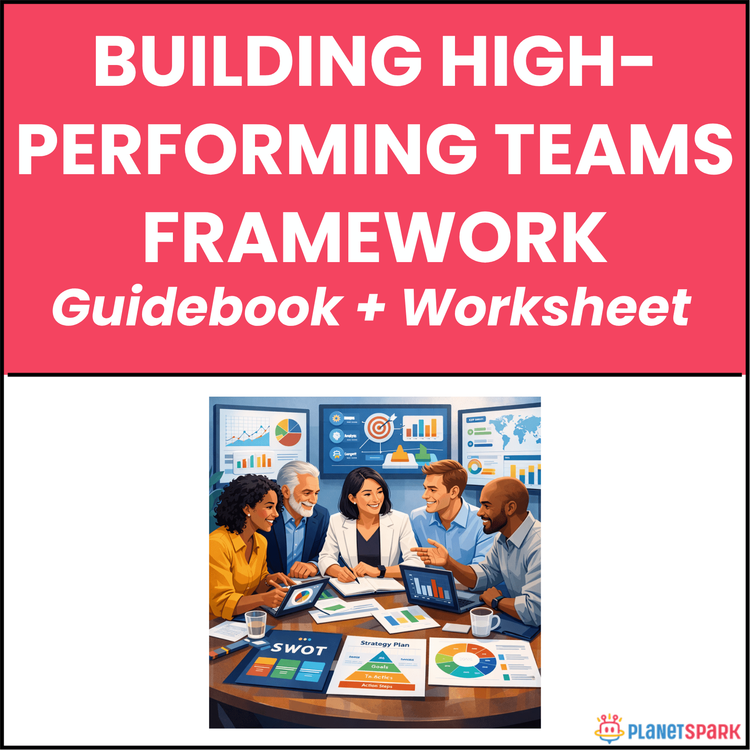
Building High-Performing Teams Framework
How to Build High-Performing Teams: A Practical Framework for Managers and Leaders
Most professionals are promoted into leadership roles without ever being taught how to build and manage a high-performing team. Suddenly, you're responsible for outcomes, alignment, motivation, and performance—yet there’s no clear playbook.
If you’ve ever felt that your team has potential but isn’t consistently delivering, the problem isn’t capability—it’s structure, clarity, and systems.
That’s exactly where the “Building High-Performing Teams Framework” comes in. This resource provides a practical, research-backed system to help you move from managing people to building a team that performs reliably under real-world pressure.
Built for immediate application, this framework helps you diagnose gaps, implement proven practices, and create a team environment where performance becomes sustainable—not dependent on individual heroics.
Book your free trial session today with PlanetSpark.
Download for more details or PDF file.
Who Is This Resource For?
This resource is highly valuable if you are:
- A manager or team lead responsible for delivering outcomes through others
- A professional transitioning from an individual contributor to a leadership role
- A consultant working on team performance, culture, or transformation
- A mid-career professional leading cross-functional or project-based teams
- Someone managing team conflicts, low engagement, or unclear accountability
- A leader looking to scale a team without losing performance quality
If you’re dealing with missed deadlines, misalignment, or inconsistent results—this framework gives you a structured way to fix it.
What Does This Resource Contain?
This is not a theory-heavy leadership guide. It is a complete, action-ready system designed for real-world execution.
Inside the resource, you’ll find:
- The 5-phase High-Performance Team Framework: Foundation, Connection, Activation, Acceleration, and Sustainability
- The five core pillars of high-performing teams: clarity, trust, accountability, communication, and adaptability
- A structured conflict resolution model to turn disagreements into productive outcomes
- The RACI framework for role clarity and ownership mapping
- A Team Foundation Builder worksheet to align purpose, roles, and success metrics
- A Trust Audit worksheet to assess psychological safety and reliability within teams
- A complete Team Operating System checklist covering meetings, communication, and accountability systems
- The SBI (Situation–Behaviour–Impact) feedback framework with real examples
- A full Team Health Self-Evaluation tool to diagnose performance gaps across all phases
- A 30-day execution plan to implement the framework step-by-step
Every section is designed to help you move from insight to action quickly.
Summary of the Resource
“Building High-Performing Teams Framework” is a structured, end-to-end system that helps you assess, build, and sustain team performance.
It goes beyond generic leadership advice and gives you concrete tools to:
- Create clarity in goals and roles
- Build trust and psychological safety
- Establish systems that reduce chaos and friction
- Drive continuous feedback and growth
- Sustain performance through culture and resilience
If you’re short on time but serious about improving team outcomes, this resource gives you a clear roadmap without unnecessary complexity.
How Will This Resource Be Useful?
This resource helps you shift from reactive management to intentional leadership.
You’ll gain:
- Clear visibility into what’s actually holding your team back
- A structured approach to fixing misalignment and confusion
- Strong systems that reduce dependency on individual effort
- Better team communication and faster decision-making
- Higher trust, engagement, and accountability within your team
- A repeatable model you can apply across different teams and situations
Most importantly, it helps you stop firefighting daily issues—and start building a team that performs consistently.
How Should You Use This Resource?
To get the most value, use this resource as a working playbook—not just a reading guide.
Start by reading through the full framework once to understand how the five phases connect.
Next, assess your current team using the Team Health Self-Evaluation. Identify your weakest areas instead of trying to fix everything at once.
Then, move into action:
- Use the Foundation worksheet to clarify purpose and roles
- Run the Trust Audit to uncover team dynamics issues
- Implement the Operating System checklist to fix process gaps
- Apply the SBI framework in real feedback conversations
Finally, revisit the framework regularly. This is not a one-time exercise—high-performing teams require continuous refinement.
You can return to specific phases whenever your team faces challenges like growth, conflict, or change.
Action Steps
After accessing this resource, take these steps immediately:
1. Complete the Team Health Self-Evaluation honestly
2. Identify the lowest-scoring area across the five phases
3. Run one team session (Foundation or Trust Audit) within the next week
4. Implement one system improvement (meeting cadence, communication norms, or accountability tracking)
5. Deliver one structured SBI feedback conversation
6. Follow the 30-day plan to build momentum gradually
Focus on one change at a time—consistent improvement beats overload.
High-performing teams are not built by chance. They are designed through clarity, trust, systems, and continuous improvement.
This framework gives you the structure—but the real impact comes from applying it. Start small, stay consistent, and build momentum over time.
Because the difference between an average team and a high-performing one is not talent—it’s how the team works together.
Book your free session today!