
Building Judgment Through Pattern Recognition

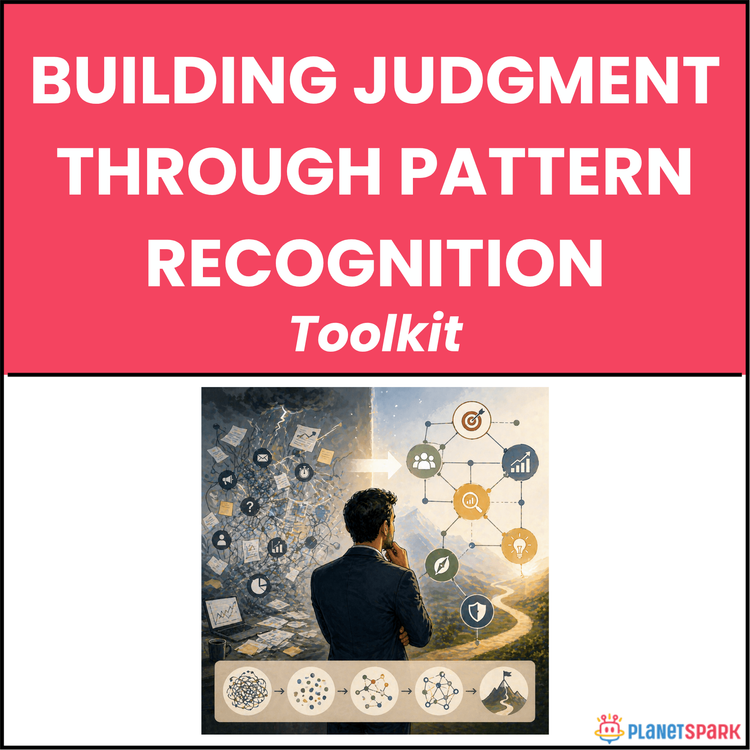
Building Judgment Through Pattern Recognition
Building Judgment Through Pattern Recognition: A Practical Guide for Smarter, Faster, and More Confident Decision-Making
If you’ve ever thought, “I’ve seen something like this before—but I can’t quite explain it,” you’re already experiencing the early stages of judgment.
But here’s the problem.
Most professionals gain experience—but don’t actually get better at using it.
You go through projects, meetings, and decisions every day. Yet when a new situation appears, it still feels unfamiliar. You start from scratch again.
That’s because experience alone doesn’t build judgment.
Pattern recognition does.
That’s exactly why the resource “Building Judgment Through Pattern Recognition” exists. It gives you a structured, repeatable system to convert everyday experiences into usable insights—so your decisions become faster, sharper, and more confident over time.
Instead of reacting to situations, you start recognising them.
Who Is This Resource For?
This resource is especially valuable if you are:
- A working professional with 0–15 years of experience
- A manager, consultant, or team lead making frequent decisions
- A career switcher navigating unfamiliar situations
- A professional who wants to improve judgment—not just knowledge
- Someone who feels “experienced but still unsure” in complex decisions
- A professional aiming for leadership, strategy, or advisory roles
If you’ve ever thought, “I need to make better decisions faster,” this guide is built for you.
What Does This Resource Contain?
This is not a theory-heavy guide—it is a practical judgment-building system.
Inside the resource, you’ll find:
- A clear explanation of why judgment—not knowledge—is the real career differentiator (page 2)
- The concept of pattern recognition as the foundation of professional judgment
- The core pattern recognition model (page 3):
- Awareness (recognising patterns)
- Extraction (learning from experience)
- Application (using patterns to decide)
- The Three-Stage Judgment Development Framework (page 4):
- Awareness Stage (noticing patterns)
- Application Stage (using patterns actively)
- Mastery Stage (refining and teaching patterns)
- The Pattern Capture Worksheet (page 5), a structured tool to:
- Record situations
- Compare expectations vs outcomes
- Identify recurring patterns
- Extract actionable lessons
- The 5 Structural Signals to read situations like a senior professional (page 6):
- Incentive alignment
- Information asymmetry
- Urgency vs importance confusion
- Historical pattern repetition
- Actual decision authority
- The Situation Diagnostic Checklist (page 7) to improve initial judgment before acting
- A real-world case study (page 8) showing how identifying “sponsor motivation inversion” unlocked a stalled project
- Common pattern recognition mistakes (page 9), such as:
- Over-fitting patterns
- Recency bias
- Confidence creep
- Context blindness
- A self-assessment tool (page 10) to evaluate your current judgment level
- A structured 30-day improvement plan
Everything is designed to turn experience into insight—not just memory.
Summary of the Resource
“Building Judgment Through Pattern Recognition” is a practical toolkit that helps professionals develop sharper decision-making by identifying recurring patterns across situations.
It transforms your thinking from reactive (“What should I do?”) to pattern-based (“I’ve seen this before—here’s what works”).
If you want to make better decisions consistently—not occasionally—this resource gives you the system.
How Will This Resource Be Useful?
This resource helps you move from experience to expertise.
You’ll gain:
- Faster and more accurate situation assessment
- Improved decision-making under uncertainty
- Stronger confidence in ambiguous situations
- Better ability to anticipate outcomes
- Reduced reliance on trial-and-error learning
- Increased credibility in professional environments
- A repeatable system to improve continuously
As explained in the introduction (page 2), judgment is not about knowing more—it’s about recognising what matters, when it matters.
Most importantly, it helps you stop relearning the same lessons repeatedly.
How Should You Use This Resource?
To get the best results, treat this as an ongoing system—not a one-time read.
Start with awareness:
- Read the framework once fully
- Understand how patterns drive decisions
Apply immediately:
- Use the Pattern Capture Worksheet after real situations
- Focus on extracting patterns—not just describing events
Train your observation:
- Look for the 5 structural signals in every situation
- Ask: “What pattern is this?”
Test your thinking:
- Form hypotheses about outcomes
- Track whether you were right
Build your pattern library:
- Capture 1–2 patterns per week
- Label them clearly
Improve continuously:
- Use the diagnostic checklist before decisions
- Reflect after outcomes
- Adjust your thinking
As highlighted in the worksheet (page 5), even 10–15 minutes of structured reflection can significantly improve judgment over time.
Action Steps
After accessing this resource, take these steps immediately:
1. Pick one recent situation (meeting, decision, project issue)
2. Write what you expected vs what actually happened
3. Identify one recurring pattern in that situation
4. Label the pattern clearly (e.g., “stakeholder misalignment”)
5. Identify one early signal you missed
6. Define what you would do differently next time
7. Repeat this process for 3–5 situations this week
8. Start building your personal “pattern library”
Better decisions don’t come from more thinking.
They come from better recognition.
The most effective professionals are not the ones who analyse everything from scratch.
They are the ones who recognise patterns quickly, apply lessons intelligently, and adapt with confidence.
When you build this skill, your judgment improves, your decisions accelerate, and your impact becomes far more consistent.
And over time, that becomes your biggest professional advantage.
Book your free session today!