
Building Personal SOPs for Managing Energy During Peak Workloads

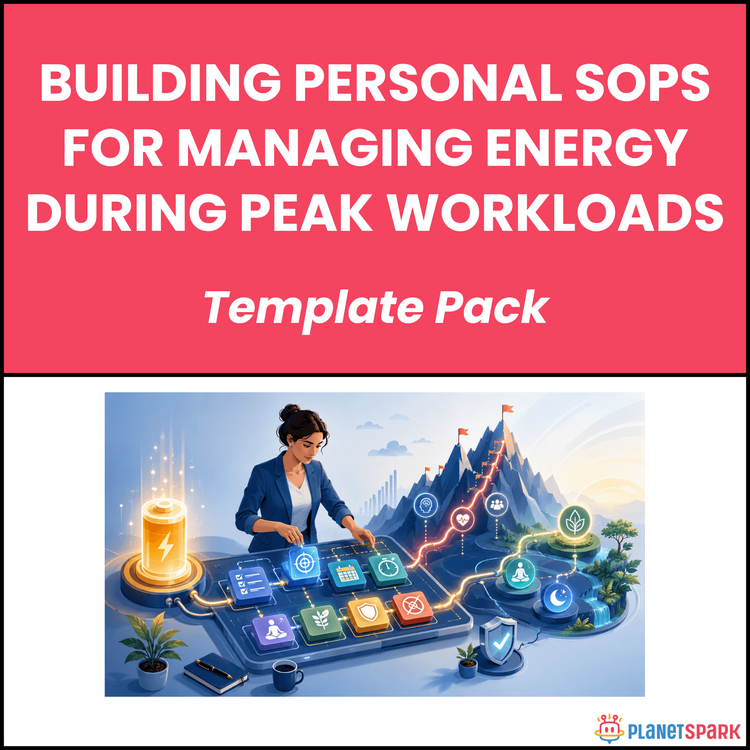
Building Personal SOPs for Managing Energy During Peak Workloads
Building Personal SOPs for Managing Energy During Peak Workloads
Peak workloads are a normal part of professional life. A major deadline, product launch, client project, quarterly review, job transition, or high-pressure sprint can quickly stretch your focus, time, and energy.
Most professionals try to survive these periods by pushing harder. They work longer hours, skip breaks, respond to everything immediately, and depend on caffeine, urgency, and willpower. This may help in the short term, but it often leads to exhaustion, mistakes, and a hard crash after the work is done.
The resource “Building Personal SOPs for Managing Energy During Peak Workloads” helps professionals manage demanding work periods with more structure. It shows you how to create personal Standard Operating Procedures, or SOPs, for protecting your energy before, during, and after peak workloads.
The goal is simple: help you perform well without burning out.
Who Is This Resource For?
This resource is useful for working professionals who regularly face intense work periods or high-pressure deadlines.
It is especially helpful for:
Project managers handling launches or delivery deadlines
Consultants managing client engagements
Managers and team leads balancing people, planning, and execution
Startup professionals working through fast-paced growth phases
Job seekers managing interviews, applications, and transitions
Early and mid-career professionals who want better work systems
Professionals who feel exhausted after every major sprint
Anyone who wants to work sustainably during peak pressure
If you often enter busy periods without a plan and come out feeling drained, this resource is designed for you.
What Does This Resource Contain?
This template pack gives you a practical structure for managing energy during high-demand work periods.
It includes frameworks, worksheets, SOP templates, reflection questions, a case example, common mistakes, and a quick-reference checklist.
The Energy SOP Framework
The guide is built around a simple three-phase model:
Before
During
After
This structure helps you prepare before the pressure starts, manage your energy while the workload is active, and recover properly after the sprint ends.
Before the Sprint
This phase focuses on preparation.
You identify your energy patterns, protect your non-negotiables, and set up your environment before the workload becomes intense.
During the Sprint
This phase focuses on execution.
You use daily planning, energy check-ins, trigger logs, and mid-sprint reviews to stay productive without burning through all your reserves.
After the Sprint
This phase focuses on recovery and learning.
You decompress, restore your energy, reflect on what happened, and update your SOP for the next busy period.
Personal Energy Audit
The guide begins with an energy audit that helps you understand how your energy changes across the day.
You identify your:
Peak Zone
Maintenance Zone
Depletion Zone
Your Peak Zone is when you are sharpest and best suited for deep work, strategy, writing, or complex decisions.
Your Maintenance Zone is when you can handle routine work, communication, admin, and follow-ups.
Your Depletion Zone is when your focus drops, mistakes increase, and major decisions should be avoided.
This audit helps you stop treating every hour as equal.
Pre-Sprint Setup Protocol
This SOP helps you prepare 3–5 days before a peak workload begins.
It guides you to:
Clarify the sprint scope
Identify your non-negotiables
Delegate, defer, or drop low-priority work
Communicate reduced availability
Prepare your physical and digital workspace
This section is useful because many professionals wait until they are already overwhelmed before they try to create order. The Pre-Sprint Setup Protocol helps you reduce friction before pressure hits.
Daily Energy Deployment Plan
This template helps you plan each sprint day according to your energy levels.
Instead of putting tasks randomly into your calendar, you match the right task to the right energy window.
For example:
Deep work goes into your Peak Zone
Meetings and communication go into medium-energy periods
Admin and routine tasks go into lower-energy periods
End-of-day time is used for review, planning, and shutdown
This helps you protect your best energy for your most important work.
Energy Drain Trigger Log
This template helps you notice where your energy is leaking during a sprint.
You track:
Major drains
Moderate drains
Energy sources
The guide encourages you to log energy drains at midday and at the end of the day. After a few days, patterns become visible.
You may realise that your biggest drain is not the workload itself, but repeated interruptions, unclear decisions, difficult communication, poor recovery, or unresolved background tasks.
Mid-Sprint Check-In Protocol
This is a 20-minute review used halfway through a major workload period.
It helps you assess your:
Physical energy
Mental focus
Emotional state
SOP discipline
You check for signs such as poor sleep, decision fatigue, irritability, mistakes, avoidance, or dropping all your non-negotiables.
This is important because many professionals only notice burnout when it is already too late. The mid-sprint check-in helps you correct course while there is still time.
Post-Sprint Recovery Protocol
The guide explains that finishing a workload does not mean you should immediately jump into the next one.
The recovery protocol has four stages:
Day 1–2: Decompress
Day 3–4: Restore
Day 5–7: Reflect
Day 8 onwards: Re-engage
This helps you recover deliberately instead of carrying exhaustion into your next project.
Sprint Debrief Worksheet
This worksheet helps you review the sprint within seven days of completion.
You reflect on:
What worked well
Where energy management broke down
What surprised you about your energy patterns
What you will do differently next time
What you want to tell your future self
This turns every sprint into useful data. Over time, your SOP becomes stronger because it is based on your real experience.
Priya’s Case Example
The guide includes a case example of Priya, a mid-level product manager at a B2B SaaS company in Bengaluru.
Before using an Energy SOP, Priya worked extremely long hours during launches, skipped meals, responded to late-night messages, made fatigue-related errors, and took weeks to recover.
After using the SOP, she prepared before launch month, protected her peak morning hours, set a no-Slack-after-9 PM rule, kept daily walks as a non-negotiable, used a mid-sprint check-in, and recovered faster after the launch.
Her workload did not disappear. Her system changed.
Common Energy SOP Mistakes
The resource also explains six common mistakes professionals make when building SOPs.
These include:
Making the SOP too complex
Treating it as a one-time document
Skipping the energy audit
Confusing busyness with productivity
Abandoning SOPs under pressure
Skipping the post-sprint debrief
This section helps readers avoid predictable mistakes and build a system they can actually follow.
Reflection Questions
The guide includes deeper reflection questions to help professionals examine their beliefs about hard work, rest, boundaries, and sustainable performance.
These questions help you understand why you may abandon your own systems when pressure increases.
Quick Reference Card
The final section gives a practical checklist for before, during, and after a sprint.
It is designed to be saved, printed, or revisited before any major workload spike.
Summary of the Resource
“Building Personal SOPs for Managing Energy During Peak Workloads” is a practical template pack for professionals who want to manage intense work periods more sustainably.
It helps you stop relying only on willpower and start using a repeatable system.
The resource teaches you how to prepare before pressure hits, deploy your energy wisely during the sprint, and recover properly afterwards.
The main message is clear: your energy is a professional asset, and it needs a system.
How Will This Resource Be Useful?
This resource helps professionals work through peak workloads with more clarity, control, and sustainability.
It helps you plan before you are overwhelmed.
The Pre-Sprint Setup Protocol gives you a way to prepare before the work becomes intense. This reduces last-minute stress and helps you enter the sprint with more control.
It helps you protect your best energy.
The Personal Energy Audit shows when you are sharpest, functional, and depleted. This helps you schedule important work when your brain is most ready for it.
It helps reduce decision fatigue.
When you create SOPs in advance, you do not need to make every decision under pressure. You already know what to protect, what to defer, and how to respond when things get difficult.
It helps you spot energy drains early.
The Energy Drain Trigger Log helps you identify the small patterns that quietly drain you, such as constant notifications, unclear tasks, avoidant behaviour, or too many meetings.
It helps prevent burnout during the sprint.
The Mid-Sprint Check-In helps you notice warning signs before they become serious. You can adjust your workload, rituals, or support before your performance suffers.
It helps you recover properly.
The Post-Sprint Recovery Protocol reminds you that recovery is not laziness. It is part of sustainable performance.
It helps you improve after every workload cycle.
The Sprint Debrief Worksheet turns every busy period into learning. Your next sprint becomes easier to manage because your SOP becomes more accurate.
How Should You Use This Resource?
Start by reading the full guide once.
Understand the Before, During, and After model before filling in the templates.
Then complete the Personal Energy Audit.
Track your energy for a few days and identify your Peak Zone, Maintenance Zone, and Depletion Zone.
Before your next major workload, complete the Pre-Sprint Setup Protocol.
Clarify the scope, choose your non-negotiables, clear unnecessary tasks, communicate availability, and set up your environment.
During the sprint, use the Daily Energy Deployment Plan every morning.
Put your most important work into your highest-energy time.
Use the Energy Drain Trigger Log at midday and at the end of the day.
Look for repeated drains and energy sources.
At the halfway point, complete the Mid-Sprint Check-In.
Check your physical, mental, emotional, and SOP status.
After the sprint, follow the recovery protocol.
Do not jump immediately into full output again.
Within seven days, complete the Sprint Debrief Worksheet.
Update your SOP based on what worked, what failed, and what you learned.
Action Steps
After downloading the resource, take these steps:
Complete the Personal Energy Audit.
Identify your Peak Zone, Maintenance Zone, and Depletion Zone.
Choose three energy non-negotiables.
Complete the Pre-Sprint Setup Protocol before your next busy period.
Block your Peak Zone in your calendar.
Use the Daily Energy Deployment Plan each sprint morning.
Track major drains and energy sources for three days.
Complete the Mid-Sprint Check-In halfway through the sprint.
Follow the Post-Sprint Recovery Protocol.
Complete the Sprint Debrief Worksheet within seven days.
Update your SOP before the next sprint.
Choose one template from the pack and complete it today.
Peak workloads will always be part of professional life. The goal is not to avoid every intense period. The goal is to enter those periods with a system that protects your energy, focus, and performance.
When you manage your energy intentionally, you do not become less committed. You become more reliable, more focused, and more sustainable.
This resource helps you create a personal playbook for doing your best work during demanding times without sacrificing your wellbeing.
Use it before your next sprint, return to it during the pressure, and update it after every workload cycle.