
Building Reputation Through Strategic Project Selection

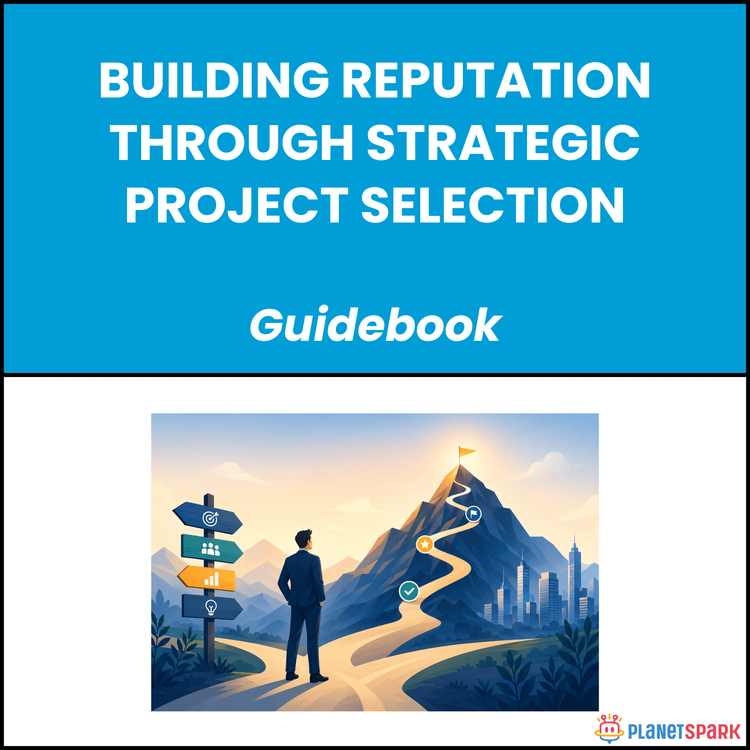
Building Reputation Through Strategic Project Selection
How to Choose the Right Projects to Accelerate Your Career Growth
Most professionals believe that career growth comes from working harder, delivering consistently, and saying yes to every opportunity. Yet many find themselves stuck—busy, reliable, and even high-performing, but not progressing the way they expected.
The problem isn’t effort. It’s direction.
What you work on matters just as much as how well you execute it. The projects you choose quietly shape how others perceive you, what opportunities come your way, and ultimately, how your career evolves. This is exactly the gap this resource addresses—a structured, practical playbook to help you make smarter project decisions and build a strong professional reputation over time.
Who Is This Resource For?
This resource is designed for professionals who want to be more intentional about their growth, not just reactive in their work.
It is especially useful for:
- Early to mid-career professionals (0–15 years of experience)
- Career switchers trying to reposition themselves in a new domain
- Consultants aiming to build visibility and credibility
- Managers seeking high-impact, cross-functional opportunities
- Professionals who feel “busy but not progressing”
- Individuals preparing for promotions or leadership roles
If you’ve ever wondered why some people seem to move ahead faster despite similar effort, this resource will give you the clarity you need.
What Does This Resource Contain?
This is not a motivational guide—it’s a structured system you can apply immediately.
Inside the resource, you’ll find:
- A clear breakdown of how professional reputation actually works (competence, character, and strategic perception)
- A step-by-step framework to audit your current reputation baseline
- A method to define a precise “target reputation” with clarity and direction
- A project landscape mapping approach to identify high-value opportunities
- A Strategic Project Filter to evaluate opportunities before saying yes
- Practical guidance on negotiating your role within projects for maximum visibility
- Execution strategies to ensure your work is seen, not just done
- A structured retrospective framework to convert experience into career capital
- A ready-to-use project selection checklist for quick decision-making
- A project portfolio worksheet to track and align your work over time
- Reflection questions to build long-term strategic thinking
- A real-world case study demonstrating transformation through project choices
- Common mistakes professionals make—and how to fix them
- A multi-year reputation-building strategy
- Communication tools to articulate your impact clearly
- A 30-day action plan to start immediately
Every section builds on the previous one, making it both comprehensive and highly actionable.
Summary of the Resource
This resource is a practical career playbook that teaches you how to use project selection as a strategic tool for growth.
Instead of passively accepting work, you learn how to:
- Choose projects that align with your long-term goals
- Build visible, credible evidence of your capabilities
- Shape how others perceive your professional value
- Create a consistent, compounding reputation over time
If you take one idea away, it’s this: your career is not defined by your job title—it’s defined by the pattern of projects you choose.
How Will This Resource Be Useful?
This guide helps you move from reactive work habits to intentional career building.
You will gain:
- Clarity on what you are currently known for vs. what you want to be known for
- Confidence in evaluating opportunities instead of defaulting to “yes”
- A structured way to identify high-impact, high-visibility work
- Better alignment between your daily work and long-term career goals
- Stronger professional positioning for promotions, role changes, or leadership opportunities
- Improved visibility without feeling like you’re “self-promoting”
Most importantly, it helps you stop drifting in your career and start directing it.
How Should You Use This Resource?
To get the best results, follow a phased approach rather than rushing through it.
First, read the initial sections to understand how reputation works and why project selection is critical. This builds the foundation.
Next, complete the reputation audit exercise. Use real data—feedback, project history, and observable patterns—to identify your current positioning.
Then, define your target reputation clearly. This becomes your decision filter for everything that follows.
After that, map your current and available projects. Use the Strategic Project Filter to evaluate which opportunities to accept, reshape, or decline.
As you work on projects, apply the execution and communication strategies to ensure your contributions are visible and impactful.
Finally, complete retrospectives after each major project and update your project portfolio regularly. This is where real growth compounds.
You can revisit this resource whenever you:
- Face a new project opportunity
- Prepare for performance reviews
- Plan a role transition or promotion
- Feel stuck or unclear about your next step
Action Steps
To start applying this immediately, take these steps:
1. Block 45–60 minutes to complete your reputation audit
2. Write your target reputation statement with specific clarity
3. List your current projects and evaluate them using the Strategic Project Filter
4. Identify one project that aligns strongly with your target reputation
5. Adjust your role or involvement in that project for better visibility and impact
6. Start documenting your contributions weekly
7. Schedule a 60-minute retrospective after your next major project
Small, intentional decisions made consistently will create disproportionate career impact over time.
Your career is not built in big, dramatic leaps—it is shaped quietly through everyday choices. The projects you accept, the roles you take, and the visibility you create all add up to the story others tell about you.
When you begin to choose your work strategically, that story changes.
And once it changes, opportunities follow.