
Building Resilient Infrastructure for Life Transitions

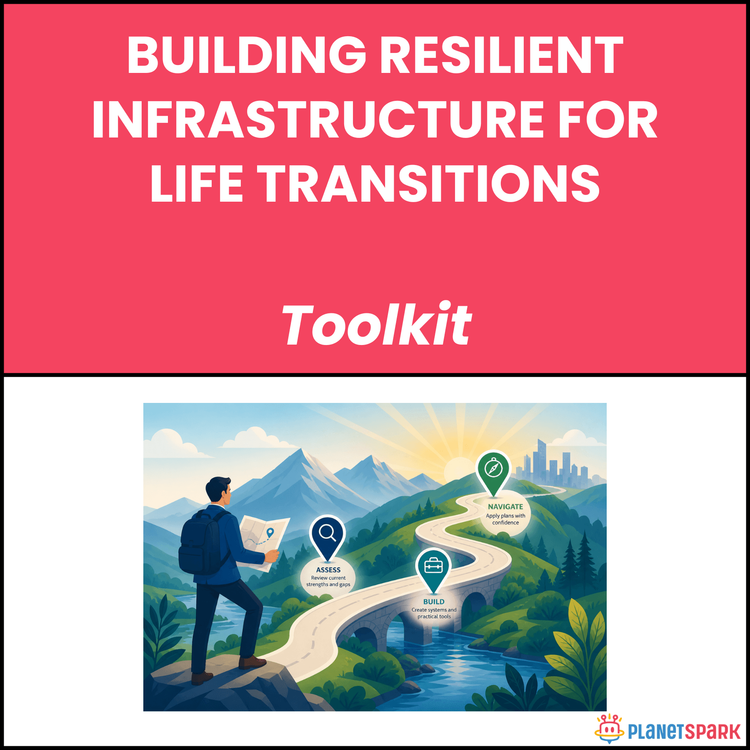
Building Resilient Infrastructure for Life Transitions
When Everything Changes, This Is What Keeps You Stable: A Practical System to Navigate Career and Life Transitions
Most professionals spend years learning how to perform — but almost no time learning how to transition.
Promotions, career pivots, layoffs, new roles, business launches, relocations — these moments don’t just require skill. They demand stability, clarity, and structured decision-making under uncertainty. And this is where even highly capable professionals struggle.
Not because they lack talent — but because their systems break down when everything changes.
The “Building Resilient Infrastructure for Life Transitions” resource exists to solve this exact problem. It gives you a structured, practical way to prepare for, navigate, and recover from major career and life shifts — without losing momentum or direction.
Who Is This Resource For?
This toolkit is designed for professionals facing — or anticipating — change.
It is especially valuable for:
- Professionals planning a career switch or pivot
- Managers stepping into new roles or environments
- Consultants building or transitioning into independent work
- Individuals experiencing organisational or personal shifts
- Anyone who feels a transition coming and wants to be prepared
If you’re at a crossroads — or even slightly approaching one — this resource becomes highly relevant.
What Does This Resource Contain?
This is a structured, action-oriented toolkit built around real transition challenges. It combines diagnostics, frameworks, and practical tools you can apply immediately.
Inside, you’ll find:
- Foundation Audit Framework
A diagnostic tool across five key pillars:
- Financial Runway
- Professional Network
- Skill Transferability
- Identity Flexibility
- Operational Systems
- Transition Readiness Worksheet
A scoring system (1–5 per pillar) to identify gaps and prioritise action.
- Five Core Infrastructure Systems
Step-by-step guidance to build:
- Financial buffer architecture
- Relationship capital network
- Portable skills portfolio
- Identity anchor framework
- Daily operating rhythm
- The Transition Navigator (3-Phase Model)
A clear execution model for every transition:
- Before: Prepare & protect
- During: Navigate & stabilise
- After: Consolidate & grow
- Practical Checklists & Templates
Including:
- Pre-transition readiness checklist
- Weekly review template during transitions
- Structured planning tools for clarity and execution
- Real-World Case Study
A step-by-step example of a professional successfully transitioning from a corporate role to independent consulting using these systems.
- Reflection Worksheets
Deep self-assessment exercises to clarify direction, identify risks, and define your professional identity.
Summary of the Resource
At its core, this resource reframes resilience.
It shows that resilience is not about mindset or motivation — it’s about infrastructure.
Instead of reacting to change, you learn how to:
- Build systems that hold under pressure
- Maintain clarity when uncertainty increases
- Make decisions without panic or urgency
- Transition without losing progress
It transforms transitions from chaotic events into structured processes.
How Will This Resource Be Useful?
The biggest benefit of this resource is stability during uncertainty.
You will gain:
- Better decision-making under pressure
Financial buffers and structured thinking remove desperation.
- Reduced overwhelm
Clear systems replace reactive, scattered action.
- Stronger positioning during transitions
You’ll know how to articulate your skills and value across contexts.
- Faster recovery and momentum
You won’t lose months figuring things out — you’ll move with intent.
- Long-term career resilience
You become someone who can handle change repeatedly, not just once.
In short, it helps you stay in control — even when your environment isn’t.
How Should You Use This Resource?
To get the most value, approach this as a system-building process — not a one-time read.
Step 1: Complete the Foundation Audit
Score yourself honestly across all five pillars. This determines where you start.
Step 2: Identify your weakest pillar
Focus your effort where your system is most fragile — that’s where risk is highest.
Step 3: Build one system at a time
Start with:
- Financial buffer
- Network strengthening
- Skill articulation
Avoid trying to fix everything at once.
Step 4: Understand your transition phase
Identify whether you are:
- Before (preparing)
- During (navigating)
- After (consolidating)
Align your actions accordingly.
Step 5: Use templates and checklists
Apply:
- Weekly review templates
- Pre-transition readiness checklist
- Reflection worksheets
Step 6: Revisit and refine
This is not static. Reassess your infrastructure every few months or before any major shift.
Action Steps
If you want to start immediately, here’s what to do:
1. Score yourself across the five foundation pillars (1–5 each)
2. Identify your lowest score — this is your priority
3. Take one action this week to strengthen that pillar
4. Write your professional identity statement (2 sentences)
5. Reach out to at least two meaningful professional contacts
6. Start building or strengthening your financial buffer
7. Create a simple weekly review habit to stay grounded
These actions will immediately increase your transition readiness.
Most professionals treat transitions as something to “get through.” But the ones who grow the fastest treat them as something to design.
Because the reality is simple: change is not an exception — it’s the pattern.
The only question is whether you will face it reactively or with structure.
When you build the right infrastructure, transitions stop feeling like disruptions. They become opportunities you are actually ready for.
Book your free session today!