
Building Systems for Team Accountability

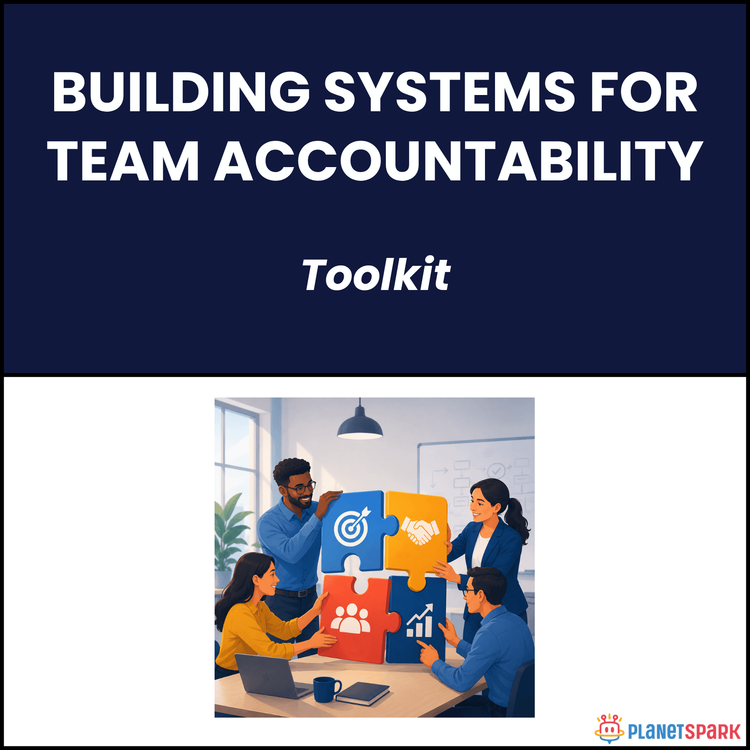
Building Systems for Team Accountability
Creating Team Accountability Systems for Better Productivity
If you’ve ever led a team that looked capable, experienced, and well-structured—but still struggled to deliver consistently—you’ve likely faced one of the most common leadership challenges: lack of accountability.
Deadlines slip without clear ownership. Tasks get completed, but not to the expected standard. Follow-ups become a constant part of your routine. And when something goes wrong, it’s often unclear where the responsibility truly lies.
What makes this situation frustrating is that it’s rarely about capability. Most teams have the talent. The real issue is the absence of a clear, structured system that drives ownership, visibility, and consistent follow-through.
Many managers try to fix this by increasing check-ins, sending reminders, or stepping in more frequently. But this approach quickly leads to micromanagement, burnout, and dependency—without solving the root problem.
Accountability is not about pushing people harder. It is about creating systems that make ownership clear and execution consistent.
This is exactly why the resource “Building Systems for Team Accountability” exists. It provides a practical, structured approach to designing accountability into your team’s daily workflow—so that results don’t depend on constant supervision, but on a system that supports performance.
Who Is This Resource For?
This resource is designed for professionals responsible for driving team outcomes and performance.
It is especially useful if you are:
- A manager dealing with missed deadlines or inconsistent delivery
- A team lead struggling to create ownership within the team
- A consultant working with teams that lack structure and clarity
- A senior professional responsible for scaling team performance
- A leader who feels their team is capable but underperforming
- Someone who wants to reduce micromanagement and build self-driven teams
If you want your team to take ownership without constant follow-ups, this guide is built for you.
What Does This Resource Contain?
This is not a theoretical leadership guide. It is a hands-on toolkit designed for immediate implementation.
Inside the resource, you will find:
- A clear explanation of why accountability is a system problem, not a people problem
- The three core pillars of accountability: Clarity, Commitment, and Consequence
- A structured 5-layer accountability system covering roles, goals, commitments, visibility, and feedback
- The Role Clarity Canvas to define responsibilities and ownership clearly
- The Goal Ladder worksheet to align individual work with team and business outcomes
- A Weekly Commitment Cadence including Monday Commit, Wednesday Pulse, and Friday Reflect
- A Weekly Accountability Board template for tracking progress and blockers
- The SBI+O framework (Situation, Behaviour, Impact, Outcome) for effective accountability conversations
- A pre-conversation checklist to prepare for performance discussions
- A real-world case example showing measurable improvement within 90 days
- Common accountability traps and how to avoid them
- A self-assessment Accountability Audit to evaluate your current systems
- A practical one-week implementation plan to get started immediately
Everything in this resource is designed to move you from reactive management to structured execution.
Summary of the Resource
“Building Systems for Team Accountability” is a practical playbook that helps you design and implement a complete accountability system within your team.
Instead of relying on reminders, pressure, or constant follow-ups, you learn how to create structures that naturally drive ownership, visibility, and consistent performance. The result is a team that delivers reliably because the system supports it.
How Will This Resource Be Useful?
This resource helps you shift from managing tasks to managing systems.
You will gain:
- Clear ownership across all roles and responsibilities
- Better alignment between individual work and team goals
- Consistent execution through structured commitment systems
- Early visibility into risks, delays, and blockers
- More effective and constructive accountability conversations
- Reduced dependency on constant supervision
Most importantly, it helps you build a team that takes responsibility proactively instead of reactively.
How Should You Use This Resource?
To get the best results, follow a structured approach:
Start by reading the entire guide to understand the overall system and how each component connects. This builds a strong foundation.
Next, focus on clarity. Use the Role Clarity Canvas and Goal Ladder to define responsibilities and align work with outcomes.
Once clarity is established, implement commitment systems. Introduce the Weekly Accountability Board and set up regular check-ins through the Monday Commit, Wednesday Pulse, and Friday Reflect cadence.
After that, strengthen your feedback approach. Use the SBI+O framework to address gaps clearly and constructively.
Finally, evaluate your system using the Accountability Audit and refine it based on your team’s performance.
This resource is most effective when applied consistently, not just read once.
Action Steps
After accessing this resource, take these steps immediately:
1. Complete the Accountability Audit to identify current gaps
2. Define clear roles and ownership using the Role Clarity Canvas
3. Set up a shared Weekly Accountability Board for your team
4. Introduce the Monday Commit ritual in your next team meeting
5. Implement mid-week and end-week check-ins for visibility
6. Address one accountability gap using the SBI+O framework
7. Review progress after one week and adjust your system
Even small changes in structure can lead to significant improvements in performance.
Accountability is not about control or pressure. It is about clarity, consistency, and creating an environment where people know what they own and how their work contributes to outcomes.
When the system is strong, the team performs better—naturally.
Use this resource not just to fix immediate challenges, but to build a long-term foundation for ownership, performance, and growth within your team.
Book your free session today!