
Building Systems to Test Career Paths Before Committing

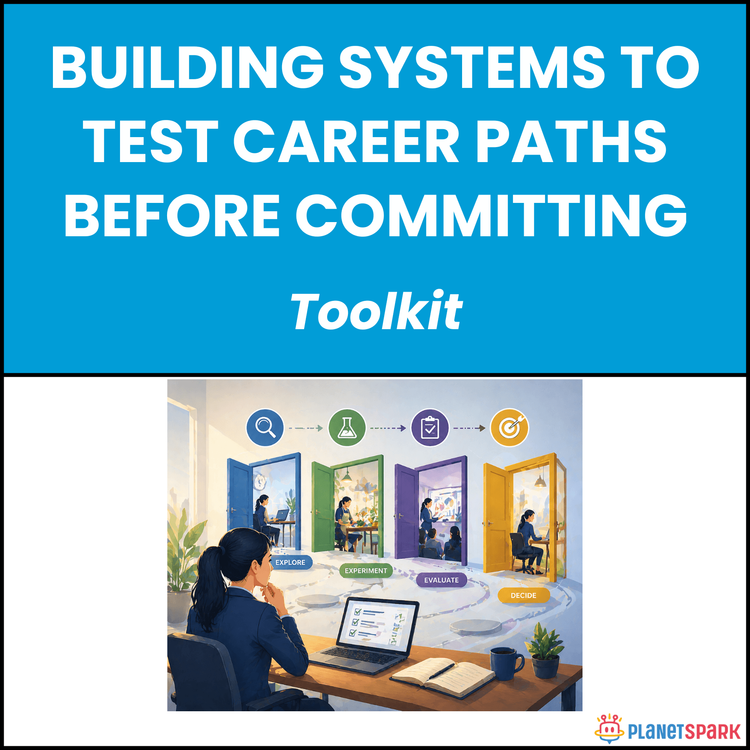
Building Systems to Test Career Paths Before Committing
Exploring Career Paths Before Switching Careers: A Practical System for Confident Career Decisions
Most professionals don’t struggle because they lack ambition—they struggle because they don’t want to make the wrong move.
You spend months thinking about a career change. You read articles, watch videos, and imagine a better future. But when it’s time to act, you either hesitate indefinitely or take a leap that feels risky and irreversible.
This is exactly where most career pivots fail.
The real problem isn’t a lack of information—it’s a lack of structured experimentation. Instead of guessing, what you need is a system to test career paths before committing.
That’s precisely what this toolkit helps you do.
Who Is This Resource For?
This resource is designed for working professionals who want clarity before making a career move. It is especially useful for:
- Professionals considering a career switch but unsure where to start
- Managers exploring roles like consulting, product management, or leadership transitions
- Mid-career professionals evaluating entrepreneurship or independent work
- Individuals stuck in decision paralysis due to too many options
- Anyone who wants to validate a career choice before investing time, money, or effort
If you’ve ever thought, “What if I choose the wrong path?”—this resource is built for you.
What Does This Resource Contain?
This is not a theoretical guide—it’s a step-by-step system built around real-world execution. The toolkit is structured into five core modules:
1. Career Hypothesis Framework
Learn how to turn vague career desires into clear, testable hypotheses.
You’ll define:
- Your target role or domain
- Why you believe it fits you
- What success looks like
- Your riskiest assumption
2. Career Experiment Design Canvas
A structured planning tool to design meaningful, low-risk experiments.
You’ll explore five types of experiments:
- Micro-projects
- Shadowing and immersion
- Structured conversations
- Skill audits
- Side projects
3. Time Architecture Framework
A practical system to run career experiments alongside your current job.
Includes:
- Weekly deep work blocks
- Weekday micro-slots
- Monthly review sessions
- Quarterly decision checkpoints
4. Signal Tracker
A structured tool to capture insights from each experiment.
Tracks:
- Energy levels
- Skill alignment
- Interest depth
- Environment fit
- Hypothesis validation
5. Conversation Playbook
A guide to conducting high-value conversations with professionals in your target field.
Includes:
- Question frameworks
- Interview structure
- Insight extraction techniques
Additionally, the resource includes:
- A real-world case study
- A 12-week career testing roadmap
- A detailed action checklist
- A self-evaluation framework
Summary of the Resource
This toolkit provides a complete system to test career paths before committing to them.
Instead of relying on guesswork or overthinking, you will:
- Define a clear career hypothesis
- Design and run structured experiments
- Capture real-world feedback
- Identify patterns in your experiences
- Make evidence-based career decisions
It transforms career exploration from a passive activity into an active, data-driven process.
How Will This Resource Be Useful?
The biggest benefit of this resource is clarity—earned through action, not assumption.
Here’s what you gain:
- Reduced risk: Avoid costly mistakes by testing before committing
- Faster decision-making: Replace months of confusion with structured experimentation
- Real confidence: Base your decisions on evidence, not opinions
- Better self-awareness: Understand what truly energises you—not just what you’re good at
- Stronger positioning: Build experience, insights, and proof before transitioning
Most importantly, it helps you move from “thinking about a change” to actually validating one.
How Should You Use This Resource?
To get the most value, follow a structured approach:
Step 1: Read the Entire Toolkit
Go through the resource once to understand the full system and how each part connects.
Step 2: Build Your Career Hypothesis
Write a clear, testable statement about the career path you want to explore.
Step 3: Design Your First Experiment
Use the Experiment Design Canvas to plan a small, actionable test.
Step 4: Schedule Your Time
Block dedicated weekly and monthly slots using the Time Architecture framework.
Step 5: Run Experiments Actively
Engage in real-world activities—projects, conversations, or skill-building.
Step 6: Capture Signals Immediately
Use the Signal Tracker within 24–48 hours of each experiment to record insights.
Step 7: Review and Adjust
Conduct monthly and quarterly reviews to evaluate your progress and refine your direction.
Step 8: Make a Decision
Use your collected data to confirm, revise, or reject your initial hypothesis.
Action Steps
If you want to start immediately, follow this 7-day action plan:
1. Write your career hypothesis in one clear sentence
2. Identify your top strengths and constraints
3. Block weekly time slots for career experiments
4. Reach out to at least 5 professionals in your target field
5. Design your first experiment using the canvas
6. Set up your Signal Tracker
7. Begin your first experiment within the week
The goal is not perfection—it’s momentum.
Career decisions don’t need to feel overwhelming or irreversible. When you approach them with a system, they become manageable, testable, and far less risky.
You don’t need to guess your next move. You can test it.
Use this toolkit to explore deliberately, learn quickly, and decide confidently. The professionals who grow fastest aren’t the ones who wait for clarity—they’re the ones who build it through action.