
Building Team Accountability Systems

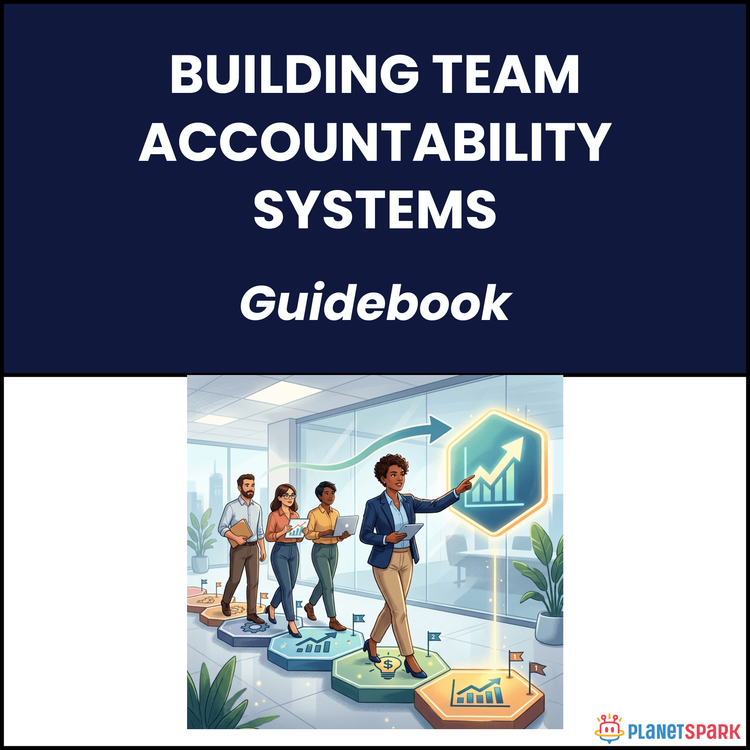
Building Team Accountability Systems
Building Team Accountability Systems: A Step-by-Step Framework for Managers to Drive Ownership and High Performance
Deadlines get missed. Ownership feels unclear. Conversations turn into subtle blame instead of solutions.
If you’ve experienced this in your team, the issue is rarely about capability or effort—it’s about the absence of a clear accountability system.
Most teams don’t fail because people are not trying hard enough. They fail because expectations are vague, ownership is shared (and therefore diluted), and follow-through isn’t built into how work happens.
This is exactly why the resource “Building Team Accountability Systems” exists. It provides a practical, structured playbook to help managers and professionals build high-trust, high-performance teams—by making accountability clear, visible, and consistent.
Who Is This Resource For?
This resource is especially valuable if you are:
- A first-time manager building systems for team execution
- A mid-level manager responsible for delivery and performance
- A consultant designing team structures or workflows
- A team lead managing cross-functional or remote teams
- A professional frustrated with lack of ownership in projects
- Someone who wants to build a culture of accountability without micromanaging
If you want your team to consistently deliver without constant follow-ups, this guide is built for you.
What Does This Resource Contain?
This is not a generic leadership guide—it is a complete accountability system you can implement immediately.
Inside the resource, you’ll find:
- A deep explanation of why accountability breaks down in teams
- The 5 most common accountability failures (e.g., ambiguous ownership, lack of consequences, misaligned goals)
- The CLEAR Accountability Model: Clarity, Linkage, Expectations, Action Check-ins, Recognition & Reset
- The RACI Matrix framework to define ownership clearly (Responsible, Accountable, Consulted, Informed)
- The SMART+ framework to define clear and measurable expectations
- A structured check-in rhythm (weekly stand-ups, 1-on-1s, monthly reviews)
- The STAR framework for effective recognition
- A Reset conversation framework to address gaps constructively
- A complete Team Accountability Audit worksheet
- A ready-to-use Accountability Agreement template
- Reflection tools to understand your leadership style (Avoider, Rescuer, System Builder)
- A real-world case study showing implementation in a team setting
- Common accountability mistakes and how to fix them
- A 30-60-90 day action plan to implement systems step by step
- A quick reference toolkit for everyday use
Everything is designed for real-world application—not just understanding.
Summary of the Resource
“Building Team Accountability Systems” is a practical, system-driven guide that helps you move from reactive management to structured leadership.
It shows you how to design accountability into your team’s workflow—so ownership is clear, progress is tracked, and results are consistently delivered.
Instead of chasing updates or fixing problems late, you build a system where accountability becomes the default way of working.
How Will This Resource Be Useful?
This resource helps you shift from managing people to managing systems.
You’ll gain:
- Clear ownership across all tasks and projects
- Better alignment between individual work and team goals
- Stronger follow-through through structured check-ins
- Reduced confusion and fewer missed deadlines
- More productive performance conversations
- Higher trust and transparency within the team
- A repeatable system you can apply across teams and roles
Most importantly, it helps you create an environment where accountability feels natural—not forced.
How Should You Use This Resource?
To get the best results, use this guide in phases rather than trying to implement everything at once.
Start by reading the full guide to understand how the CLEAR model works as a system.
Next, assess your current team using the Accountability Audit worksheet. Identify your biggest gap—this is where you should start.
Then, implement one pillar at a time:
- Begin with Clarity by defining ownership using the RACI Matrix
- Move to Linkage by connecting work to meaningful goals
- Strengthen Expectations using the SMART+ framework
- Establish a consistent check-in rhythm
- Build a culture of Recognition and Reset
As you apply each step, use the templates and tools provided—especially the Accountability Agreement and check-in structures.
Finally, follow the 30-60-90 day plan to embed these practices into your team’s everyday workflow.
You can revisit this resource whenever you:
- Experience repeated delivery issues
- Build or restructure a team
- Step into a new leadership role
- Want to improve team performance sustainably
Action Steps
After accessing this resource, take these steps immediately:
1. Complete the Team Accountability Audit to identify gaps
2. Select one CLEAR pillar to focus on this month
3. Define ownership for your top 3 priorities using RACI
4. Set up a weekly check-in rhythm (even if brief)
5. Introduce one Accountability Agreement for an active project
6. Address one existing accountability gap using the Reset framework
7. Publicly commit to one leadership action to model accountability
Small, consistent changes in how you operate can transform how your team performs.
Accountability is not about control or pressure—it’s about clarity, consistency, and trust. When you build the right system, you don’t have to chase performance. It follows naturally.
This resource gives you a complete blueprint to move from firefighting issues to building a team that owns outcomes, communicates openly, and delivers reliably.
Book your free session today!