
Business Decision-Making Checklist

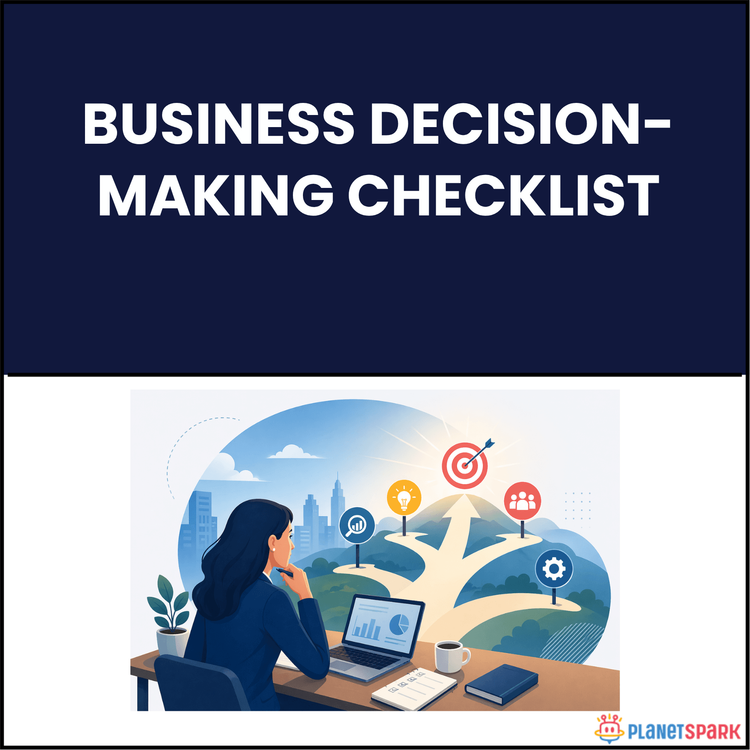
Business Decision-Making Checklist
Unlock Smarter Business Decisions: A Step-by-Step Approach
Making business decisions is part of every professional’s daily life. Whether you're a career switcher, a consultant, or a manager, the weight of these decisions often leads to stress, indecision, and mistakes. But what if you could make smarter, faster, and more confident choices? The Business Decision-Making Checklist is the tool you need to streamline your decision-making process, reduce uncertainty, and ultimately make better choices that lead to professional growth.
Who Is This Resource For?
This resource is perfect for:
- Career Switchers: Need to make significant decisions about your next steps? This guide will help you clarify your career choices and the direction you should take.
- Job Seekers: With every opportunity, the decision-making process can be overwhelming. This checklist guides you in evaluating job offers, roles, and career paths.
- Consultants & Managers: Faced with complex business decisions, this tool will guide you through evaluating options, considering risks, and making decisions with confidence.
- Professionals Seeking Growth: If you want to elevate your decision-making skills for long-term success, this checklist will help sharpen your judgment over time.
What Does This Resource Contain?
The Business Decision-Making Checklist is divided into five core phases designed to lead you step-by-step through the decision-making process:
1. Clarify - Frame the problem properly.
2. Explore - Generate and evaluate options.
3. Evaluate - Rigorously assess each option.
4. Decide - Commit to the best course of action.
5. Review - Reflect on the outcome for future learning.
Each phase includes:
- Checklists to ensure you don’t miss a critical step.
- Reflection Prompts to deepen your analysis.
- Practical Guidance for when to apply each phase.
Summary of the Resource
In essence, this checklist offers a battle-tested approach to decision-making:
- Clarify the problem: Avoid rushing into a solution by understanding the true nature of the issue.
- Explore multiple options: Widen your set of choices rather than jumping to conclusions.
- Evaluate thoroughly: Apply consistent criteria to all options.
- Decide with confidence: Document your reasoning and commit to the course of action.
- Review the results: Take time to reflect and learn from the decision-making process.
This step-by-step framework ensures that your decisions are based on clarity, solid analysis, and confidence, leading to better outcomes for both you and your team.
How Will This Resource Be Useful?
Making decisions without the right structure can lead to poor outcomes. This checklist solves that problem by:
- Reducing decision fatigue: By following a structured process, you won’t waste time on unnecessary deliberation.
- Mitigating cognitive biases: The tool helps identify biases such as confirmation bias or sunk cost fallacy, which can cloud your judgment.
- Building confidence: Clear, deliberate decision-making gives you the confidence to take action and stand by your choices.
- Enhancing long-term judgment: By reviewing and learning from each decision, you gradually build better decision-making skills over time.
How Should You Use This Resource?
Follow the five phases outlined in the checklist:
1. Clarify: Start by framing the problem clearly. Take 10 minutes to write down the issue in one sentence and ensure that you understand its root cause.
2. Explore: Generate at least four to five distinct options. Don’t limit yourself to the obvious choices. Consult with others to get diverse perspectives.
3. Evaluate: Use a structured scoring system to assess each option. Consider both short-term and long-term impacts, and avoid rushing to conclusions.
4. Decide: Commit to the best option based on the evaluation, and clearly communicate your choice to all stakeholders.
5. Review: After implementing the decision, take time to review what worked and what didn’t. This reflection will strengthen your decision-making for future scenarios.
Action Steps
1. Clarify the Problem: Write down the problem in one sentence. Take time to distinguish between symptoms and root causes.
2. Explore Options: Create a list of at least 4-5 options, including unconventional ones. Consult others to gain alternative perspectives.
3. Evaluate Options: Define your evaluation criteria and apply them consistently across all options.
4. Decide: Choose the best option, document your reasoning, and define immediate next steps.
5. Review: Schedule a 30-day check-in to assess the results and learn from your decision-making process.
Book your free session today!