
Business Decision Tree Framework

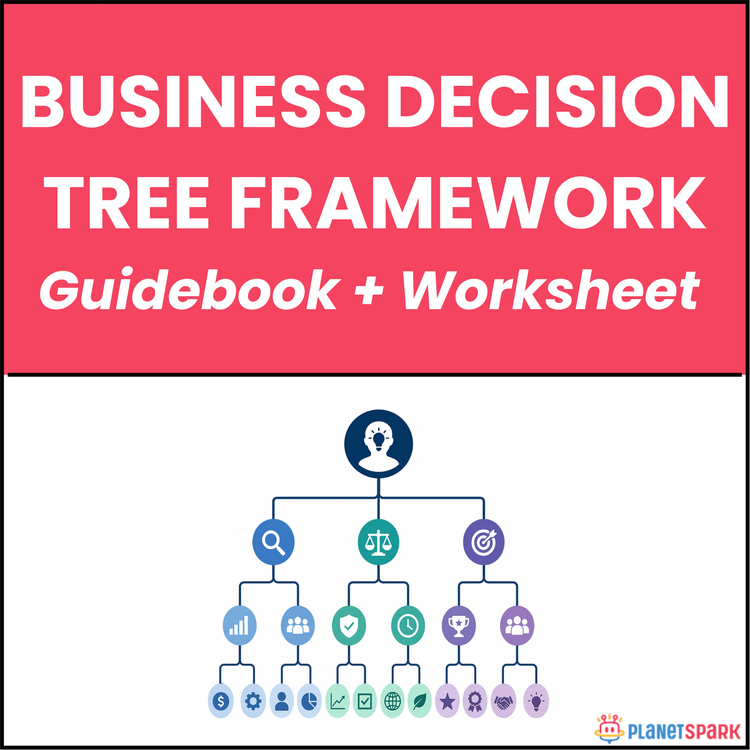
Business Decision Tree Framework
Business Decision Tree Framework Guide: A Practical System to Make Better, Faster, and More Defensible Business Decisions
If you’ve ever been in a situation where a decision had to be made—but no one was truly clear on why a particular option was chosen—you’re not alone.
Most professionals don’t struggle because they lack intelligence. They struggle because they lack a structured way to think through decisions.
As highlighted in the resource, decision failures are rarely intelligence failures—they are structure failures.
Without a clear framework, decisions default to gut feel, hierarchy (HiPPO effect), or incomplete analysis. And over time, this leads to poor outcomes, wasted effort, and lost credibility.
That’s exactly why the Business Decision Tree Framework exists.
This resource gives you a structured, repeatable system to break down complex decisions into clear, logical steps—so your decisions are not only better, but also explainable and defensible.
Who Is This Resource For?
This resource is especially valuable if you are:
- A working professional with 0–15 years of experience making business decisions
- A manager responsible for team, budget, or strategic choices
- A consultant solving complex, ambiguous problems
- A career switcher preparing for case interviews or business roles
- A professional who wants to improve decision clarity and confidence
- Someone tired of “guess-based” or politically driven decisions
If you want to make decisions that are structured, transparent, and high-quality—this guide is built for you.
What Does This Resource Contain?
This is not just a concept guide—it’s a complete decision-making system with tools, worksheets, and real-world application.
Inside the resource, you’ll find:
1. Clear Foundation of Decision Trees
The section on page 4 defines a decision tree as a visual, logical structure that breaks complex problems into clear branching choices and outcomes.
It transforms ambiguity into structured thinking.
2. A 6-Step Decision-Making Framework
The framework across chapters (pages 4–13) outlines a complete process:
1. Define the decision
2. Identify decision criteria
3. Map decision branches
4. Evaluate options
5. Stress-test your choice
6. Decide and communicate
This ensures no critical thinking step is skipped.
3. Step 1: Define the Decision Clearly
The section on page 5 emphasizes that most failures happen because the wrong problem is being solved.
You learn how to:
- Write a clear decision statement
- Identify decision owner and scope
- Classify decisions (reversible vs irreversible, strategic vs operational)
4. Step 2: Decision Criteria Framework
The section on page 6 introduces:
- Must-have criteria (non-negotiable filters)
- Nice-to-have criteria (weighted preferences)
This helps eliminate weak options early and focus on meaningful evaluation.
5. Step 3: Branch Mapping System
The diagram on page 8 explains how to structure decisions:
- Root node (main decision)
- Primary branches (2–4 options)
- Condition nodes (yes/no filters)
- Terminal outcomes (final results)
This turns messy thinking into visual clarity.
6. Step 4: Weighted Decision Matrix
The table on page 10 introduces a scoring system:
- Assign weights to criteria
- Score each option
- Calculate total scores
This replaces gut feel with structured evaluation.
7. Step 5: Stress-Testing Framework
The section on page 12 provides three powerful tools:
- Pre-mortem analysis (assume failure)
- Devil’s advocate test (challenge your decision)
- Regret minimisation (long-term thinking)
This is where strong decisions are validated.
8. Step 6: Decision Record System
The framework on page 13 helps you document:
- What was decided
- Why it was chosen
- Trade-offs and assumptions
- Success metrics and review timelines
This improves clarity, accountability, and learning.
9. Worksheets for Real Application
The resource includes:
- Decision definition worksheet
- Branch mapping template
- Weighted matrix template
- Decision record template
These ensure practical execution—not passive reading.
10. Real-World Case Study
The example on page 15 shows how a marketing manager used the framework to make a high-stakes market expansion decision—leading to faster approval and measurable outcomes.
11. Common Mistakes and Biases
The sections on pages 16–19 highlight:
- Analysis paralysis
- Confirmation bias
- Anchoring bias
- Sunk cost fallacy
Along with clear strategies to avoid them.
12. Quick Reference Decision Card
The summary on page 20 provides a one-page framework you can use before any major decision.
Summary of the Resource
The Business Decision Tree Framework is a structured, execution-focused system that helps you make better decisions by breaking complexity into clear, logical steps.
It ensures your decisions are:
- Thought through
- Transparent
- Defensible
- Learnable
Instead of relying on intuition alone, you build a repeatable decision-making process.
How Will This Resource Be Useful?
This resource helps you move from confusion to clarity.
You’ll gain:
- A structured approach to complex decision-making
- Clear thinking in ambiguous situations
- Better prioritisation and trade-off evaluation
- Stronger communication of decisions
- Increased credibility in meetings and leadership discussions
- A repeatable system you can apply across roles and industries
Most importantly, it helps you stop guessing—and start deciding with confidence.
How Should You Use This Resource?
To get the best results, follow a practical approach:
Start with One Real Decision
Pick an actual business or career decision
Apply Step-by-Step
- Define the decision clearly
- Identify criteria before options
- Map branches visually
Evaluate Objectively
- Use the weighted matrix
- Eliminate weak options early
Stress-Test Before Finalising
- Challenge assumptions
- Identify risks
Document and Communicate
- Use the decision record
- Share rationale with stakeholders
Review and Learn
- Revisit decisions after 30–90 days
- Capture learnings for future use
Treat this as a working tool—not just a guide.
Action Steps
After accessing this resource, take these steps immediately:
1. Write one clear decision statement you’re currently facing
2. Identify 3–5 decision criteria (must-have + weighted)
3. List 2–4 realistic options
4. Map a simple decision tree (even on paper)
5. Score options using a basic matrix
6. Run a 10-minute pre-mortem
7. Document your decision in one page
Even applying just Step 1 and Step 2 can dramatically improve decision quality.
Your career is shaped not by how many decisions you make—but by how well you make them.
Good decisions create momentum. Poor decisions create friction.
A structured framework removes guesswork, reduces bias, and builds confidence.
Use this resource not just to make decisions—but to build a reputation for clarity, logic, and leadership.
Book your free session today!