
Business Scenario Planning Guide
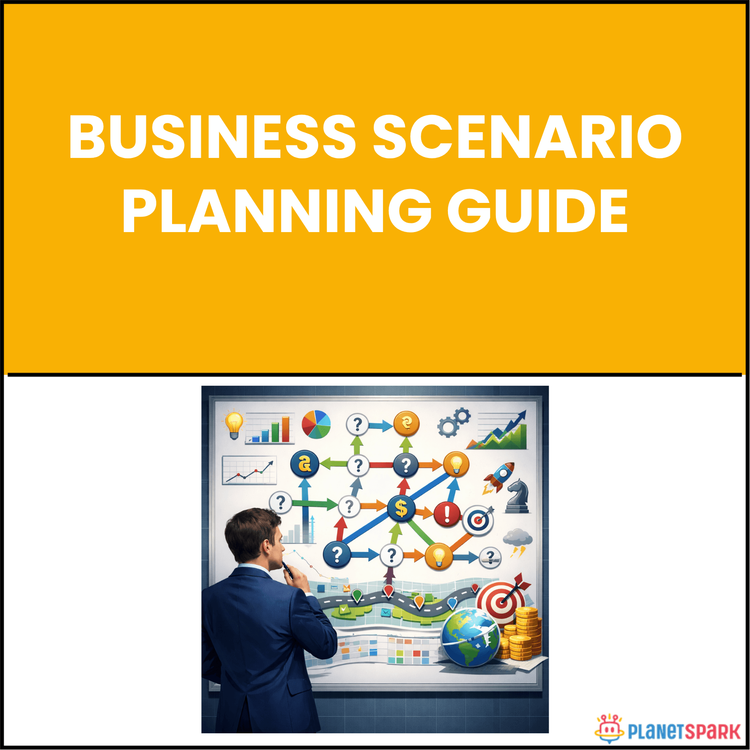
Business Scenario Planning Guide
Business Scenario Planning Guide: A Practical Framework to Anticipate Uncertainty, Make Better Decisions, and Build Strategic Confidence
If you’ve ever made a plan that quickly became irrelevant because circumstances changed—you’ve experienced the limits of single-path thinking.
Most professionals plan for one expected future.
But the reality is: business environments don’t move in straight lines.
Markets shift. Technology disrupts. Regulations change. And strategies built on a single assumption often fail when reality takes a different turn.
That’s exactly why the Business Scenario Planning Guide exists.
This resource is designed to help you move from reactive decision-making to structured, future-ready thinking—by building strategies that work across multiple possible outcomes.
Who Is This Resource For?
This resource is especially valuable if you are:
- A working professional (0–15 years experience) involved in decision-making
- A manager or consultant handling uncertainty in projects or strategy
- A business leader navigating market, technology, or regulatory changes
- A career switcher evaluating multiple future paths
- A professional preparing for leadership roles
- Someone who wants to think ahead—not just react
If your work involves decisions with uncertainty, this guide is built for you.
What Does This Resource Contain?
This is not theoretical strategy content—it’s a practical playbook.
Inside the resource, you’ll find:
1. Clear Understanding of Scenario Planning
The foundation section on page 4 clarifies that scenario planning is not prediction—it’s about exploring multiple plausible futures and preparing for them.
2. A Complete 6-Phase Framework
The diagram on page 3 shows the full cycle:
- Foundation → Define context
- Scan → Identify external forces
- Build → Create scenarios
- Stress-Test → Evaluate strategy
- Communicate → Align stakeholders
- Act → Execute with signals
This creates a full decision-making system—not just analysis.
3. Environmental Scanning Using PESTLE
The framework on page 5 helps you analyse:
- Political
- Economic
- Social
- Technological
- Legal
- Environmental factors
This ensures you consider all major external drivers.
4. Identifying Critical Uncertainties
The matrix on page 6 explains how to prioritise:
- High impact + high uncertainty factors
- These become the foundation of your scenarios
This step separates strategic thinking from guesswork.
5. Building 4 Strategic Scenarios
The examples on page 7 show how two uncertainties create four distinct futures.
Each scenario includes:
- A clear narrative
- Market behaviour
- Competitive dynamics
- Risks and opportunities
This turns abstract thinking into practical planning.
6. Strategy Stress-Testing Framework
The section on page 9 introduces a scoring model across:
- Financial resilience
- Competitive positioning
- Operational readiness
You evaluate how your strategy performs in each scenario—revealing hidden risks.
7. Strategic Decision Framework
The model on page 11 categorises actions into:
- No-Regret Moves (safe across all scenarios)
- Strategic Options (flexible bets)
- Big Bets (high-risk, conditional decisions)
This helps prioritise investments intelligently.
8. Communication Framework
The structure on page 12 teaches how to present uncertainty effectively:
- Lead with decisions, not analysis
- Explain scenarios clearly
- Align stakeholders around action
9. Signpost & Early Warning System
The process on page 14 introduces:
- Early signals to monitor
- Trigger thresholds
- Pre-defined responses
This converts strategy into a dynamic system.
10. Real-World Case Example
The case on page 16 demonstrates how a consulting firm used scenario planning to adapt to AI disruption—shifting strategy before competitors.
11. 30-Day Action Plan
The plan on page 21 gives a structured execution roadmap:
- Week 1: Define
- Week 2: Scan
- Week 3: Build
- Week 4: Stress-test & act
This ensures immediate application.
Summary of the Resource
The Business Scenario Planning Guide is a structured, execution-focused system that helps you prepare for multiple futures instead of relying on one assumption.
It transforms uncertainty from a risk into a strategic advantage.
Instead of asking:
“What will happen?”
It trains you to ask:
“What could happen—and how do we prepare for it?”
How Will This Resource Be Useful?
This resource helps you move from reactive to proactive thinking.
You’ll gain:
- Clarity in uncertain situations
- Stronger decision-making frameworks
- Better risk identification and mitigation
- More resilient strategies
- Increased confidence in leadership discussions
- A structured way to think ahead
Most importantly, it helps you stop being surprised—and start being prepared.
How Should You Use This Resource?
Follow a structured approach:
Step 1: Define Your Decision
Start with a clear focal question (page 5)
Step 2: Scan Your Environment
Use PESTLE to identify external forces
Step 3: Identify Key Uncertainties
Focus only on high-impact unknowns
Step 4: Build 4 Scenarios
Create distinct, realistic future narratives
Step 5: Stress-Test Your Strategy
Evaluate performance across all scenarios
Step 6: Define Strategic Actions
Classify into:
- No-regret moves
- Options
- Big bets
Step 7: Set Up Signposts
Track early signals and define triggers
Step 8: Review Regularly
Make this a continuous process—not a one-time exercise
Action Steps
After accessing this resource, take these steps immediately:
1. Define one real business or career decision
2. Write a clear focal question (3–5 year horizon)
3. Identify 6–8 external factors using PESTLE
4. Select 2 critical uncertainties
5. Create 4 future scenarios
6. Stress-test your current strategy
7. Identify one no-regret move you can act on this week
Even one structured scenario exercise can significantly improve decision quality.
Your career and business decisions don’t fail because of lack of effort—they fail because of unpreparedness for change.
Scenario planning changes that.
It doesn’t predict the future—it prepares you for it.
Use this guide not just to think better, but to decide better—and stay ahead of uncertainty.
Book your free session today!