
Business Writing Improvement Guide

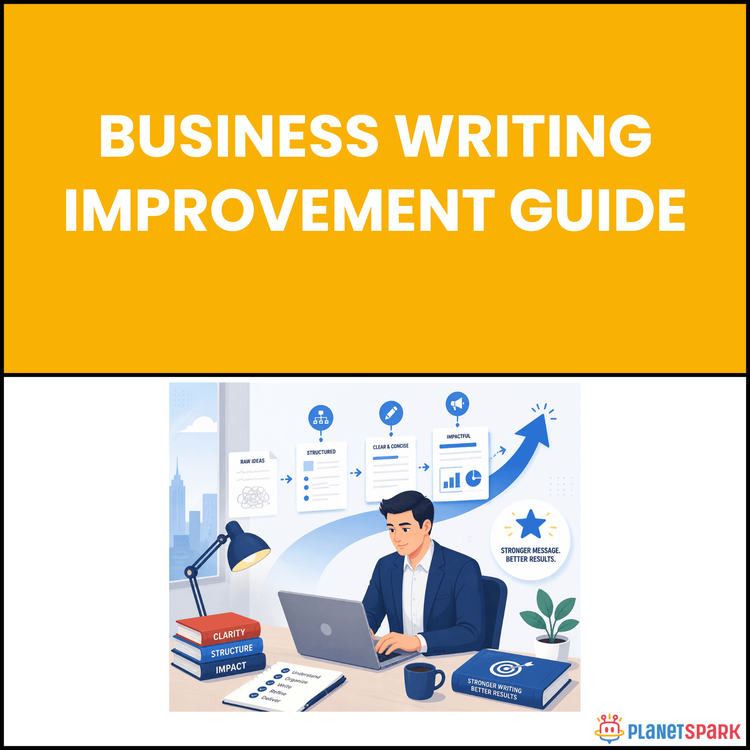
Business Writing Improvement Guide
Professional Guide to Better Business Writing: A Practical System to Write Clear, Confident, and Impactful Emails, Reports, and Proposals
Every day at work, your writing is being judged — even when you don’t realise it.
The email that didn’t get a response. The report that confused stakeholders. The proposal that didn’t convert. These are not isolated incidents — they are signals. Signals that your writing may be costing you time, credibility, and opportunities.
Most professionals assume writing improves with experience. It doesn’t — not without deliberate practice and the right frameworks.
That’s exactly why the Business Writing Improvement Guide was created — to give working professionals a clear, practical, and repeatable system to write with clarity, confidence, and impact from day one.
Who Is This Resource For?
This guide is designed for professionals who rely on writing as part of their daily work but haven’t been formally trained to do it well.
You will benefit most if you are:
- A working professional (0–15 years experience) who writes emails, reports, or proposals regularly
- A manager who needs to communicate clearly with teams and stakeholders
- A consultant or client-facing professional where writing impacts credibility
- A job seeker or career switcher aiming to improve professional communication
- Someone who feels their ideas are strong, but their writing doesn’t reflect that
Whether you are early in your career or stepping into leadership roles, this guide meets you where you are and helps you level up quickly.
What Does This Resource Contain?
This is not a theoretical writing manual. It is a structured, action-oriented system built around practical frameworks and tools.
Here’s what you’ll find inside:
- A step-by-step framework covering the full writing process — from understanding your reader to structuring and refining your message
- Proven models like BLUF (Bottom Line Up Front) and the Pyramid Principle to structure communication effectively
- Clear guidance on writing different document types — emails, reports, proposals, and business cases
- Techniques to improve sentence clarity, reduce wordiness, and eliminate jargon
- A complete professional email formula that improves response rates
- Strategies for handling difficult communication scenarios (conflict, pushback, bad news)
- A practical Business Writing Clarity Checklist for quick pre-send reviews
- A Writing Diagnosis Worksheet to identify your weakest areas and improve systematically
- A real-world case study showing how better writing transforms outcomes
- A structured 30-day improvement plan to build writing as a daily habit
Every section is designed to be immediately usable — not just informative.
Summary of the Resource
At its core, this guide gives you a simple but powerful shift:
Stop writing for yourself. Start writing for your reader.
It equips you with:
- Clear thinking before writing
- Strong structure that guides the reader effortlessly
- Concise, impactful language
- Explicit asks that drive action
Instead of guessing what “good writing” looks like, you follow a repeatable system that works across emails, reports, and proposals.
How Will This Resource Be Useful?
The value of this guide shows up immediately in your day-to-day work.
Here’s what changes when you apply it:
- You save time by reducing back-and-forth clarification emails
- Your messages get faster responses because your ask is clear
- Your credibility improves — people trust clear communicators
- Your ideas land better with stakeholders and decision-makers
- You influence outcomes more effectively through structured thinking
- You avoid common mistakes like wordiness, vague messaging, and poor structure
Poor writing creates friction. Good writing removes it.
This guide helps you remove that friction — consistently.
How Should You Use This Resource?
To get the most value, use this guide in layers rather than trying to master everything at once.
Step 1: Read it end-to-end
Start by going through the entire guide once to understand the full system and how each concept connects.
Step 2: Apply one concept at a time
Focus on one principle — for example, leading with your main point or shortening sentences — and apply it to your daily writing.
Step 3: Use it as a daily reference
Keep the checklist handy and run through it before sending important emails or documents.
Step 4: Diagnose your writing
Use the worksheet to evaluate a recent piece of writing and identify your biggest improvement area.
Step 5: Follow the 30-day sprint
Commit to the structured plan that focuses on structure, clarity, reader focus, and advanced writing skills over four weeks.
Step 6: Revisit and refine
Writing improves with repetition. Revisit the frameworks regularly and build them into your natural workflow.
This is not a one-time read. It’s a tool you return to — until the principles become instinctive.
Action Steps
If you want to start improving immediately, do this today:
1. Take your last email and rewrite the first two sentences to include your main point upfront
2. Add a clear, specific action at the end (who does what by when)
3. Cut at least 20% of unnecessary words from the message
4. Replace any jargon or filler phrases with simple, direct language
5. Run the message through the clarity checklist before sending
Then repeat this process with your next piece of writing.
Small, consistent improvements compound quickly.
Strong business writing is not about sounding smart. It is about being understood, trusted, and acted upon.
This guide gives you the tools to make that shift — from unclear to confident, from overlooked to influential.
Start with your next email. Apply one principle. Build from there.
Because in the professional world, how you write is how you are perceived.