
Communication Prioritization Worksheet (What to Say & When)
Free DownloadPDF

DeebihaVisit Profile
I am a dedicated education professional with over 6 years of experience in training and mentoring students. I have worked with reputed organizations such as uFaber Edutech Private Limited and currently with PlanetSpark, focusing on enhancing student learning while continuously developing my own skills.
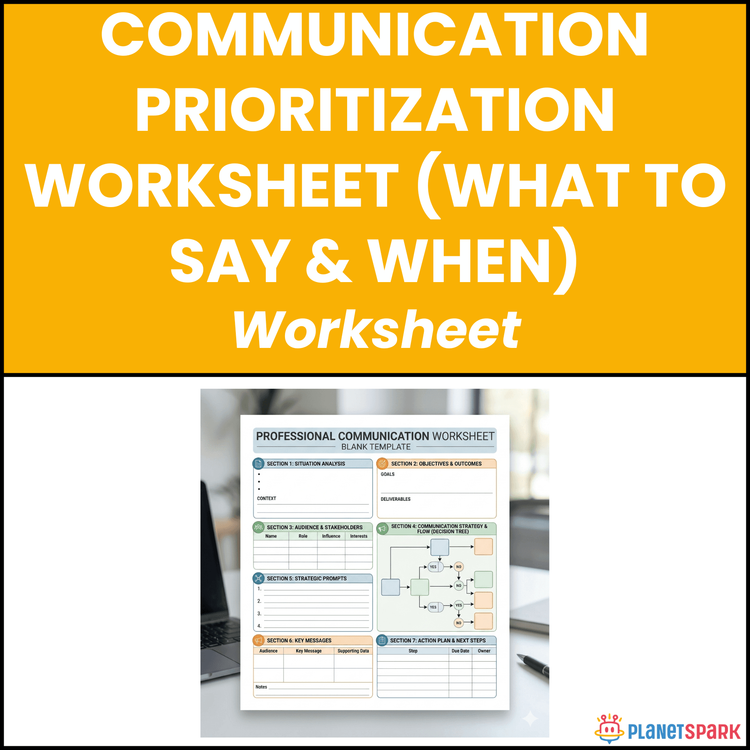
Communication Prioritization Worksheet (What to Say & When)
Free DownloadPDF
DeebihaVisit Profile
I am a dedicated education professional with over 6 years of experience in training and mentoring students. I have worked with reputed organizations such as uFaber Edutech Private Limited and currently with PlanetSpark, focusing on enhancing student learning while continuously developing my own skills.
Communication Prioritization Worksheet: How to Decide What to Say, When, and to Whom at Work
If you’ve ever felt overwhelmed by constant messages, unsure whether to send that email, or frustrated because important updates didn’t land well—you’re dealing with a problem most professionals aren’t trained to solve: communication prioritisation.
In today’s fast-paced workplace, it’s not just about communicating well—it’s about communicating strategically. Saying too much, too little, too early, or too late can quietly impact your credibility, relationships, and career growth.
That’s exactly why the “Communication Prioritization Worksheet: What to Say & When” was created. It gives you a practical, structured system to make better communication decisions—quickly, confidently, and consistently.
Instead of reacting to every message or situation, this resource helps you become intentional about what you say, how you say it, and when it matters most.
Who Is This Resource For?
This worksheet is especially useful if you are:
- A working professional with 0–15 years of experience
- A manager or team member juggling multiple stakeholders
- Someone who feels overwhelmed by constant emails, messages, and meetings
- A professional who wants to communicate more strategically, not just frequently
- Someone who struggles with choosing the right communication channel
- A mid-career professional aiming to build executive presence and credibility
- Anyone who wants to avoid miscommunication, delays, or unnecessary friction at work
If you want to be seen as thoughtful, efficient, and reliable in how you communicate, this resource is designed for you.
What Does This Resource Contain?
This is not a generic communication guide. It’s a hands-on, action-oriented worksheet built around real workplace scenarios and decisions.
Inside the resource, you’ll find:
- A communication audit to assess your current habits and identify blind spots
- A Priority Matrix to decide what actually needs to be communicated
- A structured decision-making tool based on urgency and impact
- A detailed channel selection guide (email, Slack, calls, meetings, documents, in-person)
- A timing framework to help you choose the right moment for important conversations
- Clear “timing red flags” and “green light” situations
- A stakeholder communication map to define who needs what level of information
- Practical prompts to build your own communication cadence
- A real-world case study showing how better communication drives career growth
- Common communication mistakes and how to fix them
- A weekly communication prioritisation checklist for ongoing use
- The 3-Sentence Rule framework for clear and effective updates
- A 7-day action plan to build consistent communication habits
Every section is designed for immediate application—not just reading.
Summary of the Resource
The “Communication Prioritization Worksheet: What to Say & When” is a practical toolkit that helps you move from reactive communication to intentional communication.
It teaches you how to filter what needs to be said, choose the right medium, time your messages effectively, and keep the right stakeholders informed—without overwhelming yourself or others.
If you apply even a few of the frameworks inside, you’ll quickly notice improvements in clarity, response quality, and professional perception.
How Will This Resource Be Useful?
This resource helps you build one of the most underrated career skills: strategic communication.
You’ll gain:
- Clarity on what is worth communicating—and what is not
- Confidence in choosing the right channel for every message
- Better timing of conversations, leading to stronger outcomes
- Improved stakeholder alignment and fewer misunderstandings
- Reduced communication overload (for you and others)
- Stronger professional judgement and decision-making
- Increased trust and credibility with managers and teams
Most importantly, it helps you stop communicating reactively—and start communicating with purpose.
How Should You Use This Resource?
To get the most value, use this worksheet in a structured, practical way:
Start by reading through the entire resource once to understand the frameworks and how they connect. This gives you a strong foundation.
Next, complete the Communication Audit to identify where your current habits may be helping or hurting you. This creates awareness.
Then, begin applying the Priority Matrix to your real, day-to-day communications. Use it before sending messages or scheduling meetings.
Use the Channel Decision Guide and Timing Framework whenever you are handling important or sensitive communication.
Build your Stakeholder Communication Map for your current role or project. This becomes your ongoing reference for who to update and how often.
Finally, integrate the Weekly Checklist and 3-Sentence Rule into your routine to make these practices consistent and sustainable.
You can revisit different sections based on your needs—before meetings, during project work, or when preparing for important conversations.
Action Steps
After accessing this resource, take these steps immediately:
1. Block 60–90 minutes of focused time to go through the worksheet
2. Complete the Communication Audit honestly based on your recent work patterns
3. List your top 5 upcoming communications and apply the Priority Matrix
4. Identify one situation where you used the wrong channel—and correct your approach
5. Build your Stakeholder Communication Map for your current role or project
6. Use the 3-Sentence Rule for your next update to a manager or stakeholder
7. Start using the Weekly Communication Checklist every Monday
Small changes here can significantly improve how you are perceived at work.
Strong communication is not about saying more—it’s about saying what matters, in the way that works best, at the moment it counts.
When you consistently communicate with clarity, timing, and intent, you build trust, reduce friction, and position yourself as someone others rely on.
Use this worksheet not just to improve how you communicate—but to strengthen how you think, decide, and show up professionally every day.
Book your free session today!