
Conflict Resolution Habit Checklist

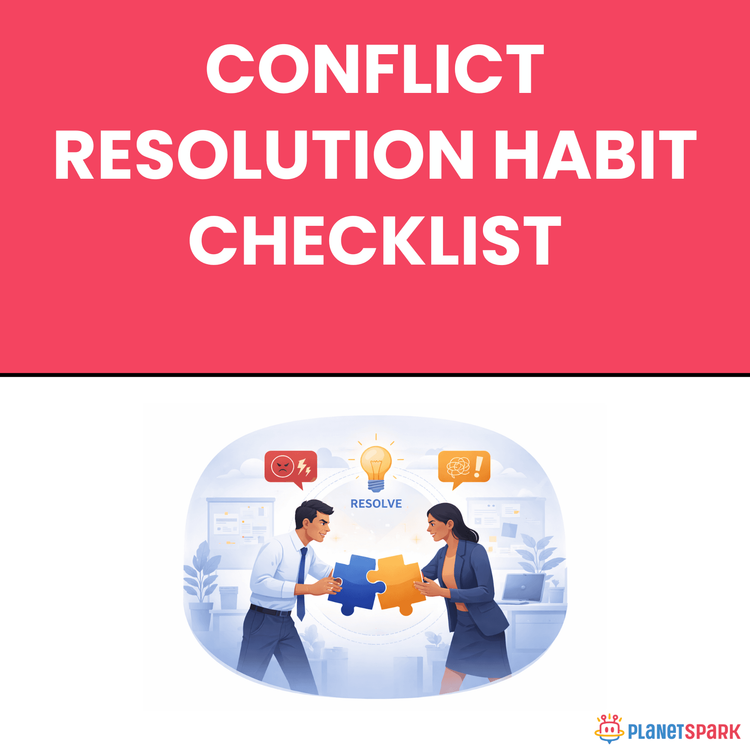
Conflict Resolution Habit Checklist
Conflict Resolution Habit Checklist for Working Professionals: A Practical Guide to Handling Workplace Conflict with Confidence
Have you ever walked out of a meeting replaying a tense moment in your head, wishing you had handled it differently? Or avoided a difficult conversation altogether because you weren’t sure how it might unfold?
Workplace conflict is not rare — it’s constant. Misaligned expectations, missed deadlines, communication gaps, and personality differences are part of everyday professional life. The real challenge is not avoiding conflict, but knowing how to handle it without damaging relationships, reputation, or results.
That’s exactly where the Conflict Resolution Habit Checklist comes in. Instead of giving you theory-heavy advice, this resource provides a structured, habit-based system you can apply before, during, and after any difficult conversation — so you’re never reacting in the moment without a plan.
Who Is This Resource For?
This resource is designed for working professionals who want to handle conflict more effectively without overthinking or escalating situations. It is especially useful for:
- Early to mid-career professionals navigating team dynamics
- Managers and team leads handling performance or expectation conflicts
- Job seekers and career switchers preparing for professional environments
- Consultants and client-facing professionals dealing with high-stakes conversations
- Anyone who avoids difficult conversations or struggles with emotional reactions at work
If you’ve ever felt unsure about what to say, when to say it, or how to stay calm under pressure, this checklist is built for you.
What Does This Resource Contain?
The Conflict Resolution Habit Checklist is structured in a clear, practical format that mirrors real workplace situations. It includes:
- A Three-Phase Framework:
- Before the Conflict: Preparation and emotional regulation
- During the Conflict: Real-time conversation techniques
- After the Conflict: Reflection, repair, and follow-through
- Detailed Checklists for Each Phase:
Action-oriented habits you can follow step-by-step instead of relying on instinct
- Reflection Questions:
Prompts to help you build self-awareness after every conflict interaction
- Real-World Scenario Walkthrough:
A relatable workplace example showing how conflict escalates — and how it can be handled better
- Common Mistakes and Fixes:
Practical guidance on what not to do and how to correct it
- Personal Conflict Habit Scorecard:
A tool to track your improvement over time and build consistency
- Proven Frameworks:
Including the SBI Model (Situation–Behaviour–Impact), Interests vs Positions, and the PAUSE protocol
- Quick Reference Summary:
A condensed version you can revisit quickly before or after important conversations
Summary of the Resource
This checklist gives you a repeatable system to handle workplace conflict with clarity and confidence. Instead of reacting emotionally or avoiding conversations, you learn how to prepare intentionally, communicate constructively, and follow through effectively.
It transforms conflict resolution from a stressful, unpredictable experience into a structured professional skill you can rely on in any situation.
How Will This Resource Be Useful?
The real value of this resource lies in how practical and immediately applicable it is. By using it consistently, you will:
- Respond instead of react in high-pressure situations
- Communicate more clearly without sounding defensive or aggressive
- Reduce misunderstandings and unnecessary escalation
- Build stronger professional relationships based on trust and respect
- Handle difficult conversations with confidence instead of hesitation
- Improve your reputation as someone who can manage complexity calmly
Over time, these are not just “soft skills” — they become career-defining advantages.
How Should You Use This Resource?
To get the most value out of this checklist, approach it as a habit-building tool rather than a one-time read.
Step 1: Read Through the Entire Resource
Understand the full Before → During → After framework so you see how each phase connects.
Step 2: Focus on the “Before” Phase First
Build the habit of pausing, identifying the real issue, and clarifying your intention before entering any difficult conversation.
Step 3: Apply During Real Conversations
Use simple techniques like:
- Asking clarifying questions
- Paraphrasing what you heard
- Using non-blaming language
Start small — even one habit per conversation makes a difference.
Step 4: Use the “After” Phase Consistently
Follow up, reflect on your behavior, and identify one thing to improve. This is where long-term growth happens.
Step 5: Track Yourself Using the Scorecard
After each significant interaction, rate yourself honestly and focus on improving one habit at a time.
Step 6: Revisit Regularly
This is not a one-time resource. Use it repeatedly until these behaviors become automatic.
Action Steps
If you want to start seeing results immediately, follow these steps:
1. Identify one unresolved or upcoming conflict at work
2. Use the “Before” checklist to prepare intentionally
3. Write down your desired outcome for the conversation
4. Practice one key habit during the conversation (e.g., listening fully before responding)
5. After the conversation, reflect using the provided questions
6. Follow up within 24–48 hours to reinforce the outcome
7. Track your performance using the scorecard
Consistency matters more than perfection. Focus on progress with each interaction.
Workplace conflict is not something you eliminate — it’s something you learn to handle well. The professionals who grow fastest are not the ones who avoid difficult conversations, but the ones who approach them with structure, clarity, and intention.
This checklist gives you that structure. The more you use it, the more natural these habits become — until handling conflict calmly and effectively is simply how you operate.
Book your free session today!