
Creating A Feedback Loop To Continuously Improve Systems

Creating A Feedback Loop To Continuously Improve Systems
Creating a Feedback Loop to Continuously Improve Systems: A Practical Guide for Working Professionals
Most professionals are constantly doing.
Delivering projects.
Managing deadlines.
Handling meetings.
Solving problems.
Responding to urgent requests.
But very few professionals consistently stop to ask an equally important question:
“Is the system itself actually improving?”
That gap is where many careers, workflows, and teams quietly stagnate.
Without structured reflection and feedback loops, professionals often:
- Repeat the same mistakes
- Operate with hidden blind spots
- Rely on assumptions instead of evidence
- Keep fixing symptoms instead of root causes
- Work harder without becoming more effective
That’s exactly why the resource “Creating a Feedback Loop to Continuously Improve Systems” was created.
This practical framework helps working professionals build structured feedback loops that turn everyday work into continuous improvement systems.
Rather than treating feedback as occasional criticism or annual review conversations, the resource teaches readers how to systematically collect signals, analyse patterns, implement improvements, and create systems that become smarter over time.
If you want to stop operating reactively and start building processes that continuously evolve and improve, this guide is designed for you.
Who Is This Resource For?
This resource is especially valuable for:
- Working professionals with 0–15 years of experience
- Managers responsible for improving team workflows
- Consultants managing client delivery systems
- Career switchers building new professional operating systems
- Professionals leading projects or cross-functional collaboration
- Individuals trying to improve productivity and execution quality
- Professionals frustrated by repeated workflow problems
- People who want structured learning and continuous improvement systems
It is particularly useful for professionals who want better systems instead of relying solely on harder work.
What Does This Resource Contain?
This is not a generic feedback or productivity guide.
It is a structured operational framework for designing and running continuous improvement systems.
Inside the resource, you’ll find:
- A detailed explanation of why feedback loops are essential for system growth
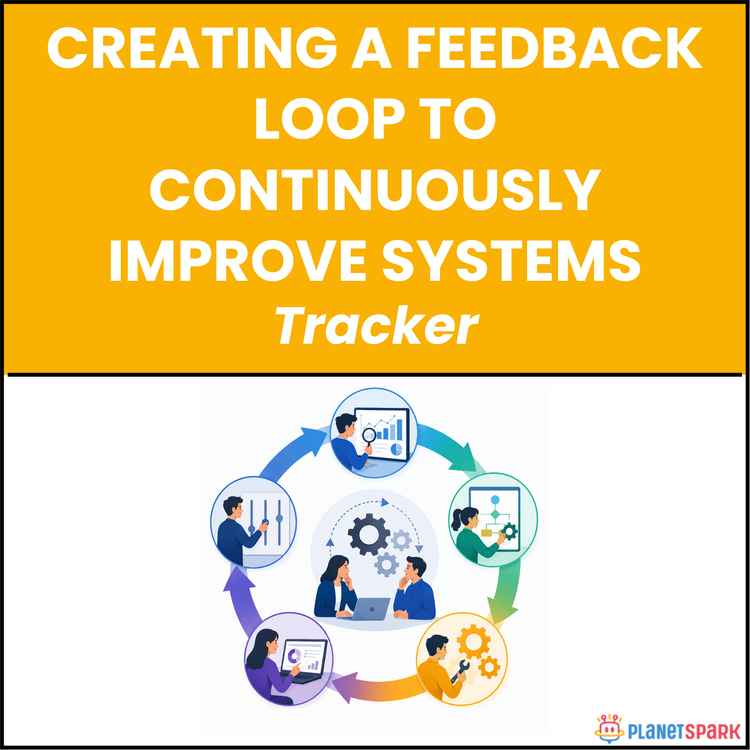
- The complete Five-Phase Feedback Loop Model:
- Define
- Collect
- Analyse
- Act
- Review
- Frameworks for defining clear system success criteria
- Guidance on identifying measurable success indicators
- Early-warning signal mapping systems
- A System Definition Snapshot worksheet
- Practical methods for building multi-source feedback channels
- Structured approaches for:
- Stakeholder feedback
- System performance data
- Self-observation
- External benchmarking
- Feedback collection readiness checklists
- The “3-Lens Analysis Method”:
- Frequency
- Severity
- Source Credibility
- Pattern Mapping worksheets for identifying meaningful insights
- Reflection prompts for uncovering hidden assumptions
- Action-planning frameworks for designing measurable improvements
- SMART-I implementation methodology
- Improvement Action Planner templates
- Structured Review and Retrospective systems
- Real-world case studies showing feedback loops in action
- Common feedback loop mistakes and how to fix them
- A practical 7-day implementation roadmap
Everything inside the resource is designed for immediate application in professional environments.
Summary of the Resource
“Creating a Feedback Loop to Continuously Improve Systems” is a practical system-improvement guide for professionals who want to build workflows, habits, and processes that become more effective over time.
The resource teaches readers how to:
- Define what success actually looks like
- Collect meaningful feedback consistently
- Analyse signals instead of reacting emotionally
- Implement small, testable improvements
- Build review systems that create compound learning
The core philosophy behind the guide is simple:
The best systems are not perfect from the beginning.
They improve because they are designed to learn.
How Will This Resource Be Useful?
This resource helps professionals move from reactive execution to intelligent system optimisation.
You’ll gain:
- Greater clarity about how your systems are actually performing
- Better visibility into hidden workflow problems
- More structured approaches to improvement and iteration
- Reduced repetition of avoidable mistakes
- Better decision-making based on real signals instead of assumptions
- Stronger problem-solving frameworks
- Improved team communication and collaboration systems
- More measurable and trackable improvement processes
- Better long-term professional growth through compound learning
- Increased confidence in refining systems systematically
Most importantly, this resource helps professionals stop depending on guesswork.
Instead, it teaches them how to build systems that continuously generate insight, learning, and improvement over time.
How Should You Use This Resource?
To get the best results, work through the Five-Phase Feedback Loop sequentially.
Start with the Define phase. Clarify:
- What system you are improving
- What success actually looks like
- Which metrics matter most
- What early failure signals look like
Keep this focused and specific.
Next, move into the Collect phase. Build multiple feedback channels:
- Stakeholder input
- System performance data
- Self-observation
- External benchmarks
Avoid relying on only one source of feedback.
Then use the 3-Lens Analysis Method to identify:
- Repeated themes
- High-severity problems
- Credible signals
This helps separate useful insight from random noise.
After identifying patterns, move into the Act phase. Design small, testable experiments instead of large, uncontrolled changes.
Each improvement should have:
- A clear owner
- A timeline
- A measurable outcome
- A review process
Finally, complete the Review phase:
- Evaluate whether the changes worked
- Identify unexpected effects
- Update your understanding of the system
- Restart the loop with better information
The framework works best when repeated consistently every few weeks instead of only during major failures.
Action Steps
After accessing this resource, take these steps immediately:
1. Choose one system you want to improve
2. Complete the System Definition Snapshot worksheet
3. Define 2–3 measurable success indicators
4. Identify at least two feedback collection sources
5. Schedule one structured feedback conversation
6. Conduct your first Pattern Mapping analysis session
7. Identify one recurring issue or bottleneck
8. Design one precise improvement experiment
9. Assign a review date in your calendar
10. Repeat the loop consistently every cycle
Professionals often assume improvement comes from working harder.
In reality, long-term improvement usually comes from building systems that learn faster.
That is what feedback loops make possible.
This resource helps professionals create structured reflection, smarter iteration, and continuous system refinement instead of repeating the same patterns indefinitely.
You do not need perfect systems from the beginning.
You need systems capable of improving continuously.
That is how high-performing professionals, teams, and organisations actually grow over time.
Book your free session today!