
Creating a Feedback Loop to Improve Your Leadership Style

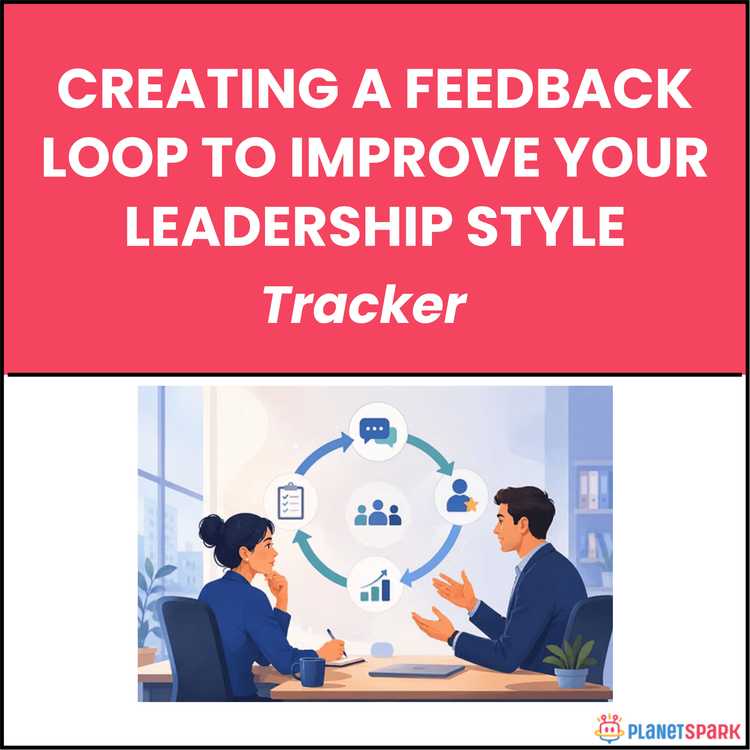
Creating a Feedback Loop to Improve Your Leadership Style
Creating a Feedback Loop to Improve Your Leadership Style: A Practical Guide for Managers and Working Professionals
Most professionals assume they’ll become better leaders with experience alone.
But experience without reflection often creates repetition, not growth.
Many managers spend years leading teams without ever truly understanding how their leadership style is being experienced by others. Feedback arrives too late, too vaguely, or only during annual reviews — long after behaviours have already become habits.
That’s why leadership blind spots quietly grow over time.
You may think your communication is clear, your decisions are supportive, or your team feels heard — but unless you have a consistent system for collecting and acting on feedback, you’re mostly relying on assumptions.
This is exactly the problem the resource “Creating a Feedback Loop to Improve Your Leadership Style” helps solve.
Rather than treating feedback as a once-a-year performance review event, this practical guide helps professionals build an ongoing leadership feedback system that improves communication, trust, decision-making, and leadership effectiveness in real time.
Designed specifically for busy working professionals, the resource combines reflection tools, feedback frameworks, leadership sprint planning, and actionable exercises into a structured system for continuous improvement.
If you want to become a more intentional, adaptive, and trusted leader, this resource gives you a practical roadmap to do exactly that.
Who Is This Resource For?
This guide is designed for professionals who want to improve how they lead, communicate, and influence others through consistent self-awareness and feedback.
It is especially useful for:
- Managers leading teams of any size
- First-time team leaders
- Mid-career professionals stepping into leadership roles
- Project managers handling cross-functional teams
- Consultants managing people and stakeholders
- Professionals aiming to improve team trust and communication
- Leaders struggling with unclear feedback or leadership blind spots
- Professionals who want measurable leadership growth
- Managers trying to build stronger team culture and psychological safety
Whether you lead formally through a job title or informally through influence, this resource helps you improve your leadership style through structured reflection and action.
What Does This Resource Contain?
The guide is structured as a practical leadership tracker and action system rather than a traditional theory-heavy leadership ebook.
Each section is designed to help professionals move from vague self-improvement intentions to measurable behavioural change.
1. Understanding Your Current Leadership Baseline
The guide begins by helping readers establish a realistic understanding of their current leadership style.
Instead of relying on self-perception alone, the resource introduces four core leadership dimensions:
- Communication Clarity
- Empathy & Presence
- Decision-Making Quality
- Development Orientation
These dimensions create a framework for evaluating leadership behaviour more objectively.
The guide also includes a baseline self-assessment worksheet where readers rate themselves using real examples and observable behaviours.
This section is especially valuable because it highlights a critical leadership truth:
The gap between how you think you lead and how others experience your leadership is often where the biggest growth opportunities exist.
Core Leadership Dimensions
The resource encourages leaders to continuously evaluate themselves across four key areas of leadership effectiveness.
By focusing on specific leadership behaviours rather than vague personality traits, professionals can make measurable improvements over time.
2. Building a Reliable Feedback Collection System
One of the strongest sections of the resource focuses on creating systems for collecting honest, useful feedback consistently.
Instead of waiting for annual reviews or occasional comments, the guide introduces three practical feedback channels:
Structured One-on-One Check-Ins
Leaders are encouraged to end conversations with focused feedback questions that invite honesty and reflection.
Bi-Weekly Micro-Surveys
The guide includes examples of short anonymous survey questions designed to collect fast, actionable input from teams.
Trusted Mirror Conversations
Readers are encouraged to identify a peer, mentor, or sponsor who can provide direct, unfiltered observations.
The guide also includes:
- Sample survey questions
- A feedback tracking log
- Templates for recording recurring themes
- Practical examples of effective feedback prompts
This makes the process easy to implement immediately in real workplace environments.
3. Learning How to Decode Feedback Properly
Collecting feedback is only useful if you know how to interpret it correctly.
This section helps readers distinguish between:
- Useful behavioural feedback
- Emotional reactions
- Isolated opinions
- Repeating patterns
The guide introduces a practical feedback decoding process that helps professionals avoid common mistakes such as:
- Becoming defensive
- Overcorrecting too quickly
- Ignoring patterns
- Staying silent after receiving feedback
Readers are also guided through reflection questions that help them evaluate:
- Whether feedback relates to behaviour or personality
- Whether the same feedback appears repeatedly
- What team members may actually need underneath the feedback
This section helps professionals respond thoughtfully instead of reactively.
4. Designing Leadership Improvement Sprints
One of the most practical concepts in the resource is the “leadership sprint” model.
Instead of trying to improve every leadership skill at once, the guide teaches professionals how to focus on one specific leadership theme at a time over a four-week period.
The sprint framework includes:
- Selecting one leadership focus area
- Defining measurable behavioural changes
- Tracking progress consistently
- Gathering mid-sprint feedback
- Reviewing outcomes after four weeks
This approach makes leadership growth feel manageable and measurable.
The resource also includes a complete sprint planning worksheet that professionals can use to structure their improvement process.
The Leadership Improvement Sprint Framework
The guide introduces a simple but highly effective improvement cycle for leadership growth.
This framework helps leaders turn feedback into structured action instead of passive awareness.
5. Closing the Feedback Loop With Your Team
This section focuses on a step most professionals completely overlook:
communicating back to the people who gave the feedback.
The guide explains why closing the loop builds:
- Trust
- Psychological safety
- Team transparency
- Better future feedback quality
Readers are given a practical three-step formula:
1. Acknowledge the feedback
2. Name the behaviour change
3. Invite ongoing input
The resource explains that leadership credibility increases significantly when teams see visible evidence that feedback leads to action.
This section alone can dramatically improve team culture and communication quality.
6. Real-World Leadership Case Study
The guide includes a detailed leadership case study featuring a product manager named Priya.
The case study walks readers through:
- Her communication challenges
- The gap between her self-perception and team experience
- How she collected structured feedback
- The leadership sprint she implemented
- The measurable improvements she achieved
The example makes the frameworks feel practical, realistic, and immediately relatable for professionals navigating similar situations.
7. Common Leadership Feedback Mistakes and Fixes
The final sections of the guide cover common reasons feedback systems fail.
These include:
- Asking overly broad questions
- Collecting feedback without acting on it
- Treating every comment equally
- Skipping self-assessment
- Failing to close the loop
- Abandoning the process after one cycle
For each mistake, the guide provides straightforward, practical fixes.
This section helps professionals avoid common leadership development traps and maintain long-term momentum.
Summary of the Resource
“Creating a Feedback Loop to Improve Your Leadership Style” is a practical leadership development guide designed to help professionals improve through consistent reflection, feedback collection, and behavioural adjustment.
The resource helps readers:
- Identify leadership blind spots
- Improve communication clarity
- Build stronger team trust
- Develop better feedback habits
- Create measurable leadership growth systems
- Turn feedback into actionable improvements
- Build sustainable leadership development practices
Instead of generic advice, the guide focuses on structured implementation and real-world workplace application.
It is practical, easy to follow, and designed specifically for busy professionals.
How Will This Resource Be Useful?
This guide is especially useful because it transforms leadership growth from something abstract into something measurable and repeatable.
Professionals using this resource can benefit in several ways.
Increased Self-Awareness
You begin to understand how your leadership behaviours are actually experienced by others.
Better Communication
The feedback systems help uncover gaps in clarity, expectations, and decision-making.
Stronger Team Trust
When people see their feedback being acknowledged and acted upon, trust improves significantly.
Faster Leadership Growth
Continuous feedback allows professionals to improve in real time instead of waiting for formal reviews.
Improved Decision-Making
Leaders become more thoughtful, intentional, and aware of how decisions affect team dynamics.
Reduced Leadership Blind Spots
Structured feedback surfaces issues before they become larger organisational problems.
More Sustainable Leadership Development
Instead of relying on motivation alone, professionals build repeatable growth systems.
These are skills that become increasingly important as professionals move into larger leadership responsibilities.
How Should You Use This Resource?
This guide works best when treated as an active working document rather than passive reading material.
Here’s the recommended approach:
Step 1: Complete the Baseline Assessment
Start by honestly evaluating your current leadership patterns across the four leadership dimensions.
Step 2: Build Your Feedback System
Set up one-on-one questions, micro-surveys, and trusted feedback channels.
Step 3: Collect Feedback Consistently
Focus on gathering behavioural observations instead of general opinions.
Step 4: Decode Before Reacting
Look for patterns and recurring themes before making major changes.
Step 5: Launch a Leadership Sprint
Choose one improvement area and work on it intentionally for four weeks.
Step 6: Close the Loop
Communicate what you heard, what you changed, and what you’re continuing to improve.
Step 7: Repeat the Process
Leadership growth is not a one-time project. The system becomes more valuable over time.
Action Steps You Can Take Immediately
If you want to begin improving your leadership style today, start with these practical steps:
1. Complete the baseline leadership self-assessment
2. Identify your weakest leadership dimension honestly
3. Add one standing feedback question to your next one-on-one meeting
4. Create a short anonymous team micro-survey
5. Ask a trusted colleague for direct observations about your leadership style
6. Identify one repeating feedback theme
7. Choose one behaviour to improve over the next four weeks
8. Track progress consistently during your leadership sprint
9. Share your growth efforts openly with your team
10. Schedule your next feedback review before the current one ends
Consistency matters more than perfection.
Great leadership rarely comes from instinct alone.
The most effective leaders build systems that help them learn, adapt, communicate, and improve continuously.
“Creating a Feedback Loop to Improve Your Leadership Style” provides a practical structure for doing exactly that.
Instead of waiting for leadership problems to surface months later, this guide helps professionals build real-time awareness, stronger communication habits, and measurable leadership growth.
The professionals who improve fastest are not necessarily the most naturally gifted leaders.
They are the ones willing to ask better questions, listen honestly, act intentionally, and improve consistently.
Leadership development is not about becoming someone completely different.
It is about building better systems that help you become more effective version of the leader you already are capable of becoming.