
Creating a Personal Burnout Risk Assessment Framework

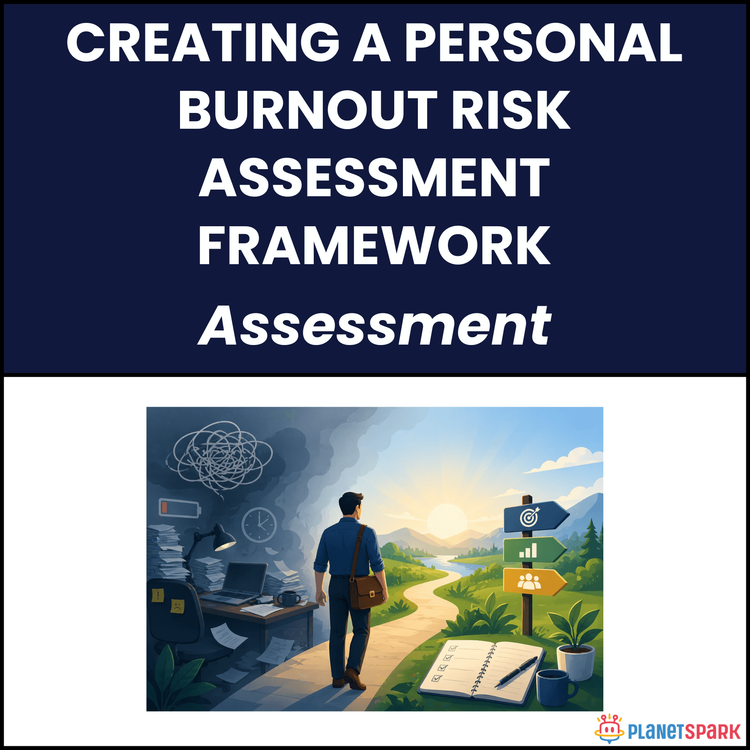
Creating a Personal Burnout Risk Assessment Framework
How to Assess and Prevent Burnout Early: A Practical Framework for Working Professionals
If you’ve ever felt “off” at work—less motivated, more exhausted, or quietly disengaged—but couldn’t clearly explain why, you’re not alone. Burnout rarely arrives as a dramatic breaking point. More often, it builds slowly beneath the surface until it starts affecting your performance, energy, and decision-making.
The problem is not just burnout itself—it’s the lack of a structured way to detect it early.
Most professionals rely on vague signals like “I’m just tired” or “this phase will pass.” By the time the signs become obvious, recovery takes significantly more time and effort.
That’s exactly why the resource “Creating a Personal Burnout Risk Assessment Framework” exists. It gives you a clear, practical system to identify, measure, and manage burnout risk before it escalates—so you can stay in control of your performance and well-being.
Who Is This Resource For?
This resource is especially valuable if you are:
- A working professional with 0–15 years of experience
- A job seeker or career switcher navigating uncertainty and pressure
- A manager or consultant handling multiple priorities and responsibilities
- A high performer who wants to sustain productivity without burning out
- Someone feeling early signs of disengagement, fatigue, or lack of clarity
- A professional who wants structured self-awareness—not vague advice
If you’re time-poor, outcome-driven, and want a clear way to assess and act on burnout risk, this framework is designed for you.
What Does This Resource Contain?
This is not a generic well-being guide. It’s a structured, decision-making toolkit designed for real-world use.
Inside the resource, you’ll find:
- A practical burnout risk model based on six key dimensions: Workload, Control, Recognition, Community, Fairness, and Values Alignment
- A self-assessment scorecard to evaluate your current burnout risk in under 10–30 minutes
- A clear scoring system that categorises you into four risk profiles (Sustainer, Navigator, Depleter, Critical Zone)
- Detailed explanations of what each risk profile means and how urgently you need to act
- Deep-dive insights into key burnout drivers like workload, autonomy, and values misalignment
- Reflection prompts to uncover hidden stress patterns
- A burnout early warning checklist covering behavioural, cognitive, and physical signals
- A structured 30-day burnout mitigation planner to turn insight into action
- A real-world case study showing how targeted actions can reverse early burnout signs
- Common mistakes professionals make when managing burnout—and how to avoid them
- A quick reference sheet for quarterly self-assessment and long-term tracking
Everything is designed for active use—not passive reading.
Summary of the Resource
“Creating a Personal Burnout Risk Assessment Framework” is a practical, self-directed toolkit that helps you move from guesswork to clarity.
It enables you to identify where your burnout risk is coming from, measure it objectively, and take focused, realistic action to prevent escalation. Instead of reacting to burnout after it happens, you learn how to detect and manage it proactively.
If you invest even 30–60 minutes in this framework, you gain a level of self-awareness that most professionals only develop after a crisis.
How Will This Resource Be Useful?
This resource helps you shift from reactive stress management to proactive career control.
You’ll gain:
- Clear visibility into your personal burnout risk across multiple dimensions
- The ability to identify root causes—not just symptoms—of stress and disengagement
- A structured way to make better decisions about workload, boundaries, and priorities
- Increased clarity on what is sustainable versus what is silently draining you
- A practical system to maintain performance without sacrificing well-being
- Early intervention strategies that prevent long recovery cycles later
Most importantly, it helps you stop normalising stress—and start managing it with intention.
How Should You Use This Resource?
To get the best results, follow a simple, phased approach:
Start by reading the framework overview to understand the six dimensions of burnout risk and how they apply to your work.
Next, complete the self-assessment scorecard honestly. Avoid overthinking—your first instinct is usually accurate.
Then, calculate your total score and identify your burnout risk profile. This gives you a clear starting point for action.
After that, use the interpretation guidance and deep-dive sections to understand which dimensions are driving your risk.
Finally, build your 30-day mitigation plan by focusing on your lowest-scoring areas. Choose small, specific, and scheduled actions you can realistically follow through on.
You can revisit this resource:
- Quarterly as a structured self-check-in
- Monthly using the early warning checklist
- Whenever you feel a shift in energy, motivation, or clarity
- During role changes, promotions, or high-pressure phases
Consistency—not intensity—is what makes this framework powerful.
Action Steps
After accessing this resource, take these steps immediately:
1. Block 30–45 minutes of uninterrupted time
2. Complete the burnout risk scorecard across all six dimensions
3. Calculate your total score and identify your risk profile
4. Highlight your 2–3 lowest-scoring dimensions
5. Use the mitigation planner to define one clear action per dimension
6. Schedule those actions in your calendar within the next 7 days
7. Set a reminder for your next assessment (30 or 90 days later)
Small, targeted actions taken early can prevent months of recovery later.
Burnout is not just about working too much—it’s about misalignment across key areas of your professional life. When you have a structured way to assess those areas, you gain the ability to act early, adjust intelligently, and protect both your performance and your well-being.
Use this framework not just as a one-time exercise, but as an ongoing system for self-awareness and career sustainability. The professionals who thrive long-term are not the ones who push the hardest—they are the ones who monitor, adapt, and act before problems escalate.
Book your free session today!