
Creating A Personal Communication Playbook For Workplace Scenarios

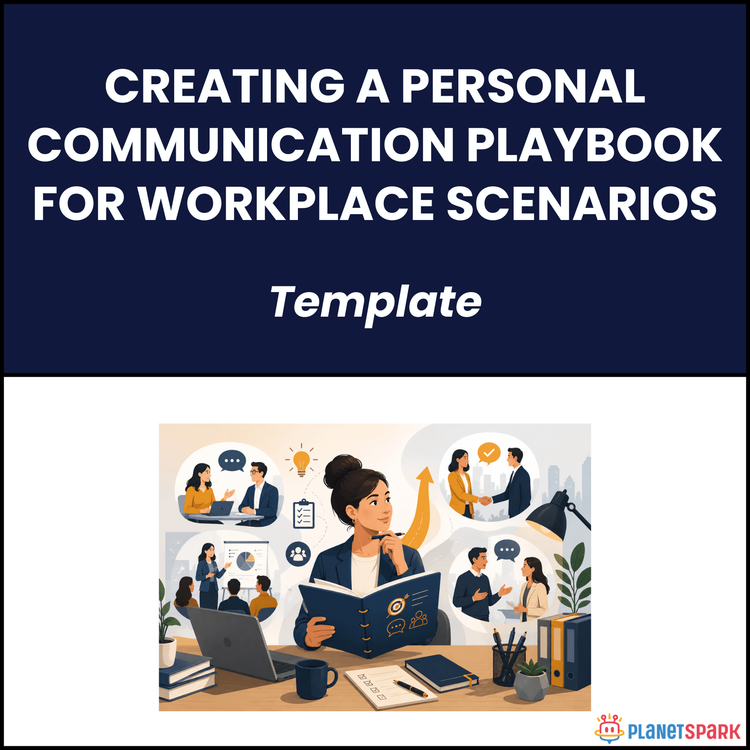
Creating A Personal Communication Playbook For Workplace Scenarios
Mastering Workplace Conversations
Most professionals assume communication is something you naturally improve over time. But in reality, many workplace conversations continue to feel stressful, unclear, or ineffective—even for highly capable professionals. You may know your work inside out, yet still struggle to ask for a promotion confidently, deliver difficult feedback without tension, or communicate clearly in high-stakes meetings.
That gap between capability and communication is exactly what this resource is designed to solve.
“Creating a Personal Communication Playbook for Workplace Scenarios” is a practical guide that helps professionals build a structured, repeatable communication system for real workplace situations. Instead of relying on instinct or improvisation, this resource gives you frameworks, templates, reflection tools, and communication strategies you can apply immediately in your day-to-day professional life.
If you’ve ever walked out of a meeting wishing you had communicated better, this guide was created for you.
Who Is This Resource For?
This resource is especially useful for:
- Working professionals with 0–15 years of experience
- Managers and team leads handling people conversations regularly
- Career switchers navigating new workplace environments
- Professionals preparing for promotions or leadership opportunities
- Consultants and client-facing professionals
- Employees who struggle with confidence in difficult conversations
- Anyone who wants to communicate more clearly, strategically, and professionally
Whether you are early in your career or already managing teams, this resource helps you become more intentional and effective in how you communicate across workplace scenarios.
What Does This Resource Contain?
This guide is structured like a real-world communication toolkit—not a theoretical textbook.
Inside the resource, you’ll find:
- A communication baseline assessment to identify your current communication patterns
- Reflection exercises to evaluate recent workplace interactions
- A stakeholder-mapping framework to understand different communication preferences
- A scenario library system for organising high-stakes workplace conversations
- Practical guidance for handling promotions, feedback, conflict, presentations, and professional boundaries
- The 4-Part Message Framework for structuring conversations clearly and effectively
- Communication templates for common workplace situations
- Realistic scripts you can personalize and apply immediately
- Worksheets for documenting communication goals, pushback responses, and improvement areas
- A real-world case study showing how structured communication improves outcomes
- A communication readiness checklist for before, during, and after important conversations
- Reflection prompts to build long-term communication awareness and confidence
Everything is designed to help you move from reactive communication to intentional communication.
Summary of the Resource
“Creating a Personal Communication Playbook for Workplace Scenarios” is a practical professional development guide that helps you build repeatable communication systems for workplace success.
Rather than offering generic communication tips, the resource focuses on helping you prepare for specific professional scenarios with clarity, structure, and confidence. It teaches you how to communicate your ideas more effectively, manage difficult conversations strategically, and adapt your communication style depending on the situation and stakeholder.
The goal is simple: help professionals communicate with greater clarity, confidence, and consistency in high-impact workplace moments.
How Will This Resource Be Useful?
Strong communication affects nearly every aspect of professional growth.
This resource helps you:
- Communicate more confidently in high-pressure conversations
- Structure your thoughts clearly before meetings and presentations
- Reduce misunderstandings and improve workplace relationships
- Handle feedback and conflict more constructively
- Present ideas more persuasively to leaders and stakeholders
- Ask for promotions, opportunities, or support more effectively
- Improve professional presence without sounding overly rehearsed
- Build communication habits that become easier over time
Most importantly, this resource helps you stop relying purely on instinct and start using frameworks that make communication more intentional and reliable.
How Should You Use This Resource?
To get maximum value from this guide, approach it as a working playbook—not passive reading material.
Start by reading through the guide once to understand the overall communication philosophy and frameworks.
Then complete the communication baseline exercises honestly. Reflect on recent conversations that went well and those that didn’t. This helps identify patterns you may not have noticed before.
Next, begin building your scenario library. Focus first on the workplace conversations that create the most stress, uncertainty, or importance in your professional life.
Once you identify those scenarios, use the templates and frameworks to prepare structured approaches for each one. Practise adapting the scripts into your own voice so the communication feels natural and authentic.
After important conversations, revisit the worksheets and reflection prompts to evaluate what worked, what felt difficult, and what you want to improve next time.
This resource becomes more valuable the more consistently you use and refine it over time.
Action Steps
After accessing this resource, take these steps immediately:
1. Identify 3 workplace conversations you currently find challenging
2. Complete the communication baseline reflection exercise
3. Build your first scenario template using the provided framework
4. Practise the 4-Part Message Framework in low-stakes conversations
5. Prepare responses for likely objections before your next important meeting
6. Use the communication checklist before and after high-stakes conversations
7. Update your playbook regularly based on real experiences and feedback
Even one well-prepared conversation can create a meaningful shift in your confidence and professional presence.
Professional growth is rarely determined by technical skills alone. The ability to communicate clearly, confidently, and strategically often becomes the difference between being overlooked and being trusted with greater responsibility.
This resource helps you build communication systems that support you in real workplace situations—not just ideal ones. Over time, those small improvements compound into stronger relationships, clearer leadership presence, and better career opportunities.
The goal is not to become someone else. It is to become more intentional, prepared, and effective in how you already communicate.