
Creating A Personal Financial Decision Framework

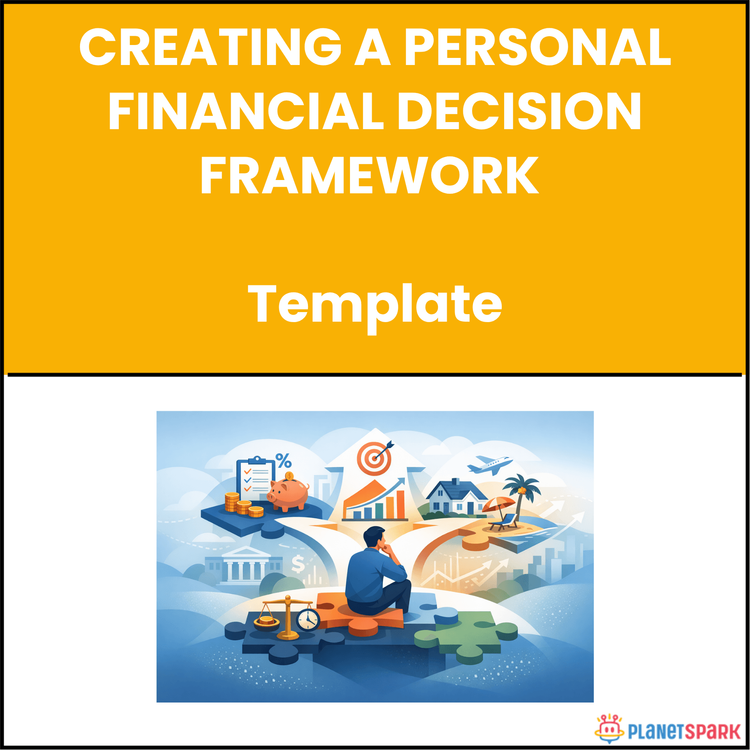
Creating A Personal Financial Decision Framework
Creating a Personal Financial Decision Framework: A Practical Playbook
Smart financial choices aren’t about luck—they’re about systems. The “Decision Framework” helps professionals make consistent, values-aligned money decisions with clarity and confidence.
Who Is This Resource For?
This playbook is designed for:
- Career switchers recalibrating financial priorities
- Early-to-mid career professionals (0–15 years experience)
- Consultants balancing irregular income
- Managers facing complex financial trade-offs
- Anyone who feels indecisive or reactive about money
If you want a structured way to make smarter financial decisions, this resource is built for you.
What Does This Resource Contain?
Inside the playbook, you’ll find:
- Introduction: Why decisions need a framework
- Module 1: Baseline audit (income, expenses, net worth, debt)
- Module 2: Values and goals (security, growth, experience, legacy)
- Module 3: Decision filters (goal alignment, affordability, risk tolerance, time horizon, reversibility)
- Module 4: Operating rules (income allocation, debt management, investment discipline, review cadence)
- Module 5: Action checklist for major decisions
- Case study showing framework application
- Common pitfalls and fixes
- Summary and next steps
Summary of the Resource
The “Decision Framework” is a structured toolkit that reframes financial choices as system-driven. It ensures professionals can evaluate, filter, and act on decisions consistently.
How Will This Resource Be Useful?
By applying this playbook, you’ll gain:
- Clarity on your financial baseline
- Confidence in aligning decisions with values
- Awareness of risk tolerance and affordability
- Tools to automate consistent behaviours
- Strategies to avoid impulsive or reactive choices
- Long-term resilience through annual audits
How Should You Use This Resource?
Follow a phased approach:
1. Complete your baseline audit.
2. Identify and rank your financial values.
3. Write down five personal decision filters.
4. Document four operating rules.
5. Apply the decision checklist before major choices.
6. Schedule quarterly and annual reviews.
Action Steps
After accessing this resource, take these immediate steps:
1. Fill out the baseline audit worksheet.
2. Identify your primary value cluster (security, growth, experience, legacy).
3. Write five decision filters tailored to your situation.
4. Document operating rules for income, debt, investments, and reviews.
5. Save the decision checklist to your phone or desktop.
6. Schedule your first quarterly review today.
Financial confidence isn’t about knowing everything—it’s about having a framework. With this playbook, you can move from indecision to clarity, ensuring your career trajectory reflects both income and consistent, values-driven choices.
Book your free session today!