

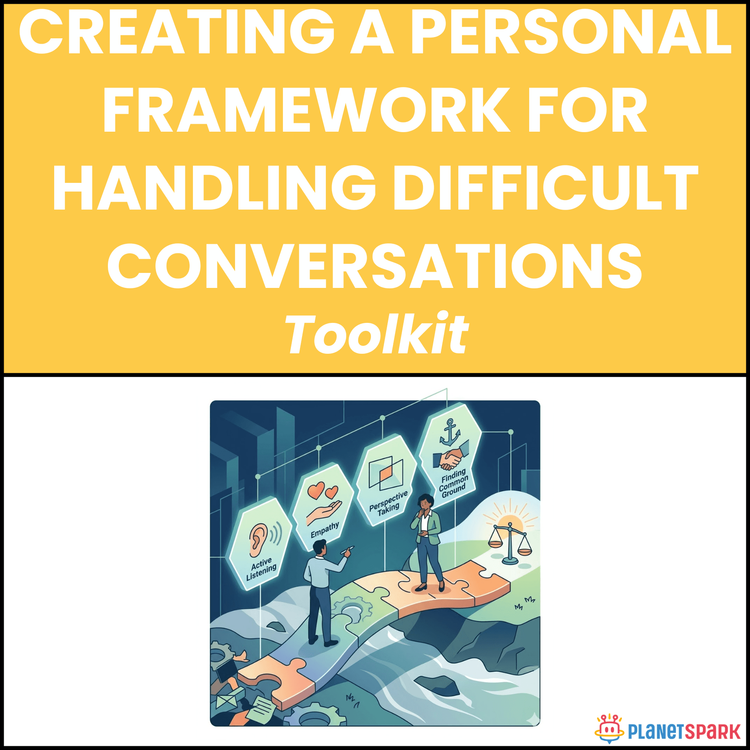
Creating A Personal Framework For Handling Difficult Conversations
How to Build a Personal Framework for Handling Difficult Conversations with Clarity and Confidence
Some conversations determine your career more than your work.
Giving tough feedback. Addressing a conflict. Saying no to a senior. Asking for clarity when expectations are unclear. These moments are uncomfortable — but avoiding them often costs more than having them.
Most professionals are never taught how to handle these conversations. They rely on instinct, emotion, or rehearsed scripts that fall apart in real situations.
The resource “Creating a Personal Framework for Handling Difficult Conversations” is designed to fix that — by helping you build a flexible, repeatable system that works across situations. As explained in the introduction (page 2), career growth often depends not on technical skill, but on the ability to navigate difficult conversations effectively.
Who Is This Resource For?
This resource is ideal for:
- Working professionals who avoid or struggle with tough conversations
- Managers handling feedback, performance discussions, or conflict
- Individuals preparing for promotions or leadership roles
- Client-facing professionals dealing with sensitive discussions
- Anyone who wants to communicate clearly without damaging relationships
If you’ve ever felt “I didn’t say what I needed to say,” this guide is built for you.
What Does This Resource Contain?
This is a structured toolkit that focuses on preparation, execution, and reflection. It includes:
- A clear understanding of why conversations become difficult (page 3):
- The “What Happened” conversation (facts and perceptions)
- The “Feelings” conversation (emotional layer)
- The “Identity” conversation (personal meaning and self-image)
- A 3-phase framework:
- Before the conversation (preparation and clarity)
- During the conversation (communication and control)
- After the conversation (reflection and improvement)
- Common triggers that make conversations harder:
- Power dynamics
- Ambiguity
- Past history
- High stakes
- Practical techniques for:
- Active listening
- Perspective-taking
- Staying calm under pressure
- Templates and structured approaches for real-world scenarios
- Reflection tools and self-evaluation methods
Summary of the Resource
This guide helps you stop relying on instinct and start using structure.
Instead of avoiding difficult conversations or mishandling them, you learn how to:
- Prepare with clarity
- Communicate with intention
- Reflect and improve
The result is more confident communication, stronger relationships, and better career outcomes.
How Will This Resource Be Useful?
This resource improves one of the most critical professional skills — communication under pressure.
You will be able to:
- Handle difficult conversations without anxiety or avoidance
- Express your perspective clearly and respectfully
- Understand others better instead of reacting emotionally
- Reduce misunderstandings and conflict escalation
- Build trust and credibility in professional relationships
- Navigate complex interpersonal situations with confidence
As highlighted on page 3, most conversations are difficult not because of facts, but because of emotions and identity. Understanding this changes how you approach them.
How Should You Use This Resource?
To get the most value, follow a structured approach.
Step 1: Understand the Framework
Learn the three layers of conversation so you can see beyond surface-level disagreement.
Step 2: Prepare Before the Conversation
Clarify:
- What you want
- What matters most
- What outcome you are aiming for
Step 3: Shift Your Mindset
Move from “winning the conversation” to understanding it.
Step 4: Apply During the Conversation
Focus on:
- Listening first
- Staying calm
- Speaking clearly and directly
Step 5: Reflect After the Conversation
Ask:
- What worked?
- What didn’t?
- What will I do differently next time?
Step 6: Build Your Personal Framework
Refine your approach based on repeated practice.
Action Steps
Start immediately:
- Identify one conversation you’ve been avoiding
- Write down what makes it difficult
- Clarify your objective for the conversation
- Identify possible emotions involved (yours and theirs)
- Plan one key message you want to communicate
- Schedule the conversation instead of delaying it
- Reflect after it happens
Difficult conversations are not optional in professional life.
Avoiding them delays growth. Handling them well accelerates it.
When you build your own framework, you stop relying on confidence in the moment — and start relying on clarity and structure.
That’s what makes communication consistent and effective.