
Creating a Personal Messaging System for Workplace Communication

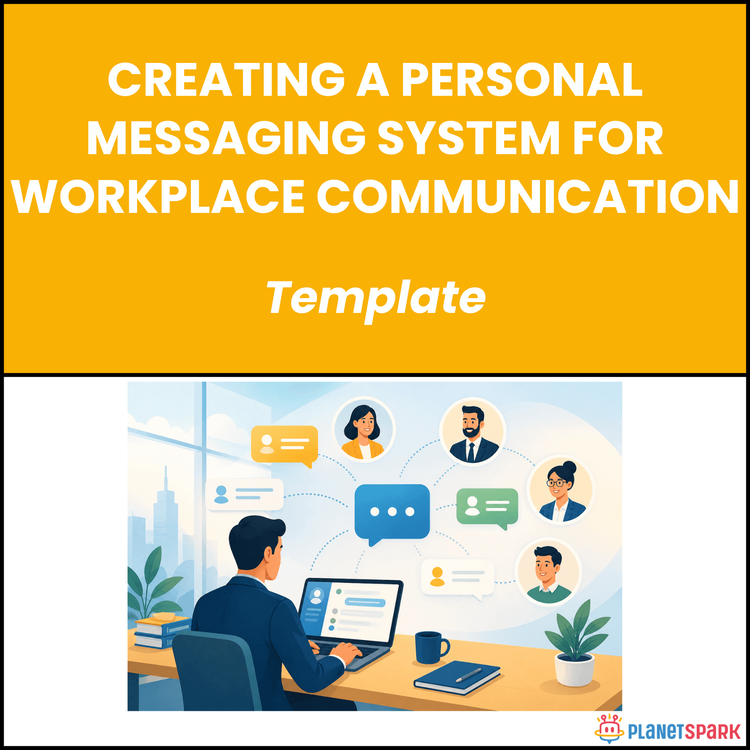
Creating a Personal Messaging System for Workplace Communication
Creating a Personal Messaging System for Workplace Communication: Templates to Communicate Clearly, Confidently, and Professionally
If you’ve ever stared at a blank email wondering “How do I say this without sounding unsure?” — you’re not alone.
Most professionals spend years sharpening their technical skills, but very little time building a consistent communication style. The result? You sound confident in one message, hesitant in another, overly apologetic in a third — and over time, that inconsistency quietly impacts your credibility.
That’s exactly the problem this resource is designed to solve.
The “Creating a Personal Messaging System for Workplace Communication” guide helps you stop improvising every message and start communicating with intention, clarity, and confidence — across every workplace scenario.
Who Is This Resource For?
This resource is especially useful if you are:
- A job seeker trying to present yourself professionally in emails and interviews
- A career switcher navigating new teams and communication expectations
- A consultant or freelancer managing multiple stakeholders
- A manager or team lead handling upward, downward, and cross-functional communication
- An early to mid-career professional who wants to sound more confident and structured at work
It’s also ideal if you:
- Overthink emails or messages
- Struggle with tone (too formal, too casual, or inconsistent)
- Find it difficult to handle sensitive conversations
- Want to communicate more strategically, not just reactively
What Does This Resource Contain?
This is not just a guide — it’s a complete system built using 10 practical, real-world templates designed for specific workplace situations.
Here’s what’s inside:
1. Professional Voice Baseline
Define your personal communication style, tone, and language rules before anything else.
2. Stakeholder Introduction Message
Introduce yourself confidently when joining a new team or project.
3. Upward Communication Framework (CIIA)
A structured way to communicate with senior leaders using Context, Insight, Impact, Ask.
4. Conflict De-escalation Script
Handle disagreements professionally without escalating tension.
5. Missed Deadline Recovery Message
Take accountability while maintaining credibility and trust.
6. Internal Visibility Pitch
Position yourself for new roles, projects, or growth opportunities.
7. Boundary-Setting Communication
Say no, reset expectations, and manage scope — without damaging relationships.
8. Cross-Functional Collaboration Opener
Start strong when working with new teams across departments.
9. Feedback Request Framework
Ask for meaningful, actionable feedback instead of vague responses.
10. Career Conversation Initiator
Start structured conversations about promotions and career growth.
Each template is built for a specific situation and includes clear structure, examples, and guidance — so you’re never guessing what to say.
Summary of the Resource
This resource helps you build a repeatable communication system instead of relying on guesswork.
Instead of thinking:
“What should I say in this situation?”
You start thinking:
“Which template applies here — and how do I adapt it?”
The result is faster communication, clearer messaging, and stronger professional presence across every interaction.
How Will This Resource Be Useful?
The biggest advantage of this resource is consistency.
Here’s what you gain:
- Clarity: You communicate with a clear purpose instead of vague language
- Confidence: You stop over-apologising or second-guessing your tone
- Credibility: Your messaging feels structured, professional, and reliable
- Efficiency: You spend less time drafting and rewriting messages
- Better outcomes: Your communication drives decisions, not confusion
For example:
- Instead of saying “Just checking in…”, you state a clear purpose
- Instead of avoiding conflict, you address it constructively
- Instead of vague updates, you present structured insights to leaders
Over time, this builds a strong professional identity — one where people trust your communication.
How Should You Use This Resource?
To get the most value, don’t try to use everything at once. Follow a structured approach:
Step 1: Start with Your Communication Baseline
Use Template 01 to define your tone, preferred language, and communication principles. This becomes your foundation.
Step 2: Identify Your Immediate Needs
Which 2–3 situations are you likely to face soon?
Focus on those templates first (e.g., introduction, feedback, or upward communication).
Step 3: Customize Each Template
Replace placeholders with your real context, role, and goals.
Make sure it sounds like your professional voice.
Step 4: Build Your Personal Message Library
Save your completed templates in a folder.
This becomes your go-to resource whenever similar situations arise.
Step 5: Review and Evolve
As your role and responsibilities grow, revisit and refine your messaging system every few months.
Action Steps
If you want to apply this immediately, here’s what to do:
1. Open the resource and complete the Professional Voice Baseline
2. Choose one real situation you’re currently facing
3. Pick the matching template from the guide
4. Customize it with your actual context
5. Read it aloud — refine until it sounds confident and natural
6. Use it in a real conversation or message this week
7. Save it for future use
Even applying just one template can significantly improve how you communicate.
Most professionals don’t struggle because they lack ideas — they struggle because they lack structure.
This resource gives you that structure.
When you stop improvising and start using a system, your communication becomes sharper, faster, and more impactful. And in the workplace, that directly translates into visibility, trust, and growth.
The most effective professionals aren’t necessarily the most eloquent — they’re the most consistent.
Build your system. Use it daily. Let it shape your professional reputation over time.