
Creating a Weekly Financial Check-In Routine

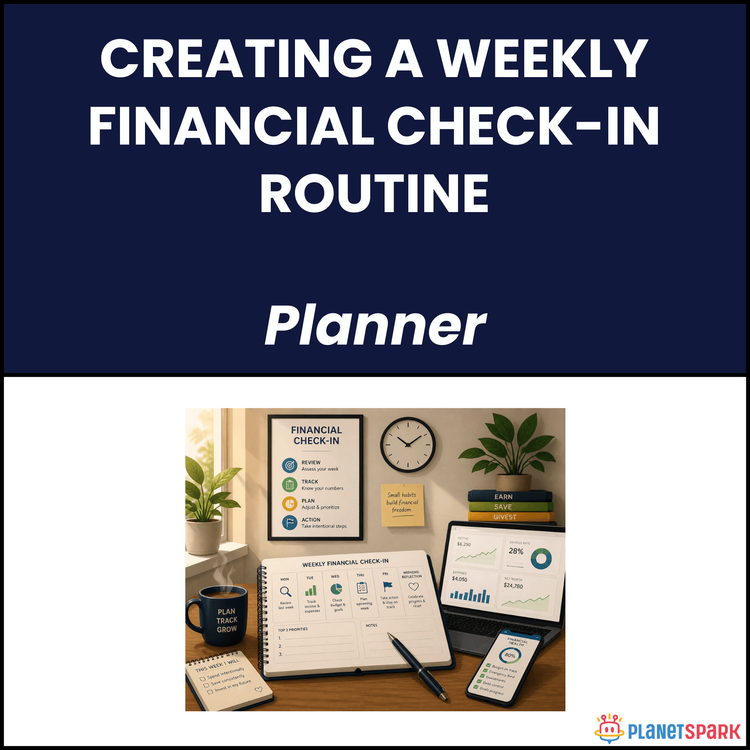
Creating a Weekly Financial Check-In Routine
Weekly Finance Reviews for Long-Term Success: A Practical System to Track, Adjust, and Take Control of Your Money Every Week
If you’ve ever reached the end of the month wondering, “Where did all my money go?”—you’re not alone.
Most working professionals don’t have a visibility problem because they don’t care about money. They struggle because they only check their finances *after* things go off track. Monthly reviews feel too late, and daily tracking feels unrealistic. The result? Missed patterns, reactive decisions, and constant financial uncertainty.
That’s exactly why the resource “Creating a Weekly Financial Check-In Routine” exists.
It gives you a simple, structured system to stay on top of your money—just 20–30 minutes a week—so you can move from confusion to clarity without overcomplicating your life.
Who Is This Resource For?
This resource is especially valuable if you are:
- A working professional with 0–15 years of experience
- Someone who feels unsure about where their money goes each month
- A consultant or freelancer managing variable income
- A manager or mid-career professional with increasing financial responsibilities
- Someone who wants better control over spending, saving, and planning
- A person who finds budgeting difficult to maintain consistently
If you want a simple, repeatable system that fits into your weekly routine, this guide is built for you.
What Does This Resource Contain?
This is not a generic budgeting guide. It’s a practical, action-oriented planner designed for real-life use.
Inside the resource, you’ll find:
- A 4-step weekly financial check-in system:
- Track (log all income and expenses)
- Review (compare actuals vs plan)
- Adjust (make small corrections)
- Plan (set clear intentions for the next week)
- Step-by-step guidance for each stage, designed to take only 5–10 minutes
- A weekly expense tracker template to organise your finances clearly
- Category-wise breakdowns (housing, food, transport, savings, etc.)
- Reflection questions to uncover spending patterns and triggers
- Practical prompts to improve financial awareness and behaviour
- Real-world case study showing measurable financial improvement
- Common mistakes professionals make—and how to fix them
- A weekly habit-building system that compounds into long-term results
- Clear next steps to build consistency over 8 weeks and beyond
Everything is designed to help you take small, consistent actions that lead to meaningful financial control.
Summary of the Resource
“Creating a Weekly Financial Check-In Routine” is a practical system that helps you stay in control of your money through short, structured weekly reviews.
Instead of waiting for problems to build up, this resource gives you a repeatable process to track, review, adjust, and plan—every single week.
If you want clarity, consistency, and confidence in your financial decisions, this guide shows you exactly how to build it.
How Will This Resource Be Useful?
This resource helps you move from financial uncertainty to proactive control.
You’ll gain:
- Clear visibility into your weekly income and expenses
- Early detection of overspending patterns
- Better alignment between your spending and priorities
- Reduced financial stress and anxiety
- Consistent progress toward savings, investments, and goals
- Improved decision-making through regular feedback loops
Most importantly, it helps you replace reactive money habits with a structured system that works every week.
How Should You Use This Resource?
To get the best results, follow a simple weekly rhythm:
First, block 20–30 minutes once a week—preferably on the same day (like Sunday).
Start with the Track step:
Log all income and expenses from the past week without judgment. Focus on accuracy.
Move to the Review step:
Compare your actual spending with your planned budget. Identify where you overspent or underspent.
Then, complete the Adjust step:
Make one or two small corrections for the coming week. Avoid overcomplicating—focus on what matters most.
Finally, finish with the Plan step:
Write down three clear, measurable financial intentions for the next week.
Use the worksheets and reflection questions regularly to deepen your understanding of your financial behaviour.
Repeat this process consistently for at least 8 weeks to build the habit.
Action Steps
After accessing this resource, take these steps immediately:
1. Block 30 minutes this Sunday for your first check-in
2. Track all your expenses and income from the past 7 days
3. Identify 2–3 categories where your spending needs attention
4. Make one small adjustment for the upcoming week
5. Write down 3 specific financial intentions for next week
6. Choose one tracking method (app, spreadsheet, or notes) and stick to it
7. Commit to repeating this process for the next 8 weeks
Small weekly actions can create powerful long-term financial outcomes.
Financial control doesn’t come from occasional effort—it comes from consistent visibility and small, deliberate adjustments.
When you check in with your money every week, you stop reacting and start leading your financial life with clarity and confidence.
Use this resource to build a simple system that works in the background—so your financial progress becomes steady, predictable, and aligned with your goals.
Book your free session today!