
Creating Feedback Loops To Improve Decision Accuracy

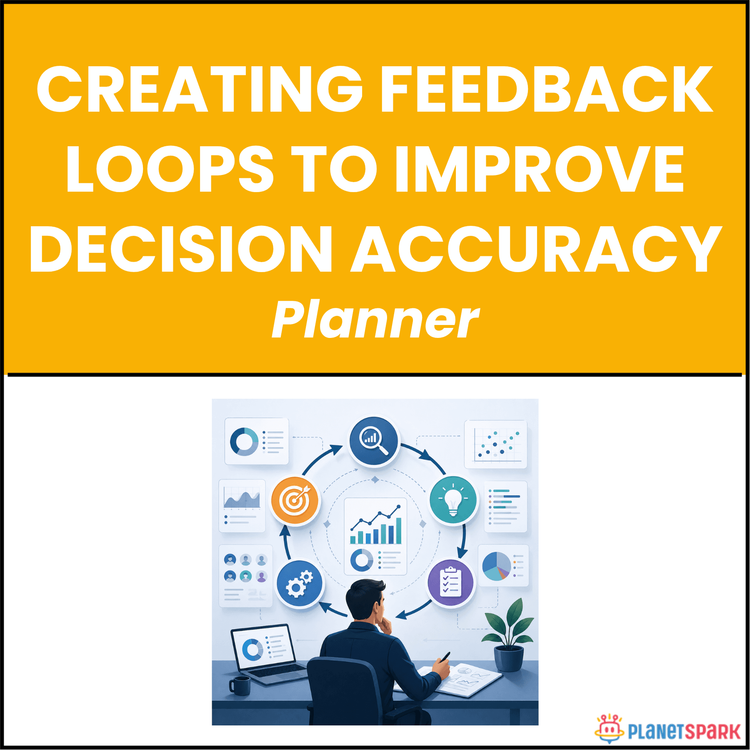
Creating Feedback Loops To Improve Decision Accuracy
Creating Feedback Loops to Improve Decision Accuracy: A Practical Guide to Making Better Decisions Over Time
Most professionals focus on making the “right” decision.
But high performers focus on something more powerful: improving how they decide.
Because the truth is—no matter how experienced you are, not every decision will be perfect. What separates average professionals from exceptional ones is not accuracy in a single moment—it’s their ability to learn, adjust, and improve consistently.
That’s exactly why the resource “Creating Feedback Loops to Improve Decision Accuracy” exists. It helps you build a structured system to learn from your decisions, refine your thinking, and improve your judgment over time.
Instead of repeating the same mistakes, you start compounding better decisions.
Who Is This Resource For?
This resource is especially valuable if you are:
- A working professional with 0–15 years of experience
- A manager or leader responsible for repeated decision-making
- A consultant evaluating outcomes and improving recommendations
- A professional who wants to improve judgment and learning speed
- Someone who reflects on decisions but lacks a structured system
- A professional aiming for consistent long-term growth
If you want to not just decide—but improve how you decide—this guide is built for you.
What Does This Resource Contain?
This is not just a reflection guide—it is a structured decision improvement system.
Inside the resource, you’ll find:
- A clear explanation of why most professionals fail to improve decision accuracy
- The concept of feedback loops and how they drive continuous improvement
- A structured framework connecting decisions → outcomes → learning → refinement
- A step-by-step feedback loop system, including:
- Pre-decision clarity (what you expect to happen)
- Outcome tracking (what actually happened)
- Gap analysis (why there was a difference)
- Learning capture (what to improve next time)
- Practical tools to document and analyse decisions
- Templates for decision journaling and outcome tracking
- A Decision Review Framework to evaluate both process and results
- Techniques to separate decision quality from outcome randomness
- Methods to identify patterns in your thinking over time
- Guidance on improving assumptions, criteria, and judgment
- Real-world examples showing how professionals refine decisions over time
- Common mistakes in feedback loops (e.g., focusing only on results, not process)
- A system to build long-term decision intelligence
Everything is designed for continuous application—not one-time use.
Summary of the Resource
“Creating Feedback Loops to Improve Decision Accuracy” is a practical system for long-term decision improvement.
It helps you:
- Learn from every decision you make
- Identify patterns in your thinking
- Improve your judgment over time
- Reduce repeated mistakes
- Build a structured decision-making process
If you want your decisions to get better consistently—not randomly—this resource gives you the system.
How Will This Resource Be Useful?
This resource helps you move from occasional success to consistent improvement.
You’ll gain:
- A clear system to review and improve decisions
- Better understanding of why decisions succeed or fail
- Increased confidence in your judgment over time
- Faster learning from both successes and mistakes
- Stronger long-term decision-making capability
- Reduced reliance on guesswork
Most importantly, it helps you turn experience into insight—and insight into better decisions.
How Should You Use This Resource?
To get the best results, use this as an ongoing practice—not a one-time read.
Start before the decision:
- Write down your expectations and assumptions
- Define what success looks like
Track outcomes:
- Record what actually happens
- Compare expected vs actual results
Analyse the gap:
- Identify what you got right and wrong
- Focus on thinking process—not just outcome
Capture learning:
- Write 1–2 key insights
- Define what you will do differently next time
Repeat consistently:
- Use this loop for important decisions regularly
- Build your personal decision journal
Over time, patterns will emerge—and your decision quality will improve naturally.
Action Steps
After accessing this resource, take these steps immediately:
1. Identify one recent decision you made
2. Write down what you expected vs what actually happened
3. Identify one assumption that was incorrect
4. Define one change for your next decision
5. Start a simple decision journal
6. Review one decision every week
Small, consistent reflection creates long-term clarity.
The goal is not to make perfect decisions.
The goal is to make better decisions over time.
When you build feedback loops into your thinking, every decision—good or bad—becomes a source of learning.
And when learning compounds, so does your growth.
Book your free session today!