
Creating Personal Boundaries Without Damaging Relationships

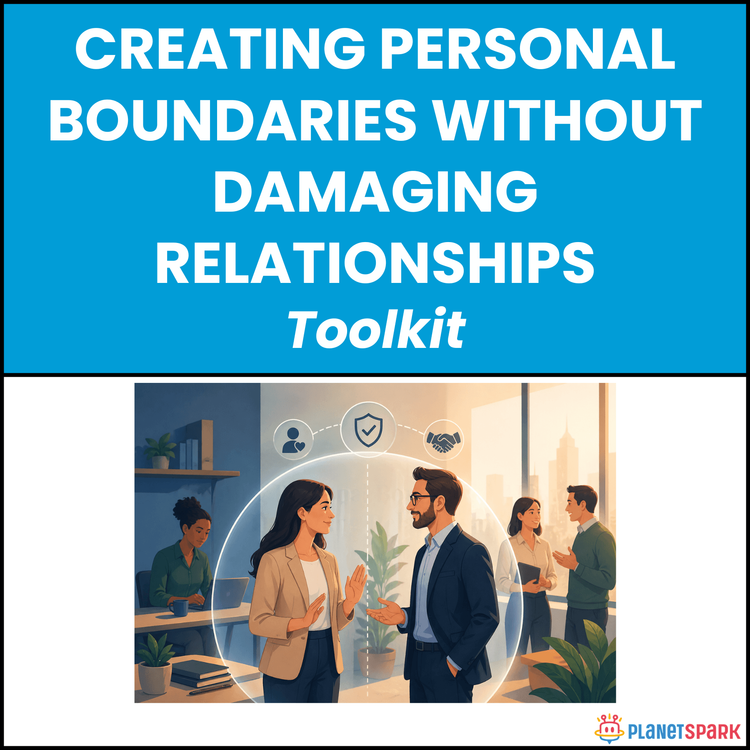
Creating Personal Boundaries Without Damaging Relationships
Creating Clear Boundaries Without Compromising Relationships: A Practical Guide for Professionals
In today’s always-on work culture, boundaries can feel almost impossible to maintain. Late-night messages, constant “quick favour” requests, emotional overload from colleagues, and the pressure to always be available often leave professionals feeling exhausted, resentful, and stretched too thin.
The problem is not that people do not understand boundaries matter—it is that most professionals do not know how to set them without feeling guilty or damaging important relationships.
That is exactly why the resource “Creating Personal Boundaries Without Damaging Relationships” exists. It is designed for working professionals who want to protect their time, energy, and mental clarity while still maintaining strong, respectful workplace relationships.
This toolkit helps you move from silent frustration to confident communication using practical frameworks, self-audit worksheets, ready-to-use scripts, and real workplace examples that make boundary-setting feel professional—not personal.
Who Is This Resource For?
This resource is especially valuable if you are:
- A working professional with 0–15 years of experience
- A manager handling team expectations and workplace communication
- A consultant or freelancer managing client demands and scope boundaries
- A career switcher adapting to new workplace cultures and expectations
- A mid-career professional struggling with burnout, resentment, or overcommitment
- Someone who finds it difficult to say no without guilt
- A people-pleaser who often prioritises others at the cost of personal wellbeing
If you want healthier professional relationships without conflict, this guide is built for you.
What Does This Resource Contain?
This is not a generic self-help guide. It is a structured, practical toolkit built for real workplace situations.
Inside the resource, you’ll find:
- A clear explanation of what professional boundaries actually are—and what they are not
- The four types of boundaries: Time, Energy, Emotional, and Values
- A complete Boundary Audit worksheet to identify where your boundaries are breaking down
- Reflection questions to uncover patterns of resentment, guilt, and overcommitment
- The CARE Method (Clarify, Acknowledge, Request, Enforce) for setting boundaries that stick
- Step-by-step guidance for boundary-setting conversations
- Word-for-word scripts for six common workplace boundary scenarios
- Real-world examples for after-hours availability, extra work requests, interruptions, and difficult conversations
- A case study showing how better boundaries improved both wellbeing and professional relationships
- Common mistakes professionals make when setting boundaries—and how to avoid them
- Boundary strategies for managers, peers, direct reports, and clients
- A personal 30-day Boundary Action Plan for immediate implementation
Everything is designed for action, not passive reading.
Summary of the Resource
“Creating Personal Boundaries Without Damaging Relationships” is a practical toolkit that helps professionals protect their time, energy, and professional standards without creating unnecessary conflict.
It teaches you how to identify weak boundaries, communicate clearly, and maintain respect while saying no when needed. Instead of reacting emotionally or avoiding difficult conversations, you learn how to set expectations calmly and confidently.
If you only have a short amount of time to improve your work-life balance and professional confidence, this resource provides a direct, usable system that creates immediate results.
How Will This Resource Be Useful?
This resource helps you move from overwhelm to control.
You’ll gain:
- Clear understanding of where your professional boundaries are weak
- Greater confidence in saying no without guilt
- Stronger communication during difficult workplace conversations
- Better work-life balance and reduced emotional exhaustion
- Less resentment and fewer unhealthy workplace patterns
- Healthier professional relationships built on mutual respect
- Improved leadership presence and personal credibility
Most importantly, it helps you stop operating from silent obligation—and start working from clarity, respect, and confidence.
How Should You Use This Resource?
To get the best results, follow a phased approach.
First, read through the full guide once to understand the overall structure and how boundaries work across different workplace relationships. This gives you context before taking action.
Next, complete the Boundary Audit worksheet honestly. Focus on your current reality—not how you wish things were. This step helps identify where the biggest problems exist.
Then, use the CARE Method to define your priority boundary. Clarify exactly what needs to change before approaching the conversation.
After that, study the scripts section and adapt the relevant examples to your own situation. This removes uncertainty and helps you communicate clearly.
Finally, complete the Personal Boundary Action Plan and follow the 30-day check-in structure to build consistency and confidence over time.
You can revisit this resource whenever you:
- Feel overwhelmed by workplace demands
- Struggle to say no professionally
- Need to prepare for a difficult conversation
- Manage client expectations or team communication
- Feel resentment building in professional relationships
Action Steps
After accessing this resource, take these steps immediately:
1. Complete the Boundary Audit worksheet honestly
2. Identify your single highest-priority boundary to address first
3. Write your boundary clearly using the CARE Method structure
4. Choose the right script for your upcoming conversation
5. Schedule the boundary conversation this week
6. Follow through consistently when the boundary is tested
7. Review your progress after 30 days and choose your next priority boundary
One well-set boundary can improve not just your workload—but your confidence, focus, and long-term career sustainability.
Boundaries are not selfish. They are a professional skill. The strongest professionals are not the ones who say yes to everything—they are the ones who know how to protect their capacity while maintaining trust and respect.
When boundaries are clear, relationships improve. Expectations become healthier. Work becomes more sustainable.
Use this resource not just to say no better, but to build a career that supports your wellbeing, leadership, and long-term growth.