
Creating Repeatable Decision Templates for Recurring Scenarios

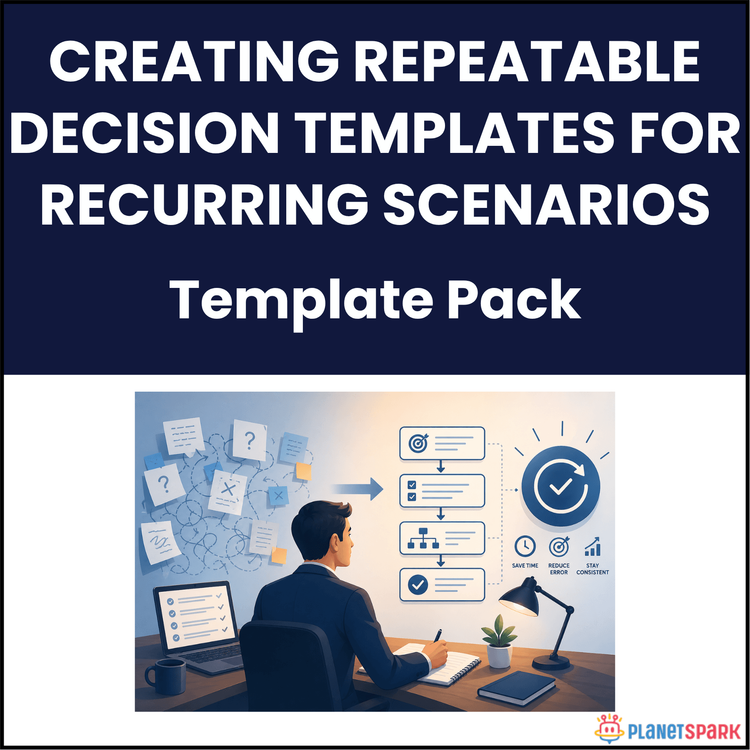
Creating Repeatable Decision Templates for Recurring Scenarios
Designing Reusable Decision Templates for Common Scenarios: A Guide to Faster and More Reliable Decision-Making
Do you find yourself facing the same types of decisions repeatedly, but feeling like each one requires starting from scratch? Whether you're selecting vendors, handling project escalations, or evaluating job offers, many professionals struggle with decision fatigue. This guide is here to help you streamline your process by building repeatable decision templates, allowing you to make smarter, faster, and more consistent decisions—without reinventing the wheel each time.
Designed for busy professionals, this resource will walk you through how to identify recurring decisions in your role and build templates that automate your thinking. By codifying the logic behind your best decisions, you'll reduce errors and make more confident calls, even under pressure.
Who Is This Resource For?
This guide is perfect for:
- Managers: Those frequently making high-stakes decisions like vendor selection or project go/no-go calls.
- Consultants: Professionals who regularly need to make consistent, defensible recommendations to clients.
- Career Changers: Individuals juggling decisions such as job offer evaluations or prioritizing upskilling efforts.
- Mid-Career Professionals: Those who need structured frameworks to make faster and more reliable decisions across multiple scenarios.
- Time-Poor Professionals: Anyone looking for a quick way to improve the quality of their decisions without overthinking.
What Does This Resource Contain?
This resource provides practical frameworks, tools, and exercises to help you:
- Scenario Inventory: Identify the top 3–5 recurring decision scenarios in your role that have high stakes and high frequency.
- Decision Autopsy: Extract the logic from past decisions to identify what factors truly drive success.
- Decision Template Structure: Build a reusable decision template with four key layers: Scenario Header, Threshold Gates, Weighted Scoring Matrix, and Decision Rule.
- Stress Testing: Ensure the reliability of your template by running it through back-testing, peer reviews, and real-world trials.
- Real-World Examples: A detailed case study showing how a professional used these templates to streamline decisions in their career.
Summary of the Resource
This guide helps you develop repeatable decision-making systems that save time and reduce errors:
- Identify recurring decisions: Conduct a Scenario Inventory to find which decisions matter most.
- Build your template: Use a structured approach to extract the logic behind your best decisions and create a template you can use again and again.
- Stress-test your template: Ensure reliability by testing your template in real scenarios and revising it based on feedback.
- Learn and improve: Review your decision templates regularly to keep them aligned with changing needs and circumstances.
By the end of this guide, you’ll be equipped to make the same decision ten times faster, with the same clarity and confidence as the first time.
How Will This Resource Be Useful?
This guide will help you:
- Save time: Automate your decision-making process for recurring scenarios so you can make decisions faster.
- Reduce errors: Use structured templates that remove guesswork and lead to more consistent outcomes.
- Improve confidence: Make decisions with more clarity and less second-guessing.
- Create defensible decisions: Build a clear record of your decision-making process, making it easier to explain and defend your choices.
How Should You Use This Resource?
- Step 1: Start by completing the Scenario Inventory to identify the key decision scenarios in your role that occur frequently and have significant stakes.
- Step 2: Perform a Decision Autopsy by reviewing past decisions to extract the logic behind your best outcomes. List the factors you considered and identify your non-negotiables.
- Step 3: Build your decision template by following the four-layer structure: Scenario Header, Threshold Gates, Weighted Scoring Matrix, and Decision Rule.
- Step 4: Stress-test your template by running it through back-testing, an adversarial test, and peer reviews. Apply it in a real but lower-stakes scenario first to identify any weaknesses.
- Step 5: Refine the template based on feedback and keep track of changes in a decision log to create an audit trail of your decision logic evolution.
Action Steps
1. Complete the Scenario Inventory: Identify your top 3–5 recurring decision scenarios and assess their stakes and frequency.
2. Conduct a Decision Autopsy: Review past decisions to identify the factors that really drive success in your role.
3. Build a Decision Template: Follow the step-by-step process to structure your decision-making template.
4. Stress-Test Your Template: Run it through a back-test, adversarial test, and peer review to ensure it works reliably in real-world situations.
5. Document and Refine: Once you've used your template, review the outcome, note any improvements, and refine the template for future use.
Book your free session today!