
Cross-Team Communication Planner

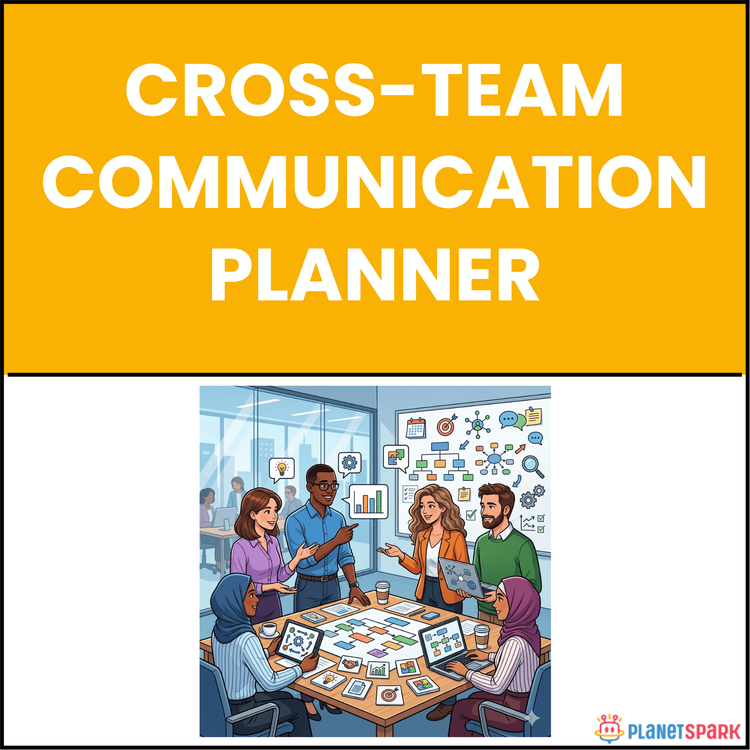
Cross-Team Communication Planner
Cross-Team Communication Planner on How to Align Teams, Improve Collaboration, and Deliver Results Faster at Work
If you’ve ever worked on a project where everything seemed “almost aligned” but still fell apart—you’ve experienced the reality of cross-team communication breakdown.
Deadlines slip. Priorities clash. Decisions get reversed. And despite everyone being competent, the outcome suffers.
The problem isn’t capability. It’s coordination.
Most professionals are trained to communicate within their own teams—but struggle when they need to collaborate across functions like Marketing, Engineering, Finance, or Operations. Different teams operate with different goals, languages, and expectations. Without a structured approach, communication becomes reactive, fragmented, and inefficient.
That’s exactly why the “Cross-Team Communication Planner” exists. It’s a practical, repeatable system designed to help you plan, execute, and improve cross-functional communication—so work moves forward smoothly instead of getting stuck in confusion.
Who Is This Resource For?
This resource is especially valuable if you are:
- A working professional with 0–15 years of experience
- A manager or team lead coordinating across multiple teams
- A consultant working with cross-functional stakeholders
- A product, project, or operations professional handling dependencies
- Someone frustrated with misalignment, delays, or repeated follow-ups
- A professional who wants to build influence beyond their own team
If your work depends on other teams—and it usually does—this planner is built for you.
What Does This Resource Contain?
This is not a generic communication guide. It’s a structured, working planner you can apply before, during, and after every cross-team interaction.
Inside the resource, you’ll find:
- A clear breakdown of why cross-team communication fails—and how to fix it
- A stakeholder mapping framework to understand goals, preferences, and expectations
- A Stakeholder Profile Worksheet to align communication with each team’s context
- The PACE framework (Purpose, Audience, Channel, Execution) to plan communication effectively
- A three-phase interaction model: Before, During, and After
- Detailed checklists for each phase to ensure clarity and follow-through
- Practical templates for common scenarios:
- Project kickoff communication
- Weekly cross-team updates
- Escalation and alignment requests
- Feedback requests across teams
- A real-world case study showing how structured communication improves outcomes
- Six common cross-team communication mistakes—and how to avoid them
- A self-assessment tool to evaluate your communication effectiveness
- A quarterly improvement framework to build long-term capability
Everything is designed to be reused, adapted, and applied in real work situations.
Summary of the Resource
The “Cross-Team Communication Planner” is a practical playbook that helps you move from reactive communication to intentional collaboration.
It gives you a clear system to understand stakeholders, plan interactions, communicate with structure, and follow through effectively—so you can reduce friction, improve alignment, and deliver results consistently.
If you want to stop chasing updates and start driving outcomes, this resource provides the framework to do it.
How Will This Resource Be Useful?
This planner helps you shift from confusion to clarity in cross-team work.
You’ll gain:
- Clear understanding of stakeholder priorities and expectations
- Structured communication that reduces back-and-forth and delays
- Stronger alignment across teams with different goals and languages
- Increased confidence in cross-functional interactions
- Better follow-through and accountability on shared work
- Improved professional credibility and trust across teams
Most importantly, it helps you become someone who connects work across teams—not someone who gets blocked by it.
How Should You Use This Resource?
To get the best results, use this planner as an active working tool—not just a one-time read.
Start by mapping your stakeholders using the Stakeholder Profile Worksheet. Understand what each team cares about before initiating communication.
Next, apply the PACE framework before every important interaction. Define your purpose, identify your audience, choose the right channel, and structure your message clearly.
During interactions, use the Before–During–After checklists to stay focused, aligned, and outcome-driven.
After each interaction, send written summaries, confirm action items, and reflect on what worked and what didn’t.
Use the templates to save time and ensure consistency across communication scenarios.
Finally, revisit the self-assessment every quarter to track improvement and build long-term communication capability.
This resource becomes more powerful the more consistently you use it.
Action Steps
After accessing this resource, take these steps immediately:
1. Identify one upcoming cross-team interaction
2. Complete the Stakeholder Profile for the teams involved
3. Define your communication purpose using the PACE framework
4. Choose the right communication channel intentionally
5. Use a relevant template (kickoff, update, or escalation)
6. Capture and confirm decisions with written follow-up
7. Reflect on the interaction and note one improvement
Even one well-planned interaction can significantly improve alignment and outcomes.
Cross-team communication is not just a soft skill—it’s a career-defining capability.
The professionals who grow fastest are not just experts in their function—they are the ones who can align teams, reduce friction, and move work forward across boundaries.
This planner gives you the system to do exactly that—consistently, confidently, and effectively.
Book your free session today!