
CV Template for Academic Collaborations

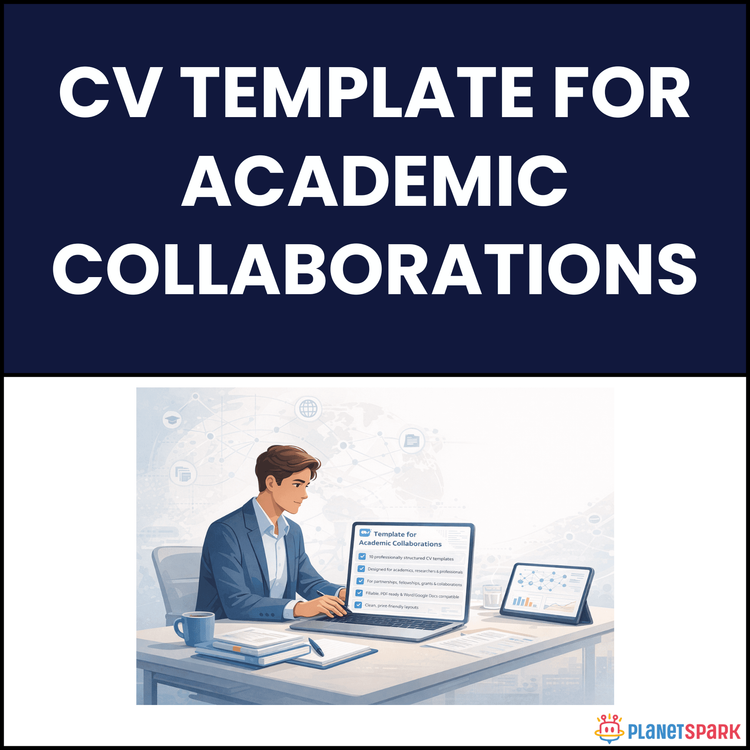
CV Template for Academic Collaborations
CV Template for Academic Collaborations: 10 Professional CV Formats to Win Research Roles, Grants & Academic Partnerships
If you’ve ever applied for a research collaboration, fellowship, or academic role and heard nothing back, you’re not alone.
Many highly qualified professionals miss out—not because they lack expertise, but because their CV fails to communicate their value in the format academic institutions expect. Review committees often scan hundreds of applications, and a poorly structured CV can get rejected within seconds.
That’s exactly where the CV Template for Academic Collaborations resource comes in. Designed by career strategists and aligned with global academic standards, this template pack helps you present your experience with clarity, authority, and credibility.
Who Is This Resource For?
This resource is ideal for professionals who want to position themselves for academic opportunities but aren’t sure how to structure their CV effectively.
You will benefit the most if you are:
- Researchers and postgraduates applying for academic collaborations or joint research
- Corporate professionals transitioning into academia or consulting roles
- Consultants and freelancers looking to partner with institutions
- Managers and domain experts exploring academic engagements
- Early-career professionals entering the research ecosystem
Whether you're applying for grants, fellowships, teaching roles, or institutional partnerships, this resource helps you present your profile strategically.
What Does This Resource Contain?
This template pack is more than just a set of CV designs—it’s a structured toolkit for academic positioning.
Here’s what you’ll find inside:
- 10 professionally designed CV templates tailored to different academic scenarios
- Fillable placeholder structures to guide what to write in each section
- Clean, print-friendly layouts that align with academic expectations
- Formats compatible with PDF, Word, and Google Docs
Each template is built for a specific use case, including:
- Academic research collaborations
- Industry-to-academia transitions
- Grant and fellowship applications
- Visiting faculty and adjunct roles
- Interdisciplinary research profiles
- Publication-heavy academic careers
- Early-career researchers
- Consultant-researcher positioning
- International collaborations
- Project-based academic roles
This level of specificity ensures that you’re not using a generic CV—but one tailored to your exact goal.
Summary of the Resource
In simple terms, this resource gives you ready-to-use, scenario-specific CV frameworks that help you:
- Present your academic and professional experience clearly
- Align your CV with institutional expectations
- Save hours of structuring and formatting time
- Increase your chances of getting shortlisted
Instead of starting from scratch, you begin with a proven structure that reflects what academic reviewers actually look for.
How Will This Resource Be Useful?
The biggest advantage of this resource is clarity.
Academic CVs are very different from corporate resumes. They require:
- Structured research narratives
- Clear presentation of publications, grants, and methodologies
- Alignment with institutional priorities
This resource helps you:
- Avoid common mistakes like generic CVs or poor formatting
- Translate industry experience into academic language
- Highlight research impact, not just responsibilities
- Present your work in a way that resonates with review committees
It also reduces decision fatigue. Instead of wondering “What should I include?”, you simply follow a structured format designed for your specific goal.
How Should You Use This Resource?
To get the most value, don’t just download and fill it randomly. Follow a structured approach:
Step 1: Choose the Right Template
Select the template that matches your career stage and objective (research, teaching, consulting, etc.).
Step 2: Replace Placeholders Thoughtfully
Each section includes guidance—use it to frame your experience strategically, not just descriptively.
Step 3: Tailor for Each Opportunity
Customize your CV for every application. Mirror the language of the institution or funding body.
Step 4: Refine and Format
Ensure consistency in headings, spacing, and font. Keep it clean and easy to scan.
Step 5: Export and Submit
Always save your final CV as a PDF with a professional file name.
The resource also highlights important best practices, such as maintaining readability, limiting length, and avoiding irrelevant information, ensuring your CV meets academic standards.
Action Steps
If you want to start using this resource effectively, here’s what you should do next:
1. Identify your immediate goal (research role, fellowship, teaching, etc.)
2. Select the most relevant template from the pack
3. Gather your academic and professional information in advance
4. Fill in the template with a focus on clarity and outcomes
5. Customize it for the specific opportunity you’re applying to
6. Review for alignment, formatting, and completeness
7. Export and submit with confidence
Your CV is not just a document—it’s your academic identity on paper.
The difference between getting shortlisted and getting ignored often comes down to how clearly and strategically you present your work. With the right structure, your experience becomes more compelling, your achievements more visible, and your intent more aligned with what institutions are looking for.
Use this resource not as a shortcut, but as a foundation. Build on it, refine it, and make it uniquely yours.