
CV Template Highlighting Multi-Institution Research Collaborations

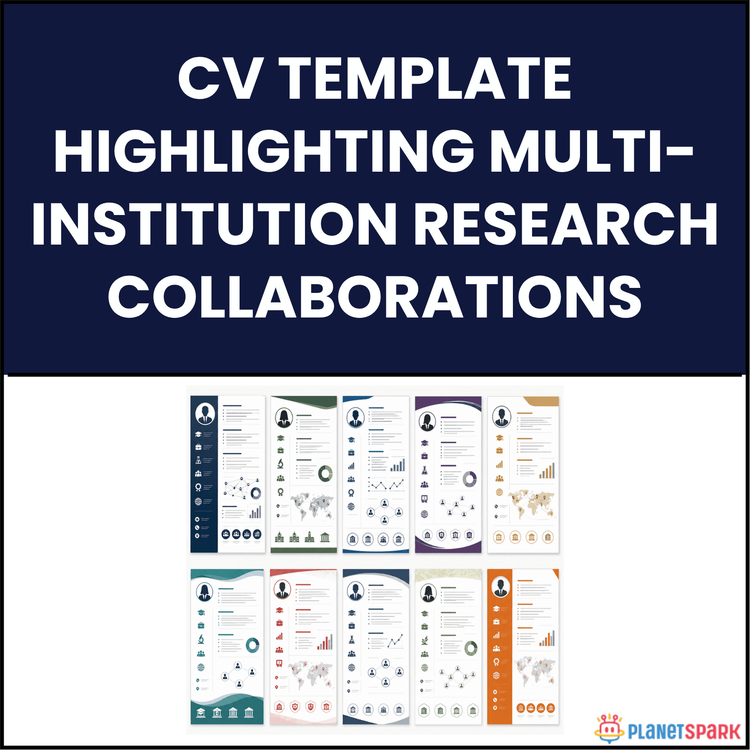
CV Template Highlighting Multi-Institution Research Collaborations
CV Template Highlighting Multi-Institution Research Collaborations: A Practical Guide to Showcasing Your Network, Partnerships, and Research Impact
If you’ve ever worked across multiple institutions—but struggled to reflect that clearly in your CV—you’re not alone.
Most CV templates are built for traditional, single-employer careers. They assume linear progression, one organisation at a time, and clearly defined roles.
But research careers don’t work that way.
You collaborate across universities, funding bodies, labs, NGOs, and international networks—often simultaneously. And when your CV doesn’t capture that properly, it underrepresents your credibility, reach, and impact.
That’s exactly why the “CV Template Highlighting Multi-Institution Research Collaborations” exists. It’s designed to help you present your collaborations, partnerships, and cross-institutional work in a structured, high-impact way.
Instead of hiding your network in scattered bullet points, you make it your strength.
Who Is This Resource For?
This resource is especially valuable if you are:
- A working professional with 0–15 years of experience in research or academia
- A PhD scholar or postdoctoral fellow working across institutions
- A researcher involved in collaborative or multi-partner projects
- A principal investigator or co-investigator managing grants
- A consultant or advisor working with multiple organisations
- A professional applying for fellowships, grants, or international roles
If your work spans institutions, partnerships, and collaborations, this resource is built for you.
What Does This Resource Contain?
This is not a generic CV pack—it is a specialised system designed for collaboration-heavy research careers.
Inside the resource, you’ll find:
- A pack of 10 recruiter-ready CV templates tailored for multi-institution research scenarios (page 1)
- A clear explanation of why traditional CVs fail to represent collaborative work effectively (page 2)
- A structured usage system: choose → replace → convert → customise → finalise (page 3)
- A comprehensive template directory aligned to real-world research contexts (page 4)
These include:
- Academic Research Collaboration CV for faculty and senior research roles
- Postdoctoral Fellowship CV for early academic careers
- Cross-Institutional Grant Applicant CV for funding and PI roles
- Industry R&D Transition CV for moving into private-sector research
- Early-Career Researcher CV for students and junior professionals
- Visiting Researcher / Fellow CV for short-term international roles
- Independent Research Consultant CV for advisory and freelance work
- Clinical & Biomedical Research CV for dual-affiliation professionals
- Publications-Forward Academic CV for output-driven roles
- International Research Network CV for global collaborations and consortia
Each template is designed to highlight:
- Partner institutions and collaboration scope
- Your specific role in joint research
- Outputs such as publications, datasets, or policy impact
- Grants, funding, and institutional affiliations
For example:
- The Academic Collaboration CV (page 5) includes a dedicated section for multi-institution partnerships with roles, outputs, and timelines
- The Grant Applicant CV (page 6) highlights funding bodies, partner institutions, and project scale
- The International Network CV (page 9) focuses on global consortia, cross-country collaborations, and international impact
As shown in the template directory (page 4), each format aligns with a specific research scenario—ensuring your CV always fits the context.
Summary of the Resource
“CV Template Highlighting Multi-Institution Research Collaborations” is a structured toolkit that helps you present your collaborative research profile with clarity and authority.
It helps you:
- Showcase cross-institutional work effectively
- Highlight partnerships, networks, and collaborations
- Structure complex research careers into clear formats
- Align your CV with academic, funding, and industry expectations
- Build professional, high-impact CVs quickly
If your strength lies in collaboration and network-driven research, this resource gives you the structure to present it clearly.
How Will This Resource Be Useful?
This resource helps you move from fragmented presentation to strategic positioning.
You’ll gain:
- Clear visibility of your collaborations and institutional reach
- Stronger credibility with hiring committees and funding bodies
- Better positioning for grants, fellowships, and international roles
- Faster CV creation without starting from scratch
- Improved clarity and professional presentation
- Higher chances of shortlisting and selection
As explained on page 2, most CVs fail because they hide collaboration under generic sections—this template pack brings it to the forefront.
Most importantly, it helps you demonstrate the scale and impact of your work.
How Should You Use This Resource?
To get the best results, follow a structured approach:
Start with alignment:
- Identify your target role (faculty, grant, fellowship, consulting, etc.)
- Choose the template that matches your scenario (page 4)
Then customise your content:
- Replace placeholders with your actual details
- Clearly name partner institutions and your role
Strengthen your positioning:
- Highlight collaboration outcomes (publications, policy impact, datasets)
- Show scale (countries, institutions, funding value)
Optimise your structure:
- Prioritise collaboration sections
- Keep formatting consistent and clean
Finally:
- Convert to Word or Google Docs if needed
- Tailor your CV for each application
As recommended in the usage guide (page 3), always name partner institutions explicitly—this significantly increases credibility and transparency.
Action Steps
After accessing this resource, take these steps immediately:
1. Identify your most significant collaborative research project
2. Select the most relevant template from the pack
3. List all partner institutions and your role clearly
4. Add 2–3 key outputs (publications, reports, policy impact)
5. Tailor your CV for one specific application
6. Save both a master CV and customised versions
Small changes in structure can significantly improve how your work is perceived.
Your CV is not just a record of your work—it’s a reflection of your network, influence, and impact.
The most successful research professionals are not just independent contributors—they are collaborators who create value across institutions.
When your CV reflects that clearly, you don’t just show experience—you demonstrate scale.
Book your free session today!