
Decoding Status Signals and Hierarchy Behavior in Workplace Settings

Decoding Status Signals and Hierarchy Behavior in Workplace Settings
Reading Power Dynamics at Work: How Professionals Build Influence, Credibility, and Career Visibility
You can be highly competent, hardworking, and consistently deliver results—yet still watch others get noticed faster, invited into strategic conversations, or trusted with bigger opportunities.
If you've ever walked into a meeting and felt like invisible rules were shaping who got heard, who got ignored, and who seemed to naturally command respect, you're not imagining it.
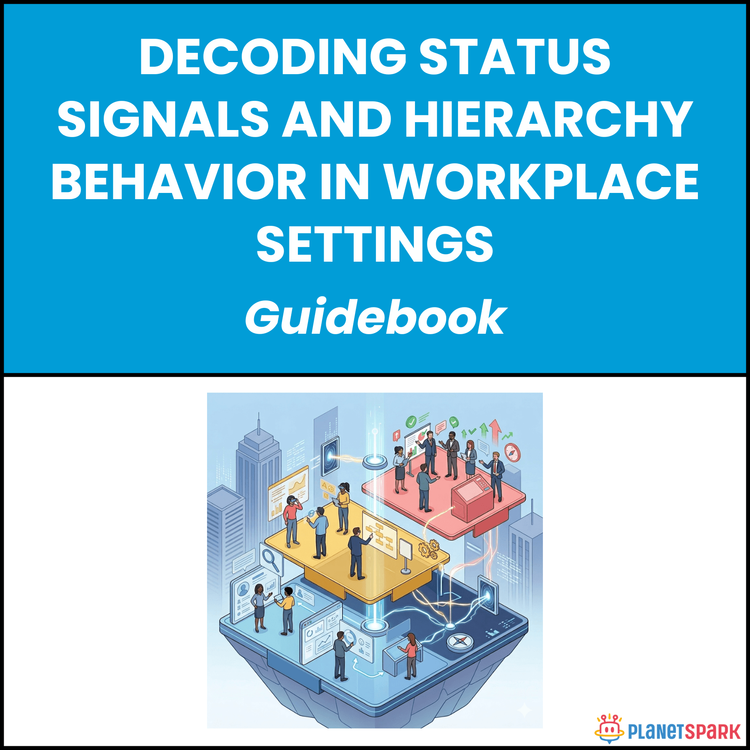
Every workplace operates on two systems at the same time: the official one everyone can see, and the invisible one that quietly influences careers, opportunities, credibility, and leadership perception.
PlanetSpark’s “Decoding Status Signals and Hierarchy Behaviour in Workplace Settings” is designed to help working professionals understand these invisible workplace dynamics, read status signals in real time, communicate with authority, and build influence without playing manipulative politics. This practical guide gives you frameworks, observation tools, self-assessments, and action plans to help you navigate hierarchy with clarity and confidence.
Who Is This Resource For?
This resource is built for professionals who want to become more visible, influential, and strategically effective in workplace environments.
It is especially useful for:
- Early-career professionals trying to build credibility faster
- Career switchers adapting to new workplace cultures
- Consultants entering client environments with no existing internal influence
- Managers who want stronger executive presence
- Mid-career professionals preparing for leadership roles
- Job seekers preparing for interviews, stakeholder conversations, and organizational transitions
Whether you work in consulting, corporate functions, technology, finance, operations, sales, or management, this guide helps you understand how influence actually works beyond job titles.
What Does This Resource Contain?
This resource combines workplace psychology, behavioral frameworks, observation tools, worksheets, and implementation plans that can be applied immediately.
Inside the guide, you’ll discover:
The Architecture of Workplace Hierarchy
The guide explains one of the most important career concepts:
Every organization has two parallel systems:
Formal Hierarchy
- Job titles
- Reporting structures
- Organizational authority
Informal Hierarchy
- Perceived expertise
- Relationship capital
- Access to information
- Influence over decisions
The resource teaches you how to identify both systems and understand where real power often lives.
The Three Layers of Status Intelligence
You’ll learn how workplace status operates across three layers:
Positional Status
Authority based on role, seniority, and title
Relational Status
Influence built through trust, sponsorship, and internal relationships
Performative Status
Real-time authority signals created through communication, body language, meeting behavior, and social presence
This framework helps professionals understand why some people gain influence faster—even without formal authority.
Real-Time Status Observation Tools
The guide provides a powerful status observation checklist that helps you identify:
- Who gets interrupted
- Who controls meeting agendas
- Whose ideas are repeated and credited
- Who gets included in critical conversations
- Who shifts the room’s energy when they enter
These observation skills help you read workplace dynamics with far greater accuracy.
Non-Verbal Authority Training
The resource teaches you how your body language affects perceived authority.
You’ll learn how to identify:
Expansive signals:
- Direct eye contact
- Calm pauses
- Open posture
- Deliberate movement
Contractive signals:
- Nervous laughter
- Apologizing before speaking
- Shrinking physical presence
- Speaking too quickly
The included Non-Verbal Habit Audit helps you identify your own authority leaks.
Verbal Status Communication Frameworks
You’ll learn practical language upgrades such as:
Instead of:
“I might be wrong, but…”
Say:
“Based on the data, here’s what I see.”
Instead of:
“Does that make sense?”
Say:
“What questions do you have?”
These communication shifts significantly improve executive presence.
Meeting Presence Framework
The guide provides a practical Before-During-After framework for meetings, helping you:
- Prepare stronger contributions
- Speak with better timing
- Position your ideas strategically
- Increase visibility with senior stakeholders
Career Transition and New Environment Mapping Tools
If you are joining a new company or changing careers, the guide includes a 30-60-90 day hierarchy mapping framework to help you:
- Identify key decision-makers
- Understand informal power networks
- Build relationships intentionally
- Avoid credibility-damaging mistakes
90-Day Status Equity Builder
One of the most valuable sections is the structured 90-day action plan covering:
- Positional visibility
- Relationship building
- Meeting presence
- Reputation management
This helps professionals systematically build influence over time.
Summary of the Resource
At its core, this resource helps professionals answer one critical question:
Why do some people get trusted, promoted, heard, and remembered faster than others—even when technical skill levels are similar?
The answer often lies in status intelligence.
This guide teaches you how to:
Read power structures
Interpret hidden workplace signals
Communicate with authority
Build strategic relationships
Protect and grow your professional reputation
Navigate political environments with maturity
It transforms workplace ambiguity into a practical system you can understand and apply.
How Will This Resource Be Useful?
By applying this guide, you can:
Increase your visibility in meetings
Communicate with more executive presence
Build stronger credibility with senior leaders
Avoid common status-damaging behaviors
Adapt faster in new organizations
Build stronger sponsorship relationships
Gain influence without formal authority
Navigate workplace politics with intelligence and integrity
In short, this resource helps ensure your competence gets noticed—not overlooked.
How Should You Use This Resource?
To get maximum value, follow this sequence:
Step 1: Understand your current position
Complete the status intelligence self-assessment.
Step 2: Observe before acting
Use the status observation checklist in meetings and stakeholder interactions.
Step 3: Identify authority leaks
Complete the non-verbal habit audit.
Step 4: Upgrade communication habits
Practice verbal authority swaps in daily conversations.
Step 5: Build strategic relationships
Map key stakeholders and invest in high-value internal relationships.
Step 6: Follow the 90-day action plan
Use the Status Equity Builder to create measurable growth.
This resource works best when used as an active workbook—not passive reading material.
Action Steps
After accessing this resource, do these five things immediately:
1. Complete the Status Intelligence Self-Assessment.
2. Use the Status Observation Checklist in your next three meetings.
3. Identify your top two communication habits that reduce authority.
4. Map your formal and informal hierarchy at work.
5. Start your 90-day status-building plan.
Awareness creates leverage.
Action creates transformation.
The workplace is rarely as simple as job descriptions, reporting lines, or performance reviews.
Influence often lives in the invisible layers—relationships, presence, timing, credibility, and perception.
The professionals who learn to read those signals early don’t just survive complex workplaces.
They lead them.
PlanetSpark’s “Decoding Status Signals and Hierarchy Behaviour in Workplace Settings” gives you the practical frameworks, tools, and behavioral strategies to build influence with authenticity, confidence, and strategic intelligence.
Because in today’s workplace, it’s not enough to do great work.
You also need to make sure the right people recognize it.