
Designing a Distraction-Free Work Environment

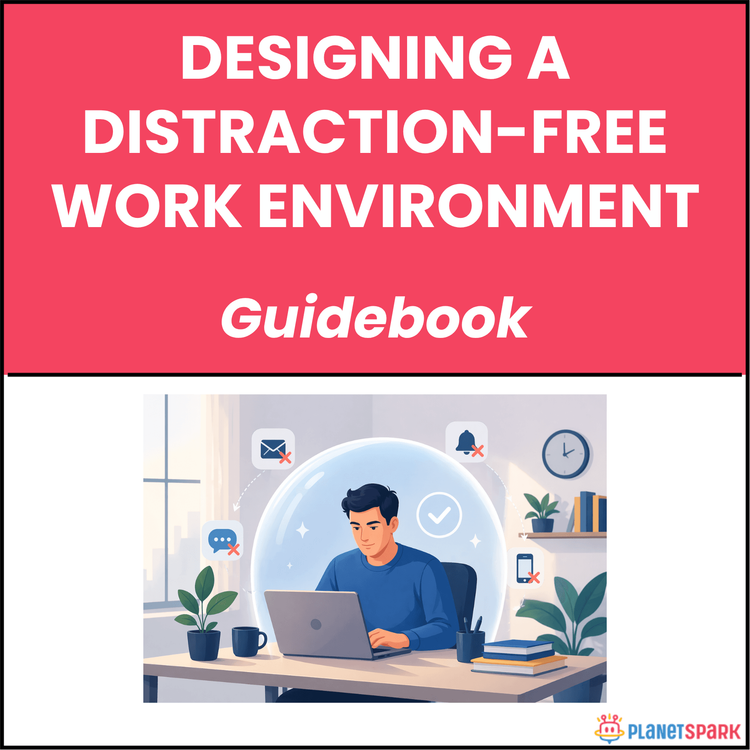
Designing a Distraction-Free Work Environment
Creating a Focused Workspace That Minimizes Distractions and Boosts Productivity
If you often end your workday feeling busy—but not productive—you’re not alone. Many professionals spend hours responding to messages, attending meetings, and juggling tasks, only to realize that their most important work remains untouched.
The problem isn’t a lack of discipline or capability. It’s your environment.
Constant notifications, interruptions, and unstructured schedules silently drain your focus. Over time, this leads to lower-quality work, missed opportunities, and growing frustration.
That’s exactly why the resource “Designing a Distraction-Free Work Environment” exists. It’s built for working professionals who want to stop reacting all day—and start doing meaningful, high-impact work consistently.
This guide gives you a structured, practical system to redesign your physical, digital, and mental workspace so it actively supports deep focus—not disrupts it.
Who Is This Resource For?
This resource is especially valuable if you are:
- A working professional struggling to stay focused during the day
- Someone who feels constantly busy but not truly productive
- A manager, consultant, or knowledge worker juggling multiple priorities
- A professional working in high-interruption environments (open offices, remote teams, Slack-heavy workflows)
- Someone trying to improve the quality of their work—not just the quantity
- A career-driven individual who wants to create time for deep, meaningful work
If you feel like your attention is constantly pulled in different directions, this guide is built for you.
What Does This Resource Contain?
This is not generic productivity advice. It’s a structured, action-oriented system designed for immediate application.
Inside the resource, you’ll find:
- A clear breakdown of how distraction impacts your performance, energy, and career growth
- A “Distraction Audit” framework to identify where your time and attention actually go
- A classification system for distractions: external, internal, and structural
- A complete physical workspace optimization checklist (desk setup, lighting, noise, device management)
- A digital environment reset system (notifications, email control, messaging boundaries)
- A time-blocking framework to structure deep work into your schedule
- A weekly planning template to design your ideal focus week
- Psychological tools like pre-work rituals, single-tasking, and shutdown routines
- Real-world case study showing transformation from reactive work to focused execution
- Common mistakes professionals make—and how to avoid them
- A self-assessment tool to measure your current focus environment
- A 30-day action plan to systematically redesign your work environment
- A quick reference guide for daily focus habits
Everything is designed to help you move from awareness to execution.
Summary of the Resource
“Designing a Distraction-Free Work Environment” is a practical, step-by-step guide that helps professionals take control of their focus.
It shows you how to identify distractions, redesign your workspace, structure your time, and build habits that support deep, high-quality work.
Instead of relying on willpower, this resource helps you create systems that make focus easier, more consistent, and more sustainable.
How Will This Resource Be Useful?
This guide helps you move from constant distraction to intentional productivity.
You’ll gain:
- Clarity on where your time is actually going
- Better control over your attention and workday
- Higher-quality output through uninterrupted deep work
- Reduced cognitive fatigue and burnout
- Stronger professional performance and visibility
- More time for meaningful, high-impact tasks
Most importantly, it helps you stop reacting to work—and start driving it.
How Should You Use This Resource?
To get the most value, approach this guide in phases:
First, read the entire guide once to understand the full framework. This gives you context on how all the pieces fit together.
Next, start with the Distraction Audit. Spend 2–3 days tracking your distractions honestly. This step is critical—it ensures you solve the right problems.
Then, move into implementation:
- Redesign your physical workspace using the checklist
- Configure your digital environment (notifications, email, tools)
- Introduce time-blocking into your weekly schedule
- Apply psychological tools like pre-work and shutdown rituals
Finally, use the self-assessment and 30-day plan to track progress and refine your system.
This is not a one-time read. It’s a repeatable system you can revisit as your work evolves.
Action Steps
After accessing this resource, take these steps immediately:
1. Block 2–3 hours this week for focused implementation
2. Complete the Distraction Audit over 2–3 working days
3. Identify your top 3 sources of distraction
4. Redesign your workspace using the physical environment checklist
5. Disable all non-essential notifications across devices
6. Schedule at least one 90-minute deep work block in your calendar
7. Introduce a simple pre-work and shutdown ritual
8. Review your progress at the end of the week
Small changes here can dramatically improve how you work every day.
The ability to focus deeply is becoming one of the most valuable skills in today’s professional world. Not because it’s rare—but because so few environments support it.
This resource helps you change that.
When you intentionally design your environment, you make focus easier, work more meaningful, and performance more consistent. Over time, this compounds—not just in productivity, but in confidence, growth, and career outcomes.
Start small. Stay consistent. The results will follow.
Book your free session today!