
Designing a Personal Career Experimentation Framework Before Switching

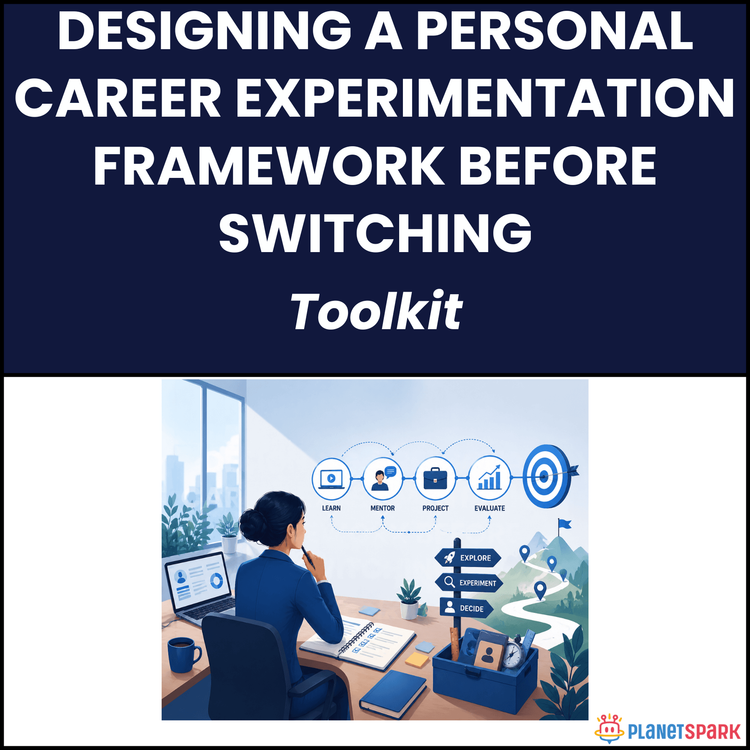
Designing a Personal Career Experimentation Framework Before Switching
Leverage the Career Experimentation Framework for Successful Career Transitions
Navigating a career transition can feel like leaping into the unknown. Whether you're exploring a new role, industry, or even considering a complete career pivot, the fear of the unknown can hold you back. How do you avoid making a move you'll regret? The answer lies in experimentation. Instead of taking a risky leap based solely on instinct or surface-level research, you can test, validate, and measure your career transition choices systematically — ensuring you make well-informed, confident decisions. This is exactly what the Personal Career Experimentation Framework Before Switching offers. A structured, low-risk method that gives you the clarity to pivot without burning bridges or betting everything on a gut feeling.
Who Is This Resource For?
This toolkit is designed for time-poor, outcome-oriented professionals who are eager to transition into a new role or career path without the luxury of taking extended time off. It’s particularly useful for:
- Mid-career professionals considering a pivot into a new field
- Managers thinking about switching to consulting or advisory roles
- Analysts and specialists exploring product management, leadership, or technical roles
- Job seekers who want to validate their career direction before making any irreversible decisions
What Does This Resource Contain?
This resource offers a practical five-phase framework for career transitions:
1. Audit: Understand your current situation by assessing your skills, energy levels, and values.
2. Hypothesize: Form specific, testable career hypotheses about potential directions you want to explore.
3. Design Experiments: Create small, low-risk career experiments to test your hypotheses and gather real data.
4. Run & Measure: Execute your experiments, measure their success, and reflect on the outcomes.
5. Decide: Use the gathered evidence to make a confident decision on whether to switch careers, pivot, or adjust your approach.
Each phase includes templates, reflection prompts, and action steps to guide you through the process, ensuring you experiment intelligently while maintaining your current role.
Summary of the Resource:
In short, this toolkit helps professionals who want to test their career hypotheses through real-world experiments. By systematically exploring potential career moves, you gather evidence that reduces uncertainty, helping you make well-informed decisions. The framework is designed to be iterative — you aren’t expected to feel certain at any point but are encouraged to stay curious, gather data, and refine your hypothesis based on the evidence you collect. This process ensures that when you do make a transition, it’s a confident, data-backed decision.
How Will This Resource Be Useful?
The Career Experimentation Framework isn’t just about making a switch; it’s about doing so with clarity and confidence. Here’s how it will help:
- Avoid costly mistakes: Instead of making a leap based on gut feeling, you’ll have real-world evidence to back up your decisions.
- Reduce uncertainty: With every experiment, you gain more clarity about what aligns with your skills, values, and energy.
- Save time: By experimenting while keeping your current role, you avoid the risk of switching too early and regretting it later.
- Boost confidence: Each successful experiment adds a layer of validation, empowering you to make your final decision with assurance.
How Should You Use This Resource?
The framework is designed to be flexible and adaptable to your career goals. Here’s how to approach it:
1. Read-through: Begin by understanding the entire framework so you know what to expect from each phase.
2. Reference: As you move through the toolkit, return to each module as needed.
3. Worksheet Mode: Complete the action templates as you progress through each phase to track your insights and experiments.
4. Share: Use the toolkit with a mentor, coach, or accountability partner to get feedback and keep yourself on track.
Action Steps:
1. Start with the Audit phase: Spend 30 minutes filling out the first worksheet to assess your current reality, skills, and energy levels.
2. Generate hypotheses: Based on your self-assessment, write down a few testable career hypotheses.
3. Design your first experiment: Pick a low-risk experiment that aligns with one of your hypotheses (e.g., writing a blog, conducting a mock interview, or taking a short freelance project).
4. Measure and reflect: Run your experiment and keep an experiment log to track the outcomes and energy levels.
5. Refine: After each experiment, loop back to adjust your hypothesis or design a new experiment based on what you’ve learned.
By taking these steps, you can systematically test your career direction, make more informed decisions, and confidently navigate your career transition.