
Designing a Personal Identity Experimentation Plan for Career Growth
Free DownloadPDF

Belsiah Darling RVisit Profile
I’m an online public speaking coach who builds speakers from the ground up. Combining the technical discipline of a Master’s in Structural Engineering with a year of dedicated tutoring experience, I help my students transform 'information' into 'influence.' Let’s engineer your voice to be clear, stable, and powerful.
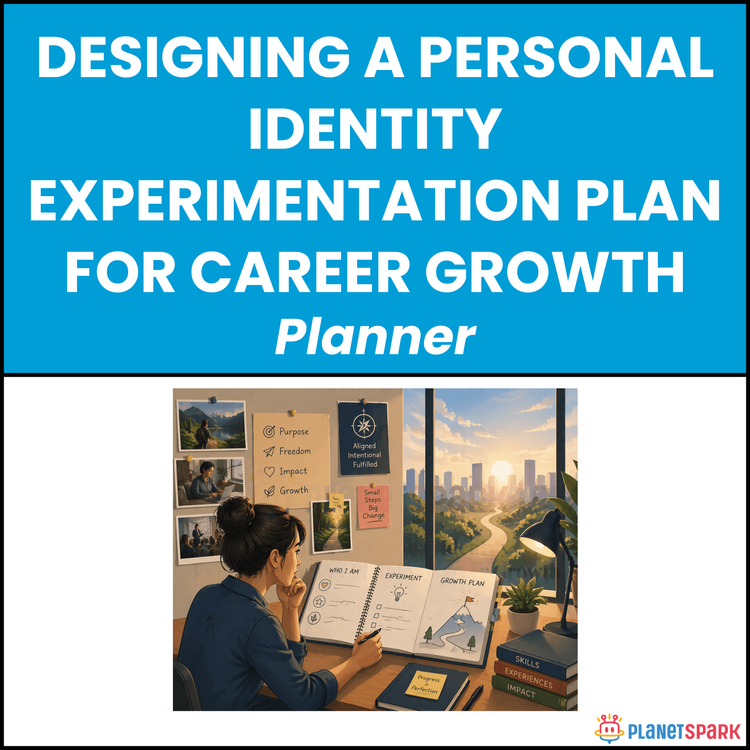
Designing a Personal Identity Experimentation Plan for Career Growth
Free DownloadPDF
Belsiah Darling RVisit Profile
I’m an online public speaking coach who builds speakers from the ground up. Combining the technical discipline of a Master’s in Structural Engineering with a year of dedicated tutoring experience, I help my students transform 'information' into 'influence.' Let’s engineer your voice to be clear, stable, and powerful.
Crafting a Personal Identity Experimentation Plan for Career Advancement
Most working professionals don’t lack skills—they lack clarity.
You may be doing well on paper, delivering results, and progressing steadily. Yet, there’s a persistent feeling: “Is this really what I want to be doing?” Every attempt to figure it out leads to more overthinking, not answers.
The real issue isn’t confusion—it’s lack of experimentation.
That’s exactly why the resource “Designing a Personal Identity Experimentation Plan for Career Growth” exists. Instead of forcing you to decide your future through introspection alone, it gives you a structured, real-world system to test different career directions—safely, practically, and without quitting your current job.
Who Is This Resource For?
This planner is especially useful if you are:
- A working professional (0–15 years of experience) feeling unclear about your next move
- Someone considering a career switch but unsure where to start
- A professional stuck between multiple interests or paths
- A mid-career individual seeking more meaningful or aligned work
- Someone who tends to overthink career decisions instead of taking action
- A professional who wants to build a strong, authentic career identity
If you want clarity through action—not endless thinking—this resource is built for you.
What Does This Resource Contain?
This is not a traditional career planning guide. It’s a structured experimentation system designed to help you test and refine your professional identity in real-world scenarios.
Inside the resource, you’ll find:
- A powerful introduction to the concept of career identity and why it matters
- The PIE Model (Probe, Iterate, Embed) to guide your experimentation journey
- A detailed Identity Audit Worksheet to map your current roles, strengths, values, and narrative
- A Hypothesis Builder Template to define possible career identities worth testing
- A structured Experiment Design Card to plan safe, time-bound career experiments
- A Weekly Signal Log to track energy, feedback, and narrative clarity
- Reflection questions to help you interpret results without bias
- A clear Pivot / Persist / Park decision-making framework
- A real-world case study showing how a professional transitioned careers using this model
- A list of common mistakes and practical fixes
- A “Next 48 Hours” action plan to help you get started immediately
Everything is designed for action—not passive reading.
Summary of the Resource
“Designing a Personal Identity Experimentation Plan for Career Growth” is a practical planner that helps you move from career confusion to clarity by running structured, low-risk experiments.
Instead of guessing your next move, you test it.
Instead of overthinking, you act.
By following the PIE Model, you build a repeatable system to explore new roles, validate career directions, and confidently shape your professional identity over time.
How Will This Resource Be Useful?
This resource helps you replace uncertainty with evidence.
You’ll gain:
- Clarity on what actually fits you—not just what sounds good in theory
- A structured way to explore career transitions without major risk
- Confidence in making career decisions based on real-world signals
- A stronger, more coherent professional narrative
- Reduced overthinking and faster decision-making
- The ability to test multiple paths before committing to one
Most importantly, it helps you take control of your career direction—rather than reacting to circumstances.
How Should You Use This Resource?
To get the best results, follow the structured three-phase approach:
Start with Phase 1 (Probe). Complete the Identity Audit Worksheet honestly and quickly. Focus on capturing raw insights about your current roles, strengths, values, and narrative.
Move to defining your Identity Hypotheses. Write 2–3 possible career identities you want to explore. These should be testable, not perfect.
Next, enter Phase 2 (Iterate). Design small, low-risk experiments using the Experiment Design Card. These could include side projects, content creation, networking, or temporary role exposure.
Run these experiments in real-world settings. Track your weekly signals—energy, feedback, and narrative clarity—using the Signal Log.
Reflect regularly. Use the structured reflection questions to interpret what’s working and what isn’t.
Finally, move to Phase 3 (Embed). Based on your experiment results, decide whether to Persist, Pivot, or Park a direction. Then take the next concrete step—whether that’s repositioning your profile, pursuing a role, or designing the next experiment.
Revisit this cycle regularly. Career identity is not a one-time decision—it’s an evolving process.
Action Steps
After accessing this resource, take these steps immediately:
1. Block 2 focused hours to complete your Identity Audit
2. Write 2–3 clear identity hypotheses using the provided template
3. Design your first experiment (keep it small and time-bound)
4. Set a start date within the next 7 days
5. Schedule a 10-minute weekly “Signal Log” review
6. Commit to running the experiment for at least 3 weeks before evaluating
7. Decide your next move: Persist, Pivot, or Park
Small experiments today can prevent years of misalignment.
Your career identity isn’t something you “figure out” once—it’s something you build through action. The professionals who create meaningful, fulfilling careers aren’t the ones who plan the most—they’re the ones who experiment, learn, and adapt continuously.
This resource gives you the structure to do exactly that—without unnecessary risk, confusion, or delay.