
Designing Personal Systems for Managing Global Work Schedules

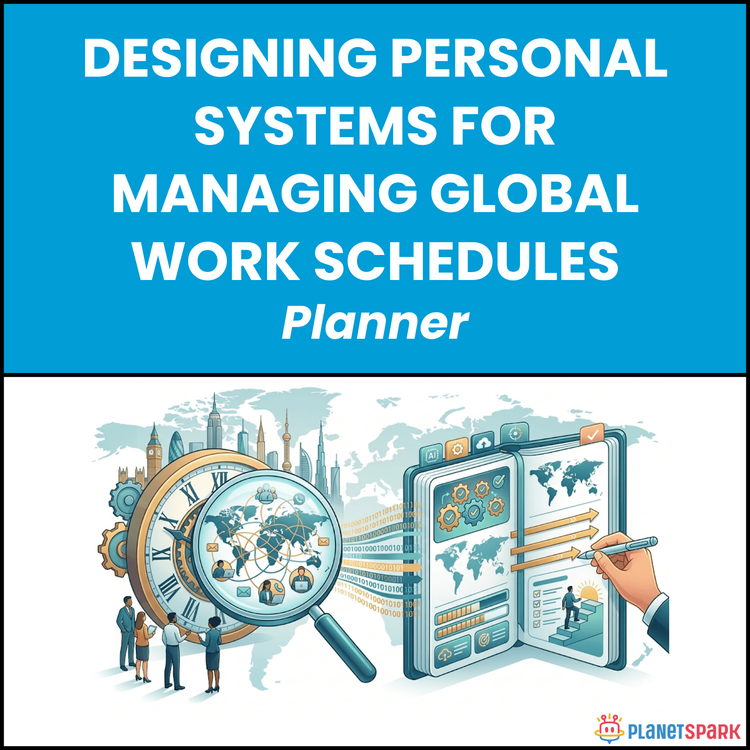
Designing Personal Systems for Managing Global Work Schedules
Creating Work Productivity Systems for International Collaboration
If you work across countries, clients, or distributed teams, chances are your calendar does not look anything like a traditional workday anymore. Your mornings may begin with Europe, your afternoons may be packed with Asia-Pacific collaboration, and your evenings may quietly disappear into calls with North America.
At first, it feels manageable. Then the cracks start showing. Interrupted focus. Delayed strategic work. Family dinners missed. Constant notifications. And the uncomfortable feeling that you are always working—but rarely working at your best.
This is exactly why PlanetSpark created “Designing Personal Systems for Managing Global Work Schedules.”
This planner helps working professionals stop reacting to global calendars and start designing systems that protect focus, energy, relationships, and long-term performance. It is built for professionals who want more than productivity hacks—they want a repeatable system that actually works in the real world.
Who Is This Resource For?
This planner is especially valuable for:
- Working professionals with 0–15 years of experience managing global responsibilities
- Career switchers entering international or remote-first roles
- Consultants balancing clients across multiple countries
- Managers leading distributed teams across time zones
- Team leads responsible for cross-border collaboration
- Professionals struggling with meeting overload, time-zone fatigue, or blurred work-life boundaries
If your workday stretches across geographies, cultures, or client schedules, this resource is built for you.
What Does This Resource Contain?
This is not a generic productivity guide. It is a structured planner designed to help you build a personal operating system for global work.
Inside this resource, you will find:
- A complete Time Landscape Audit to identify recurring global obligations, energy drains, and hidden schedule patterns
- Reflection exercises to identify where your personal time is currently being compromised
- A Core Hours Architecture framework that helps you design three critical work zones:
- Deep Work Zone
- Global Collaboration Window
- Protected Personal Boundary
- Communication protocol templates for managing different communication scenarios across teams
- Response-time frameworks for Slack, email, urgent escalations, document reviews, and async updates
- A Weekly Rhythm Template that helps you structure your week intentionally instead of reacting to calendar chaos
- A real-world case study showing how a consultant redesigned her schedule for better performance and work-life integration
- A 30-day implementation checklist for turning ideas into sustainable habits
The visual worksheets on pages 2, 3, and 4 make this highly practical. Instead of simply reading concepts, you actively map your schedule, redesign your week, and implement boundaries that fit your role.
Summary of the Resource
“Designing Personal Systems for Managing Global Work Schedules” is a practical planner that helps professionals build a repeatable system for working effectively across time zones.
It helps you audit your current schedule, identify hidden friction points, create structured focus blocks, establish communication norms, and design a weekly operating rhythm that protects both productivity and wellbeing.
Instead of relying on willpower, this guide helps you build systems.
How Will This Resource Be Useful?
This resource delivers immediate and practical benefits.
By applying it consistently, you can:
- Reduce meeting fatigue and calendar overload
- Protect high-energy hours for strategic work
- Improve communication expectations across global teams
- Create healthier work-life boundaries
- Reduce after-hours interruptions
- Improve consistency, focus, and output quality
- Build sustainable habits that prevent long-term burnout
The before-and-after case study on page 4 makes this painfully obvious: when systems improve, performance improves too.
How Should You Use This Resource?
To get the best results, use this planner in five practical phases:
Step 1: Audit your current reality
Complete the Time Landscape Audit. List every recurring meeting, async obligation, and global collaboration responsibility.
Step 2: Identify your energy patterns
Review your highest-energy-cost commitments and identify which meetings or commitments create the most fatigue.
Step 3: Design your core hours
Use the Core Hours framework to define:
- When you do your best thinking
- When you collaborate with global teams
- When you are fully offline
Step 4: Build communication protocols
Define how your team should reach you, expected response times, and what qualifies as urgent.
Step 5: Create your weekly rhythm
Map your ideal weekly schedule and assign purpose to every major time block.
Then review and refine every 30 days as projects and priorities evolve.
Action Steps
After accessing this planner, do these five things immediately:
1. Export your calendar from the last four weeks
2. Complete the Time Landscape Audit worksheet
3. Identify your top three energy-draining commitments
4. Block your first 90-minute Deep Work Zone for tomorrow
5. Share one communication boundary with your team this week
Systems do not fail because they are complicated. They fail because they are never implemented.
The professionals who perform best in global roles are rarely the ones working the longest hours. They are the ones who build systems that protect their attention, their energy, and their ability to think clearly under pressure.
This planner gives you the tools to design that system—one meeting, one boundary, and one calendar block at a time.