
Developing A Personal Infrastructure That Supports Long-Term Goals

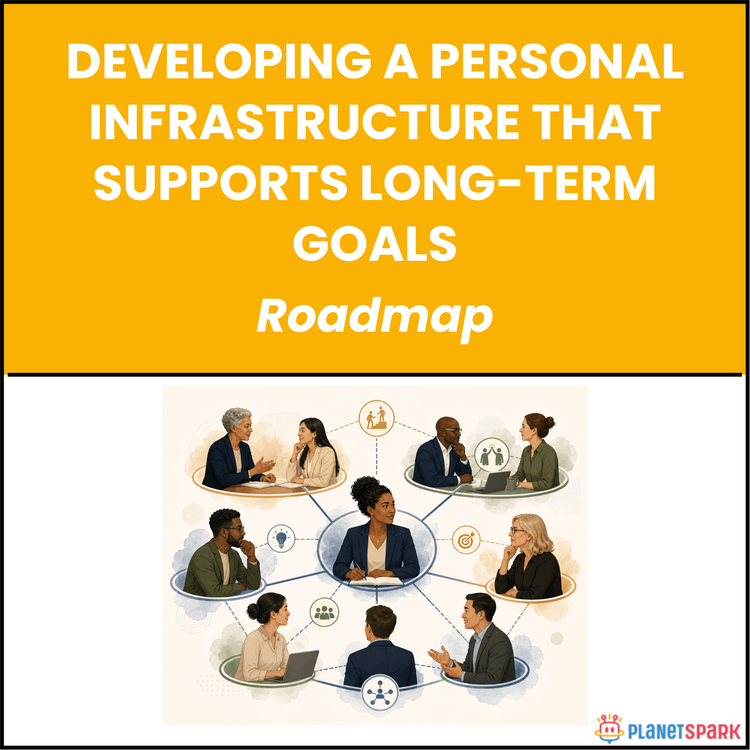
Developing A Personal Infrastructure That Supports Long-Term Goals
How to Build a Personal Infrastructure for Long-Term Goals: A Practical Guide for Working Professionals
You set a goal. You feel motivated. You even make a plan.
And then life happens.
Deadlines pile up, meetings take over, energy drops—and slowly, your long-term goals fade into the background. Not because you don’t care. But because your daily environment isn’t designed to support them.
This is where most professionals get it wrong.
The problem isn’t discipline. It’s infrastructure.
The resource “Developing a Personal Infrastructure That Supports Long-Term Goals” is built to solve exactly this—helping you design a system where your daily actions naturally align with your biggest ambitions.
Who Is This Resource For?
This resource is ideal for:
- Working professionals (0–15 years experience) aiming for long-term growth
- Career switchers trying to transition into new roles or industries
- Managers and consultants balancing multiple responsibilities
- Individuals who feel stuck despite having clear goals
- People who start strong but struggle with consistency over time
- Anyone looking to build sustainable, structured progress
If your goals keep losing to your daily workload, this resource is built for you.
What Does This Resource Contain?
This is a structured roadmap—not just advice. It walks you through building a complete personal system across five key layers.
Here’s what’s inside:
1. Clarity Framework (Step 1)
Helps you define:
- Your 3-year vision
- Annual milestones
- Key constraints holding you back
Includes a guided “Clarity Map” worksheet
2. Environment Design System (Step 2)
Covers both:
- Physical environment (workspace, visual cues, friction reduction)
- Digital environment (tools, notifications, focus systems)
Includes a checklist to audit your setup
3. Routine Architecture (Step 3)
A simple, practical daily structure:
- Morning anchor (intentional start)
- Deep work block (focused progress)
- Evening reflection (capture + planning)
Also includes a weekly rhythm for consistent progress
4. Relationship Infrastructure (Step 4)
Helps you build a support system with:
- Mentors
- Accountability partners
- Challengers
- Connectors
Includes a relationship audit framework
5. Review Cadence System (Step 5)
A structured review cycle:
- Daily (10 min)
- Weekly (30 min)
- Monthly (60 min)
- Quarterly (2 hours)
Designed to catch “drift” before it derails your goals
6. Real-World Case Study
Demonstrates how one professional built a working system and achieved measurable progress
7. Self-Evaluation Scorecard
Helps you assess your current infrastructure and identify top priorities
8. Common Mistakes & Fixes
Highlights predictable errors like over-engineering, skipping reviews, and relying on motivation
9. 72-Hour Action Plan
A step-by-step quick-start plan to begin implementation immediately
Summary of the Resource
This resource helps you shift from goal-setting to system-building.
Instead of asking:
“How do I stay motivated?”
You start asking:
“What structure will make progress automatic?”
In simple terms, it helps you:
- Align your daily actions with long-term goals
- Reduce reliance on motivation and willpower
- Build systems that work even on low-energy days
- Create consistency without increasing workload
How Will This Resource Be Useful?
The biggest value of this resource is that it changes how you approach growth.
You stop relying on motivation
Your environment and routines do the heavy lifting
You reduce decision fatigue
Clear systems remove constant “what should I do?” thinking
You build sustainable progress
Small, consistent actions compound over time
You catch drift early
Regular reviews prevent long-term derailment
You leverage relationships
Accountability and mentorship accelerate your progress
As highlighted in the resource, your environment and systems are constantly shaping your outcomes—whether you design them intentionally or not.
How Should You Use This Resource?
To get real results, treat this as a working system—not just a read.
Step 1: Read for Full Context
Understand the complete roadmap before taking action
Step 2: Complete the Clarity Map
Define your 3-year vision and key milestones
Step 3: Upgrade Your Environment
Make small, immediate changes to your workspace and digital setup
Step 4: Build a Simple Routine
Start with:
- One morning anchor
- One deep work block
- One weekly review
Step 5: Add Relationship Support
Identify at least one accountability partner or mentor
Step 6: Implement Review Cadence
Schedule daily, weekly, and monthly check-ins
Step 7: Iterate Over Time
Refine your system every 30–90 days
The resource itself is designed to be revisited regularly—especially as your goals evolve.
Action Steps
Start with these practical steps:
1. Write your 3-year goal in one clear paragraph
2. Identify your top 2 current constraints
3. Create a dedicated workspace for focused work
4. Block a 60-minute deep work session tomorrow
5. Choose one daily habit that supports your goal
6. Reach out to one accountability partner
7. Schedule a weekly 30-minute review
8. Complete the self-evaluation to identify gaps
Focus on building one layer at a time. Don’t try to implement everything at once.
Most professionals don’t fail because their goals are unrealistic. They fail because their systems are missing.
When you build the right infrastructure—clarity, environment, routine, relationships, and review—progress stops being something you chase and starts becoming something that happens.
This resource gives you that blueprint.
Apply it consistently, and you won’t just set better goals—you’ll actually achieve them.
Book your free session today!