
Diagnosing Energy Drains in Your Work Environment

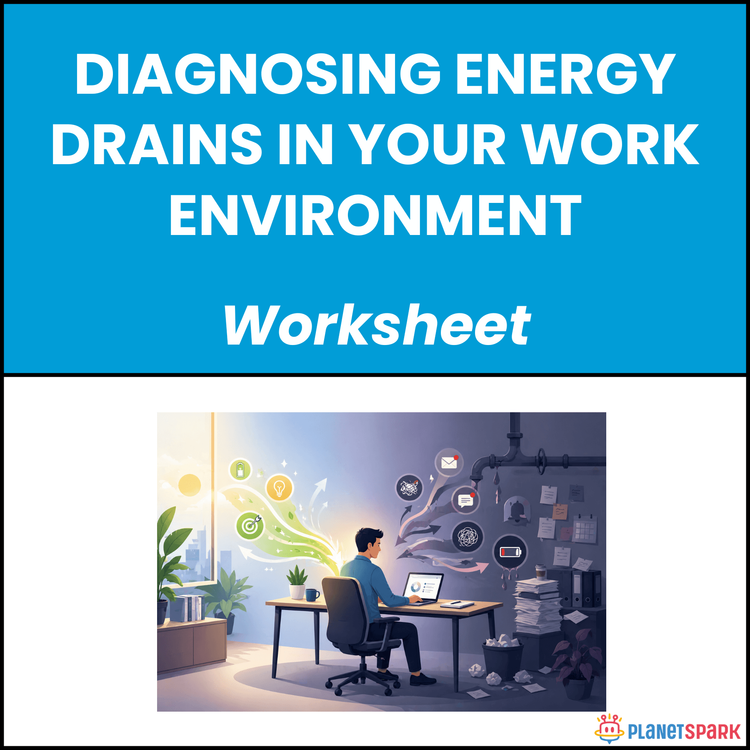
Diagnosing Energy Drains in Your Work Environment
A Guide to Diagnosing Energy Drains in the Workplace: A Practical Worksheet to Reclaim Focus, Reduce Burnout, and Improve Performance
If you often end your workday feeling exhausted—but can’t clearly explain why—you’re not alone. Many professionals assume they need better time management, more discipline, or new productivity tools. But the real issue is often hidden in plain sight: your work environment is quietly draining your energy.
These energy drains are subtle. They show up as unproductive meetings, constant interruptions, unclear expectations, difficult interactions, or a lingering sense of misalignment. Over time, they compound—impacting your focus, performance, and overall well-being.
That’s exactly why the resource “Diagnosing Energy Drains in Your Work Environment” exists. It gives you a structured, practical way to identify where your energy is leaking—and more importantly, how to fix it.
Who Is This Resource For?
This worksheet is especially valuable if you are:
- A working professional feeling consistently drained or unfocused
- Someone experiencing burnout without a clear cause
- A manager or individual contributor navigating complex work environments
- A professional struggling with unclear priorities or constant interruptions
- A mid-career employee feeling stuck, disengaged, or misaligned
- Anyone looking to improve performance without simply “working harder”
If you’re outcome-driven but low on energy, this resource helps you fix the system—not just push yourself harder.
What Does This Resource Contain?
This is not generic advice about work-life balance. It’s a structured diagnostic system designed for real-world application.
Inside the resource, you’ll find:
- A clear explanation of why work environments—not just workload—drain energy
- The Energy Drain Diagnostic Model covering five key domains:
- Relational (people and interactions)
- Environmental (workspace and tools)
- Structural (processes and systems)
- Cognitive (mental load and focus)
- Emotional (alignment and meaning)
- A full Energy Audit worksheet to identify and score your biggest drains
- Deep-dive reflection prompts to uncover root causes—not just symptoms
- The Control Spectrum framework to separate what you can control vs. influence vs. accept
- A structured Energy Drain Map to consolidate insights
- A step-by-step Energy Recovery Plan template for action
- A practical toolkit with domain-specific tactics you can apply immediately
- A real-world case study to show how professionals apply the framework
- Common diagnostic mistakes to avoid
- A 30-day review system to ensure follow-through and measurable improvement
- A self-assessment to identify personal habits contributing to energy loss
- A quick-reference guide for daily use
Everything is designed to move you from awareness to action—quickly and effectively.
Summary of the Resource
“Diagnosing Energy Drains in Your Work Environment” is a practical, structured worksheet that helps professionals identify the hidden factors draining their energy at work.
Instead of treating symptoms like fatigue or lack of motivation, it guides you to diagnose root causes across five critical domains—and take targeted, realistic action.
If you only invest 45–60 minutes, you’ll walk away with clarity, a prioritised action plan, and a system you can revisit as your work environment evolves.
How Will This Resource Be Useful?
This resource helps you move from confusion to control.
You’ll gain:
- Clear visibility into what is actually draining your energy
- The ability to distinguish between symptoms and root causes
- A structured way to prioritise high-impact changes
- Better decision-making about what to fix, influence, or accept
- Increased focus, reduced burnout, and improved day-to-day performance
- Stronger awareness of how your environment affects your productivity and well-being
Most importantly, it helps you stop blaming yourself for systemic issues—and start making smarter, targeted changes.
How Should You Use This Resource?
To get the best results, follow a simple phased approach:
First, read through the entire worksheet to understand the five-domain framework and how energy drains are interconnected.
Next, complete the Energy Audit honestly based on your last 30 days. Avoid overthinking—your first instinct is usually accurate.
Then, focus only on your highest-scoring drains. Use the deep-dive questions to understand what’s actually causing them.
After that, apply the Control Spectrum to classify each drain. This step is critical—it ensures you don’t waste effort on things outside your control.
Once you have clarity, build your Energy Recovery Plan. Focus on your top 2–3 drains instead of trying to fix everything at once.
Finally, use the action toolkit to implement small, practical changes—and schedule your 30-day review to track progress and refine your approach.
You can revisit this resource whenever:
- Your energy levels drop without a clear reason
- Your role, team, or manager changes
- You feel stuck, overwhelmed, or disengaged
- You want to proactively improve your work environment
Action Steps
After accessing this resource, take these steps immediately:
1. Block 45–60 minutes of uninterrupted time
2. Complete the Energy Audit based on your last 30 days
3. Identify your top 3 highest energy drains
4. Use the deep-dive prompts to understand root causes
5. Classify each drain using the Control Spectrum
6. Create a simple action plan for your top 2–3 drains
7. Schedule a 30-day review in your calendar
Small, targeted actions here can dramatically improve how you feel and perform at work.
Most professionals try to fix low energy by pushing harder. But sustainable performance doesn’t come from more effort—it comes from a better environment.
When you can clearly see what’s draining you, you gain the power to change it. And when you change the system, everything else—focus, motivation, performance—starts to improve naturally.
Use this resource not just as a one-time exercise, but as an ongoing tool to manage your energy, your environment, and your career more intentionally.
Book your free session today!