
Diagnosing Financial Overconfidence and Its Risks

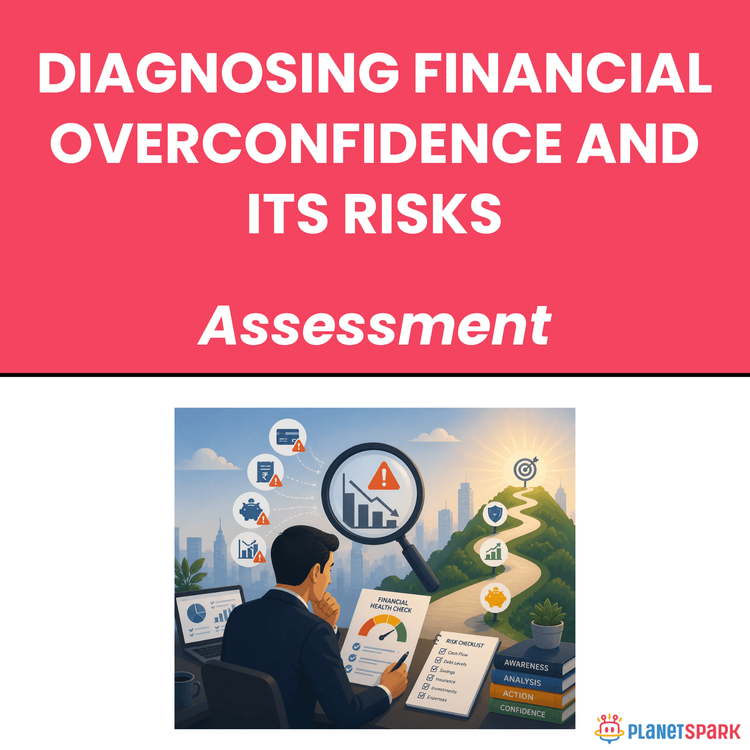
Diagnosing Financial Overconfidence and Its Risks
Identifying Financial Overconfidence: A Practical Guide to Making Smarter, More Calibrated Money Decisions
You’ve built your career on confidence—making decisions, taking risks, and trusting your judgment. But what if that same confidence is quietly working against you when it comes to money?
Most professionals don’t lose money because they lack knowledge. They lose it because they feel too certain in situations that are inherently uncertain. They overestimate returns, underestimate risks, and delay course correction—all while believing they’re making rational choices.
This is the hidden problem of financial overconfidence—and it’s exactly what the resource “Diagnosing Financial Overconfidence & Its Risks” is designed to address.
Instead of giving you more financial advice, this guide helps you understand how you think about money—so your decisions become sharper, more grounded, and significantly more effective.
Who Is This Resource For?
This resource is especially valuable if you are:
- A working professional (0–15 years experience) managing your own finances
- A career switcher navigating income uncertainty or major transitions
- A consultant or freelancer handling irregular cash flow
- A mid-career manager making higher-stakes financial decisions
- Someone confident in their judgment but unsure about financial outcomes
- A professional who wants to avoid costly mistakes—not just fix them later
If you’re outcome-driven and want better financial decisions—not just more information—this guide is built for you.
What Does This Resource Contain?
This is not a theory-heavy finance guide. It’s a structured self-assessment and decision toolkit.
Inside the resource, you’ll find:
- A clear explanation of financial overconfidence and why it affects high-performers
- The three types of overconfidence:
- Overprecision (overestimating accuracy)
- Overplacement (believing you outperform others)
- Overestimation (inflating control over outcomes)
- A detailed diagnostic checklist to assess your susceptibility
- A scoring system to identify your risk level (low, moderate, high)
- Real-world financial risks tied to overconfidence:
- Portfolio concentration
- Emergency fund gaps
- Delayed decision correction
- Under-insurance
- Career-stage mapping to identify context-specific blind spots
- A Financial Confidence Calibration Worksheet to align expectations with reality
- An Overconfidence Red Flags checklist for real-time decision filtering
- Deep reflection questions to build financial self-awareness
- A real-world case study illustrating how overconfidence plays out in practice
- The CALM framework (Calibrate, Assess, Locate, Map) for better decisions
- A self-evaluation scorecard to track progress over time
- A quick-reference decision card for everyday use
Everything is designed to help you think better before you act—not after.
Summary of the Resource
“Diagnosing Financial Overconfidence & Its Risks” is a practical assessment guide that helps professionals identify hidden biases in their financial thinking and replace them with structured, calibrated decision-making.
It shifts your approach from confident guessing to informed judgment—ensuring your financial decisions are based on reality, not assumptions.
If you invest even a few focused hours, this resource can significantly improve how you evaluate risk, plan finances, and make long-term decisions.
How Will This Resource Be Useful?
This guide helps you move from blind confidence to informed clarity.
You’ll gain:
- Awareness of how overconfidence shows up in your financial decisions
- The ability to identify and correct hidden decision-making biases
- Stronger risk assessment and scenario planning skills
- Better financial resilience during uncertainty (career shifts, income changes)
- Faster course correction when decisions don’t go as planned
- Improved long-term financial outcomes through better judgment
Most importantly, it helps you avoid the most dangerous financial mistake: being wrong without realizing it.
How Should You Use This Resource?
To get the most value, approach this resource as a self-diagnostic system.
Start by reading through the guide to understand the concept of financial overconfidence and how it applies to your career stage.
Next, complete the diagnostic checklist honestly. Focus on patterns, not isolated incidents.
Once you have your score, identify whether your risk level is low, moderate, or high—and treat it as a baseline, not a judgment.
Then, use the Financial Confidence Calibration Worksheet with a real recent decision. This step is critical—it helps you connect theory with your actual behavior.
Apply the CALM framework to any upcoming financial decision. This ensures your choices are structured, not impulsive.
Finally, complete the self-evaluation scorecard and revisit it after 90 days to track improvement.
You can reuse this resource whenever you:
- Make a major investment or financial commitment
- Plan a career transition or income change
- Feel unusually confident about a financial decision
- Want to improve your long-term financial judgment
Action Steps
After accessing this resource, take these steps immediately:
1. Block 45–60 minutes of uninterrupted time
2. Complete the overconfidence diagnostic checklist honestly
3. Calculate your risk level and identify key patterns
4. Apply the calibration worksheet to one recent financial decision
5. Use the CALM framework on your next major decision
6. Identify your lowest-scoring area in the self-evaluation sheet
7. Set one specific action to improve it within the next 30 days
Consistent small improvements here can prevent large financial mistakes later.
Confidence is essential for growth—but uncalibrated confidence is a hidden risk. This resource doesn’t reduce your ambition; it sharpens your judgment.
When your confidence is aligned with reality, your decisions become stronger, your risks become clearer, and your outcomes become more predictable.
Use this guide to build not just financial knowledge, but financial self-awareness—the foundation of every smart decision you’ll make.
Book your free session today!