
Diagnosing Trust Deficits Within Teams

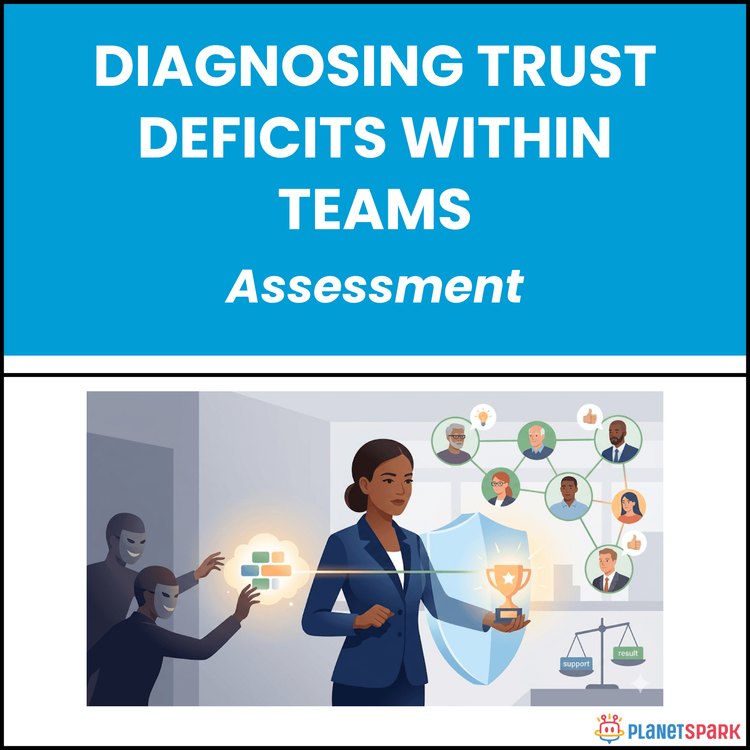
Diagnosing Trust Deficits Within Teams
Why High-Performing Teams Quietly Lose Trust Before Performance Dropss
A team can have top talent, strong processes, and ambitious goals—and still underperform because of one invisible problem: low trust.
When trust begins to erode inside a team, the signs are rarely dramatic at first. Meetings become quieter. Collaboration becomes more transactional. Feedback gets filtered. Accountability becomes selective. Before anyone openly talks about it, performance, morale, and culture often start paying the price.
Who Is This Resource For?
This resource is designed for professionals responsible for team performance, culture, and collaboration.
It is especially valuable for:
- Managers leading newly formed or inherited teams
- Consultants working with client-side teams during transformation projects
- Team leads navigating low engagement or hidden conflict
- Career switchers moving into leadership roles
- HR and people managers supporting team effectiveness
- Senior professionals trying to improve cross-functional collaboration
If you have ever sensed that "something feels off" in your team but struggled to identify exactly what is causing it, this guide is built for you.
What Does This Resource Contain?
This guide goes beyond theory and gives you a complete trust diagnosis system.
Inside, you will find:
1. The Team Trust Architecture Model
The resource introduces three core trust dimensions:
- Cognitive Trust: Confidence in competence and reliability
- Affective Trust: Confidence in care, intent, and psychological safety
- Systemic Trust: Confidence in fairness, processes, and leadership structures
This framework helps you identify exactly where trust is breaking down.
2. The Five Stages of Trust Deterioration
The guide maps how trust declines over time, from subtle discomfort to complete team collapse.
The stages include:
- Discomfort
- Tension
- Withdrawal
- Entrenchment
- Collapse
This helps leaders diagnose urgency accurately.
3. The Team Trust Audit
A structured self-assessment tool helps you score your team across all trust dimensions using evidence-based rating criteria.
4. Observable Trust Signals Framework
The resource teaches you how to identify behavioral signals across:
- Communication patterns
- Meeting behavior
- Accountability habits
- Energy and engagement indicators
5. Reflection Worksheets
The guide includes structured prompts such as:
- Incident archaeology
- Silence mapping
- Leadership mirror
- Structural scans
These help uncover hidden root causes.
6. Trust Diagnostic Framework
A practical root-cause model:
- Name the signal
- Trace the pattern
- Hypothesize the cause
- Test the hypothesis
This prevents surface-level interventions.
7. Conversation Toolkit
The resource provides one-on-one diagnostic conversation questions that uncover insights surveys often miss.
8. Action Planning Roadmap
A practical 48-hour, 30-day, and 90-day trust repair plan designed for measurable team improvement.
Summary of the Resource
If you are short on time, here is the essence of this guide:
How Will This Resource Be Useful?
Applying this resource can help you:
- Identify trust issues before they become performance problems
- Reduce hidden conflict and team politics
- Improve psychological safety in meetings
- Build stronger accountability systems
- Improve communication across functions
- Increase retention and team engagement
- Become a more credible and self-aware leader
In real-world terms, this means fewer misunderstandings, better collaboration, faster decisions, and stronger execution.
How Should You Use This Resource?
To get the maximum value, use it in phases.
Step 1: Start with the Trust Audit
Assess your current team honestly across cognitive, affective, and systemic trust.
Step 2: Observe Team Behaviors
Review recent meetings, communication patterns, and accountability behaviors using the trust signal framework.
Step 3: Complete Reflection Exercises
Use the worksheets to identify incidents, leadership blind spots, and structural issues.
Step 4: Conduct Diagnostic Conversations
Schedule private one-on-ones before moving into team-wide discussions.
Step 5: Identify Root Causes
Use the trust diagnostic framework to confirm what is really driving the issue.
Step 6: Build and Execute Your Action Plan
Start with one high-impact trust repair action within 48 hours.
Step 7: Reassess Progress
Re-run the trust audit at 30-day and 90-day intervals.
Action Steps
Start using this resource today by doing the following:
1. Think of one team where trust feels weaker than it should
2. Complete the Trust Audit using recent evidence, not assumptions
3. Identify one trust signal you have been ignoring
4. Schedule one private diagnostic conversation this week
5. Write down one leadership behavior you need to improve
6. Commit to one visible trust-building action within the next 48 hours
The strongest teams do not happen by accident. They are built by leaders who know how to spot hidden dysfunction early, ask better questions, and act with consistency.
This resource gives you a complete roadmap to do exactly that. If you want to build teams where people speak honestly, collaborate openly, and perform consistently under pressure, this guide deserves your attention and your action.
Trust is not just a culture issue. In modern workplaces, it is a performance advantage.