
Diagnosing When Your Skills are Losing Market Value

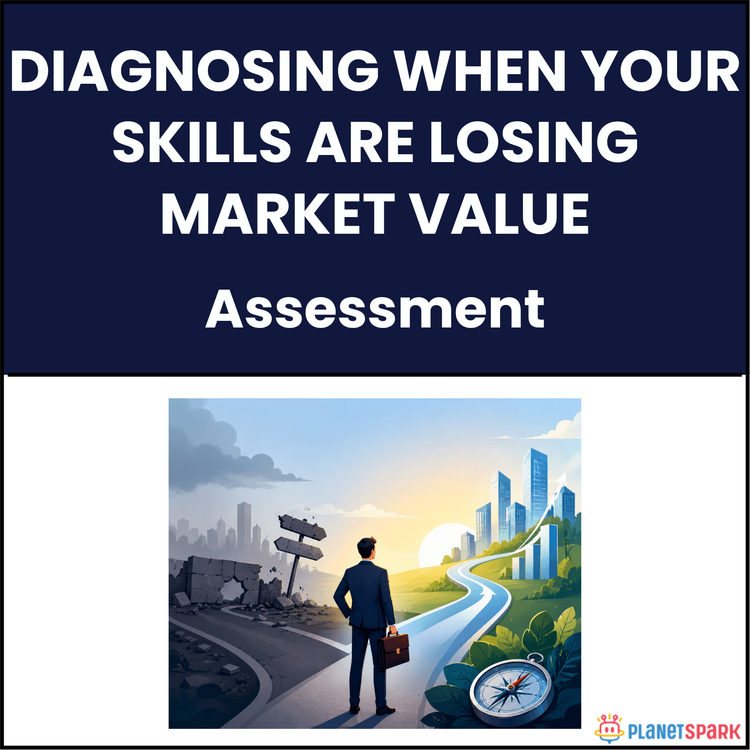
Diagnosing When Your Skills are Losing Market Value
Understanding When Your Skills Are Losing Competitive Value: A Practical Career Resilience Guide
Most professionals assume that working hard automatically keeps them professionally relevant. But the market does not reward effort alone. It rewards skills that are current, valuable, adaptable, and aligned with changing industry needs. This creates a dangerous situation for many working professionals. You may be performing well in your current role, receiving positive feedback, and staying busy every day — while your market value quietly declines in the background.
The problem is that skill obsolescence rarely announces itself dramatically. It happens gradually. One day you notice newer professionals using tools you do not understand. Job descriptions start listing unfamiliar platforms and methodologies. Promotions slow down. Salary growth plateaus. Strategic opportunities go to someone else.
By the time most professionals recognize the pattern, the gap has already widened.
That is exactly why the “Diagnosing When Your Skills Are Losing Market Value” guide was created.
This practical assessment guide helps professionals identify early warning signs before career stagnation becomes a serious problem. Instead of waiting for a job search crisis, the resource teaches readers how to proactively evaluate their skill relevance, identify emerging gaps, and build a structured skill-refresh roadmap.
Whether you are a career switcher, consultant, manager, or working professional trying to stay competitive in a rapidly evolving market, this resource gives you a clear framework to assess where you stand today — and what to do next.
Who Is This Resource For?
This resource is especially valuable for:
- Working professionals with 3–15 years of experience
- Mid-level professionals concerned about long-term relevance
- Career switchers evaluating whether their skills remain competitive
- Consultants and freelancers who depend on market demand for opportunities
- Managers responsible for staying strategically valuable
- Professionals feeling stuck despite strong performance
- Individuals worried about automation, AI, or changing industry expectations
It is particularly useful for professionals who:
- Feel their career growth has slowed down
- Notice job descriptions evolving faster than their skills
- Want to future-proof their careers
- Are unsure which skills to prioritize next
- Want objective frameworks instead of vague career advice
If you have ever wondered:
- “Are my skills still valuable in today’s market?”
- “Am I becoming outdated without realizing it?”
- “What should I learn next to stay competitive?”
- “How do I identify career risk before it becomes urgent?”
Then this guide is designed specifically for you.
What Does This Resource Contain?
The guide combines diagnostics, worksheets, reflection exercises, and strategic career frameworks to help professionals assess their current market relevance honestly and systematically.
1. Understanding Skill Obsolescence
The guide begins by explaining what skill obsolescence actually means.
It clarifies:
- The difference between competence and market relevance
- Why some skills lose value over time
- The difference between absolute and relative skill obsolescence
- Why professionals become vulnerable after the first few years of experience
This section helps readers understand why career stagnation often happens gradually rather than suddenly.
2. The 5 Warning Signs Your Skills Are Losing Value
One of the most valuable parts of the resource is the breakdown of five early warning signals professionals often ignore.
The guide explains indicators such as:
- Losing access to stretch assignments
- Seeing unfamiliar tools in job descriptions
- Salary stagnation despite strong performance
- Feeling threatened by junior talent
- Avoiding conversations around new technology or methodologies
Each warning sign is explained with practical examples and career implications, making it easier for readers to recognize patterns in their own professional lives.
3. The Skills Risk Matrix Framework
The resource introduces a practical diagnostic framework called the Skills Risk Matrix.
This tool helps readers evaluate their skills across two important dimensions:
- Market demand
- Personal proficiency
The matrix helps professionals identify whether their skills fall into:
- Strength Zones
- Watch Lists
- Declining Assets
- Priority Investment areas
This section transforms abstract career anxiety into a structured decision-making process.
4. Personal Skills Inventory Worksheet
The guide includes a detailed worksheet that helps readers:
- List their core professional skills
- Evaluate demand levels
- Assess proficiency honestly
- Categorize risk exposure
The worksheet encourages professionals to move beyond vague assumptions and analyze their capabilities strategically.
5. The Market Signal Audit
This practical audit framework helps readers validate their assumptions against real market data.
The guide walks readers through:
- Job board analysis
- LinkedIn profile comparisons
- Industry report reviews
- Peer benchmarking conversations
- Salary trend analysis
This section is especially valuable because it shifts career evaluation from internal perception to external market reality.
6. Skills Risk Scoring Framework
Readers learn how to classify skills into:
- Low-risk strengths
- Medium-risk watch areas
- High-risk priority investments
The guide also explains:
- What actions to take for each category
- How to prioritize learning investments
- How to avoid panic while still acting strategically
7. Real-World Career Case Study
The guide includes a highly relatable case study of a senior marketing manager whose traditional marketing expertise was gradually losing market relevance.
Readers see:
- How the diagnostic framework identified hidden risks
- How targeted skill upgrades created new opportunities
- How strategic upskilling improved career positioning
This practical example helps readers understand that they do not necessarily need a full career pivot — often they need a focused capability upgrade.
8. Common Mistakes Professionals Make
The guide highlights several career-development mistakes professionals frequently make, including:
- Confusing busyness with growth
- Collecting credentials without application
- Relying only on internal feedback
- Waiting until a job search to evaluate skills
The resource also provides practical corrective actions for each mistake.
9. Reflection Questions and Self-Assessment Exercises
The guide includes deep reflection prompts designed to help readers evaluate:
- Their current positioning
- Future career risks
- Avoided skill gaps
- Long-term competitiveness
These exercises help surface blind spots many professionals avoid confronting.
10. The 90-Day Skills Refresh Roadmap
The guide concludes with a structured roadmap that helps readers:
- Select one priority skill
- Build a realistic learning schedule
- Apply the skill in real work settings
- Create visible evidence of progress
This makes the resource highly practical and implementation-focused.
Summary of the Resource
“Diagnosing When Your Skills Are Losing Market Value” is a structured career assessment and upskilling guide designed to help professionals identify skill gaps before those gaps negatively impact career growth.
Instead of relying on assumptions, the guide helps readers:
- Diagnose skill relevance objectively
- Recognize early warning signs
- Evaluate external market signals
- Prioritize high-value learning investments
- Build a realistic skill-refresh strategy
The resource combines worksheets, frameworks, scoring systems, audits, and reflection exercises to create a practical career-maintenance system for modern professionals.
It is especially valuable because it helps readers think proactively rather than reactively about career development.
How Will This Resource Be Useful?
This guide addresses one of the biggest professional risks in today’s market: becoming outdated without realizing it.
After using this resource, readers can expect benefits such as:
Greater Career Awareness
The guide helps professionals understand how the market currently values their skills instead of relying purely on internal feedback.
Earlier Detection of Career Risk
The warning-sign frameworks help readers identify problems before they become urgent.
Smarter Upskilling Decisions
Instead of randomly taking courses or chasing trends, readers learn how to prioritize learning strategically.
Better Professional Positioning
The diagnostic frameworks help professionals strengthen their market relevance intentionally.
Improved Confidence During Career Transitions
Whether switching roles, industries, or companies, professionals gain clearer understanding of where they stand competitively.
Reduced Career Anxiety
Clarity reduces uncertainty. The guide transforms vague fear into actionable next steps.
Stronger Long-Term Career Resilience
Professionals who regularly evaluate and refresh their skills are better prepared for industry disruption, technological change, and evolving employer expectations.
How Should You Use This Resource?
This guide is designed to function both as a one-time assessment and an ongoing career maintenance system.
Step 1: Read the Guide Fully First
Start by reading the entire guide from beginning to end.
This creates context before moving into the worksheets and diagnostic exercises.
Step 2: Complete the Skills Inventory Honestly
List your core skills realistically and evaluate:
- Current market demand
- Your actual proficiency
- How recently you updated those skills
Avoid optimistic scoring. The value of the assessment depends on honesty.
Step 3: Conduct the Market Signal Audit
Use:
- Job boards
- LinkedIn comparisons
- Industry reports
- Salary benchmarks
- Peer conversations
This helps validate your assumptions against real external signals.
Step 4: Score Your Skills Using the Risk Framework
Categorize each skill into:
- Low Risk
- Medium Risk
- High Risk
This helps prioritize where to focus first.
Step 5: Select One Priority Skill
Do not attempt to fix every gap immediately.
Choose:
- One high-impact skill
- One realistic learning path
- One clear application opportunity
Focused action creates better long-term momentum.
Step 6: Build Your 90-Day Refresh Plan
Use the roadmap template to:
- Structure learning goals
- Apply new knowledge
- Create visible proof of capability
- Build professional confidence
Step 7: Revisit the Diagnostic Quarterly
The guide is designed for repeated use.
Markets evolve continuously, so readers should:
- Reassess skills every few months
- Update learning priorities regularly
- Monitor changing market signals consistently
Action Steps You Can Take Immediately
If you want to begin strengthening your market relevance today, start with these practical actions:
1. List your top 8–10 professional skills
2. Identify which skills feel increasingly commoditized
3. Review 10 job descriptions for roles above your current level
4. Highlight unfamiliar tools or methodologies
5. Conduct one honest peer benchmarking conversation
6. Choose one Priority Investment skill
7. Enroll in a structured learning path this week
8. Identify one real-world application for your new skill
9. Set a recurring quarterly career audit reminder
Career stagnation rarely happens overnight.
It happens gradually when professionals assume that past competence automatically guarantees future relevance.
The professionals who remain valuable over time are not necessarily the smartest or most experienced people in the room. They are the ones who consistently evaluate market signals, stay curious, and adapt intentionally before disruption forces them to.
This guide helps professionals develop that habit proactively.
Your career relevance is not something you secure once. It is something you maintain continuously through awareness, learning, and strategic action.
The earlier you diagnose gaps, the easier they are to close.
Book your free session today!