
Diagnosing Why Your Communication Isn’t Landing

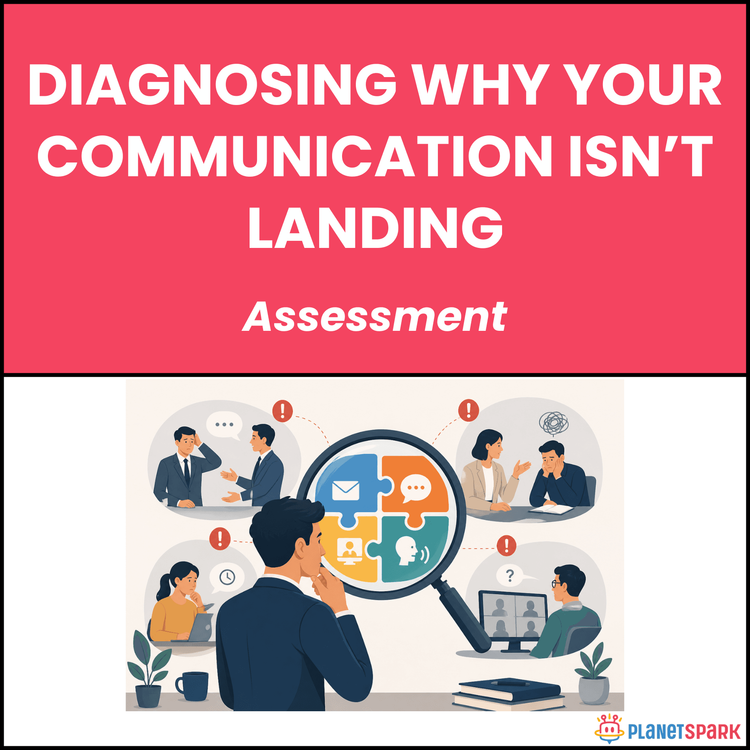
Diagnosing Why Your Communication Isn’t Landing
Why Your Communication Isn’t Landing at Work — And How to Fix It with 10 Practical Diagnostic Templates
You’ve done the work. You’ve written the email, prepared for the meeting, delivered the pitch, or answered the interview questions confidently.
And yet—no response. No decision. No traction.
This is one of the most frustrating experiences for working professionals today. The problem often isn’t your capability or effort. It’s that your communication isn’t landing the way you think it is.
Most professionals assume communication issues are personal—“I’m not confident enough” or “I’m not articulate.” But in reality, communication breakdowns are structural. They come down to unclear asks, wrong tone, missing context, or poor framing.
That’s exactly what this resource, is designed to solve.
It gives you a clear, structured way to diagnose where your communication is failing—and more importantly, how to fix it.
Who Is This Resource For?
This resource is ideal for professionals who regularly communicate in high-stakes environments and want better outcomes from their interactions.
It is especially useful for:
- Job seekers who aren’t getting interview callbacks or follow-ups
- Managers and team leads facing confusion or lack of execution from their teams
- Consultants and freelancers struggling to win client buy-in
- Mid-level professionals whose ideas aren’t gaining traction with leadership
- Career switchers adapting to new communication expectations
- Anyone whose emails, messages, or meetings consistently fail to drive action
If you’ve ever felt like “I said the right thing, but it didn’t work,” this resource is built for you.
What Does This Resource Contain?
This is not a generic communication guide. It’s a practical diagnostic toolkit built around real-world professional scenarios.
Inside, you’ll find:
10 Scenario-Based Diagnostic Templates
Each template focuses on a specific communication breakdown, including:
- Unanswered emails
- Silent or unproductive meetings
- Interview performance gaps
- Client pitch misalignment
- Upward communication failures
- Team delegation issues
- Tone mismatches
- Ineffective written feedback
- Networking messages that get ignored
- Cross-functional communication friction
Structured Diagnostic Sections
Each template includes:
- Context capture (what happened, when, and with whom)
- Communication audits (what you said and how you said it)
- Checklists to identify red flags
- Root cause identification frameworks
Rewrite Exercises
You don’t just diagnose—you improve. Each template helps you rewrite your message with better structure and clarity.
Master Tracker Page
A dedicated summary tool to:
- Track repeated communication failures
- Identify patterns across different scenarios
- Build a focused improvement plan
Summary of the Resource
This resource gives you a repeatable system to analyze, fix, and improve your professional communication.
Instead of guessing what went wrong, you’ll be able to:
- Pinpoint the exact breakdown (clarity, tone, structure, timing)
- Understand why your message didn’t land
- Make targeted improvements immediately
In short, it transforms communication from a vague skill into a measurable, improvable process.
How Will This Resource Be Useful?
The biggest advantage of this resource is clarity.
It helps you move from:
“I don’t know why this didn’t work”
to
“I know exactly what to fix next time”
Here’s what that looks like in practice:
Better Email Responses
You’ll learn how to structure subject lines, keep messages concise, and include clear calls to action—so your emails actually get replies.
More Productive Meetings
You’ll identify why meetings lack decisions and fix issues like unclear objectives or missing follow-ups.
Stronger Interview Performance
You’ll spot gaps in how you present your experience, structure answers, and connect with the role.
Improved Client and Stakeholder Buy-In
You’ll shift from feature-focused communication to outcome-driven messaging that resonates.
Clearer Team Execution
You’ll delegate with precision, reducing confusion, rework, and missed expectations.
More Effective Networking
You’ll write outreach messages that feel relevant, personalized, and easy to respond to.
Ultimately, this resource helps you communicate in a way that drives action—not just attention.
How Should You Use This Resource?
To get the most value, use this resource actively—not passively.
Step 1: Identify the Scenario
Start with a real communication breakdown:
- An ignored email
- A failed pitch
- A confusing meeting
- A rejected interview
Step 2: Choose the Relevant Template
Pick the template that matches your situation (for example, “Unanswered Email Audit” or “Interview Disconnect Analyser”).
Step 3: Fill It Honestly
Document exactly what you said or did. Avoid editing or improving it at this stage.
Step 4: Review Diagnostic Signals
Use the built-in checklists to identify structural issues such as:
- No clear ask
- Too much information
- Wrong tone
- Missing context
Step 5: Identify the Root Cause
Each template helps you isolate the primary gap—this is where the real insight comes from.
Step 6: Rewrite and Improve
Use the rewrite sections to create a stronger version of your communication.
Step 7: Apply Immediately
Use your improved version in your next email, meeting, or interaction.
Step 8: Track Patterns
Use the Master Tracker to identify recurring issues across different situations.
Action Steps
If you’re ready to improve your communication starting today, follow this simple plan:
1. Think of one recent communication that didn’t work
2. Open the corresponding diagnostic template
3. Fill in the details without overthinking
4. Identify one primary gap (not multiple)
5. Rewrite your message with one clear improvement
6. Apply that change in your next real interaction
7. Repeat this process for at least 3–5 scenarios
Consistency matters more than perfection here. Even small structural improvements can lead to significantly better outcomes.
Great communication isn’t about sounding impressive—it’s about being understood and driving action.
Most professionals don’t struggle because they lack ideas. They struggle because their ideas aren’t landing the way they intend.
The difference between being overlooked and being heard often comes down to a few structural changes in how you communicate.
This resource gives you the lens to see those gaps clearly—and the tools to fix them.
If you’re serious about improving your professional communication, don’t just read about it. Diagnose it. Rewrite it. Apply it.
That’s how real progress happens.