
Diagnosing Why Your Team Isn’t Responding to Your Leadership

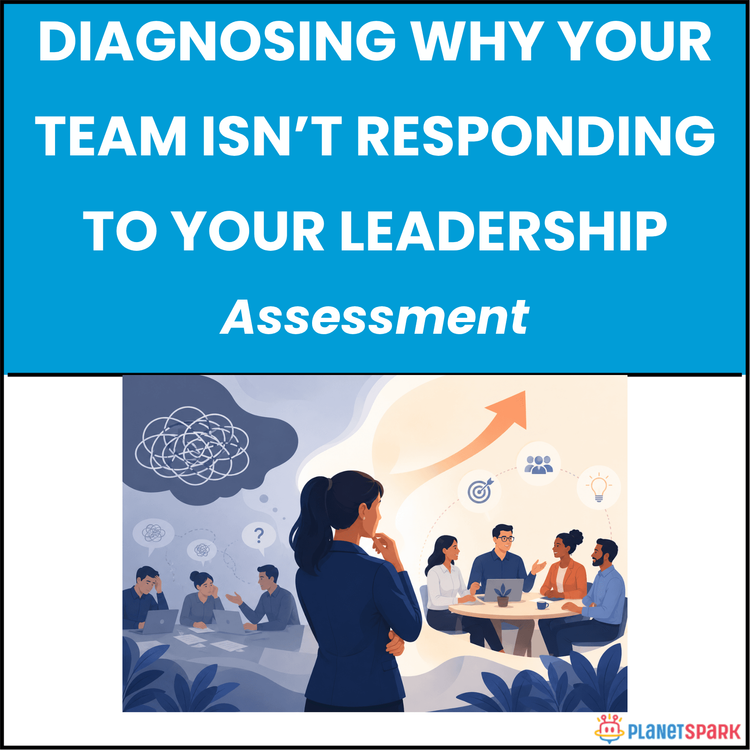
Diagnosing Why Your Team Isn’t Responding to Your Leadership
Diagnosing Why Your Team Isn’t Responding to Your Leadership: A Practical Leadership Assessment Toolkit
Few leadership experiences are more frustrating than feeling like your team simply is not responding.
You communicate expectations clearly, hold meetings regularly, give feedback, and try to stay supportive — yet something still feels disconnected.
Conversations feel flat.
Energy feels low.
Instructions are only partially followed.
Feedback doesn’t seem to create change.
And over time, leadership starts feeling heavier than it should.
Most professionals immediately assume the problem is effort, discipline, or team attitude.
But in many cases, the real issue is diagnosis.
Without understanding the actual reason your leadership is not landing, it becomes almost impossible to fix the right problem.
That is exactly what this resource is designed to solve.
“Diagnosing Why Your Team Isn’t Responding to Your Leadership” is a practical assessment toolkit that helps managers and team leaders identify the real causes behind team disengagement, lack of responsiveness, low trust, poor alignment, or inconsistent execution.
Instead of offering generic leadership advice, this resource provides structured diagnostic frameworks, reflection tools, and practical leadership lenses that help professionals identify what is actually breaking down inside their teams.
Who Is This Resource For?
This toolkit is especially valuable for:
- First-time managers
- Team leads struggling with engagement
- Mid-career professionals leading growing teams
- Managers dealing with low responsiveness
- Consultants managing delivery teams
- Professionals leading under pressure
- Leaders inheriting disengaged teams
- Managers trying to improve trust and communication
If you often feel like your team is “technically listening” but not truly aligned, motivated, or engaged, this resource will help you diagnose why.
What Does This Resource Contain?
The resource is built around five diagnostic leadership lenses that help professionals identify where leadership breakdowns are happening.
Each section includes:
- Leadership explanations
- Diagnostic questions
- Self-assessment tools
- Reflection exercises
- Repair strategies
- Practical workplace examples
1. Understanding Why Leadership May Not Be Landing
The guide starts by addressing a reality many managers quietly struggle with:
“I’m doing everything right, but my team still isn’t responding.”
Instead of immediately focusing on solutions, the resource teaches leaders to first identify root causes accurately.
This section explains:
- Why leadership problems are often misdiagnosed
- How different leadership breakdowns overlap
- Why pushing harder rarely solves the issue
- The importance of structured self-diagnosis
This framing alone helps leaders approach team problems more strategically instead of emotionally.
2. The Trust and Credibility Gap
One of the strongest sections in the toolkit focuses on trust.
The guide explains that teams do not follow titles — they follow leaders they perceive as:
- Competent
- Consistent
- Invested in team success
The resource explores:
- Signs of broken trust
- Credibility self-audits
- Leadership inconsistency patterns
- Trust-repair actions
It also includes practical exercises such as:
- Commitment consistency checks
- Public accountability reflection
- Direct trust-repair conversations
This section is particularly valuable for leaders managing inherited teams or newly promoted managers leading former peers.
3. The Communication Mismatch Lens
Another highly practical module examines communication style mismatches between leaders and teams.
The toolkit explains how leadership communication can fail even when intentions are clear.
It breaks down different communication styles:
- Directive
- Coaching
- Visionary
- Supportive
The resource also includes a Communication Mismatch Diagnostic Worksheet that helps leaders analyze:
- How they give direction
- How team members receive information
- Feedback preferences
- Conflict-handling approaches
This section is extremely useful for managers who feel their team “doesn’t get the message” despite repeated communication.
4. Clarity and Expectation Failure
One of the most actionable parts of the resource focuses on leadership clarity.
The guide explains how ambiguity creates:
- Anxiety
- Misalignment
- Rework
- Low ownership
- Apparent disengagement
The toolkit includes:
- Clarity checklists
- Role expectation exercises
- Ownership mapping
- Success-definition frameworks
- Escalation-path planning
One of the strongest ideas in this section is the principle:
“Clarity is kindness.”
The resource repeatedly reinforces that many performance issues are actually clarity problems in disguise.
5. Motivation and Psychological Safety
The final diagnostic lens explores emotional and psychological barriers to engagement.
The resource explains:
- Why people disengage quietly
- How unsafe teams become passive
- The role of psychological safety in performance
- Why compliance is not the same as commitment
Readers learn how leadership behaviour influences:
- Team openness
- Risk-taking
- Idea-sharing
- Feedback culture
- Participation levels
This section helps leaders identify hidden emotional dynamics affecting team responsiveness.
Summary of the Resource
“Diagnosing Why Your Team Isn’t Responding to Your Leadership” is a practical self-assessment toolkit that helps leaders identify the root causes behind low engagement, poor responsiveness, weak trust, and leadership disconnects.
Instead of treating leadership challenges as personality problems, the resource breaks them into diagnosable systems and behavioural patterns.
The toolkit focuses on:
- Trust gaps
- Communication mismatches
- Clarity failures
- Psychological safety
- Leadership credibility
- Team responsiveness
It gives professionals structured ways to understand leadership breakdowns before attempting to solve them.
How Will This Resource Be Useful?
This resource is valuable because many managers attempt solutions before understanding the actual problem.
It Helps Leaders Diagnose Accurately
Instead of relying on assumptions, the toolkit provides structured reflection frameworks that reveal where leadership friction is happening.
It Improves Team Communication
The communication diagnostics help leaders adapt their messaging style to different team needs and situations.
It Strengthens Trust
The trust-gap exercises help leaders identify behaviours that may unintentionally reduce credibility or consistency.
It Reduces Leadership Frustration
Understanding the difference between:
- Motivation problems
- Clarity problems
- Trust problems
- Communication problems
helps leaders stop treating every issue the same way.
It Creates Better Leadership Self-Awareness
The reflection tools encourage leaders to evaluate their own behaviours honestly instead of focusing only on team performance.
It Helps Teams Become More Responsive
Once the correct root causes are identified, leaders can apply targeted changes that improve alignment, engagement, and execution quality.
How Should You Use This Resource?
This toolkit works best when used actively and honestly.
Step 1: Read the Diagnostic Overview Carefully
Start by understanding the five leadership lenses before jumping into solutions.
Many teams experience multiple overlapping breakdowns simultaneously.
Step 2: Complete the Self-Assessments Honestly
Avoid defensive answers.
The more honest your reflections are, the more useful the resource becomes.
Step 3: Identify the Primary Leadership Breakdown
Ask yourself:
- Is this mainly a trust issue?
- A communication issue?
- A clarity issue?
- A psychological safety issue?
Focus on the strongest pattern first.
Step 4: Apply One Repair Action at a Time
Do not attempt to overhaul your leadership style overnight.
Choose:
- One communication improvement
- One trust-building action
- One clarity system
- One behavioural adjustment
Consistency matters more than intensity.
Step 5: Revisit the Toolkit Regularly
Leadership dynamics change as teams grow, pressure increases, and organizational structures evolve.
Use the toolkit periodically as a leadership check-in tool.
Action Steps
After reading this resource:
1. Identify one recurring team frustration you are currently facing
2. Complete the trust and credibility self-audit
3. Analyze your communication style with your team
4. Clarify one ambiguous expectation immediately
5. Ask a trusted team member for honest leadership feedback
6. Choose one repair strategy to implement this week
Leadership problems are rarely solved by pushing harder.
Most of the time, they are solved by understanding more clearly what is actually happening beneath the surface.
When leaders learn how to diagnose trust gaps, communication mismatches, clarity failures, and psychological safety issues accurately, they become far more effective at creating teams that respond with trust, ownership, and genuine engagement.
This resource provides the practical frameworks to make that diagnosis possible.