
Diagnosing Why Your Team Lacks Ownership and Initiative

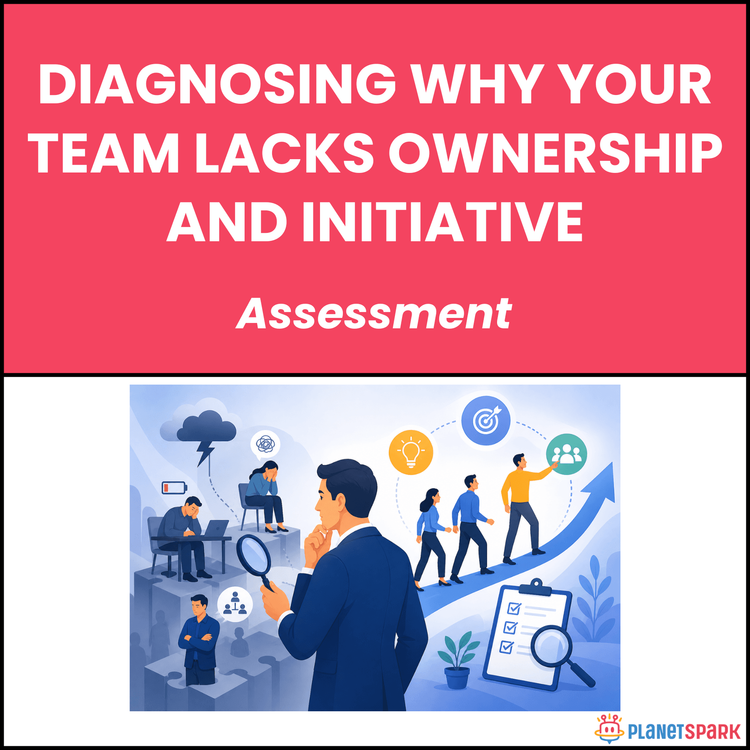
Diagnosing Why Your Team Lacks Ownership and Initiative
Diagnosing Why Your Team Lacks Ownership and Initiative: A Practical Toolkit to Build Accountability and Proactive Teams
If you’ve ever found yourself thinking, “Why does no one take initiative on this team?”—you’re not alone.
Missed deadlines, constant escalations, and a team that waits for instructions instead of taking action are some of the most frustrating challenges managers face. And the instinctive response is often to blame motivation or capability.
But in reality, lack of ownership is rarely a people problem—it’s a system problem.
The “Diagnosing Why Your Team Lacks Ownership and Initiative” resource is designed to help you uncover the real reasons behind low accountability and fix them with clarity and precision.
Who Is This Resource For?
This resource is ideal for professionals responsible for team performance and culture, including:
- Managers leading teams with low accountability or initiative
- Team leads dealing with dependency culture or passive behaviour
- Consultants diagnosing team performance issues
- New managers inheriting underperforming teams
- HR and L&D professionals working on leadership development
If your team is capable but not proactive, this resource will help you understand why—and what to do about it.
What Does This Resource Contain?
This is a structured diagnostic toolkit built around 10 scenario-based templates. Each one addresses a different angle of ownership and initiative breakdown.
Here’s what you’ll find inside:
1. Team Ownership Baseline Audit
A structured first assessment to identify where ownership gaps exist.
2. Root Cause Fishbone Diagnostic
A visual and analytical framework (shown on page 5) to map causes across leadership, structural, cultural, and individual factors.
3. 1-on-1 Accountability Conversation Guide
Helps you run non-confrontational conversations to uncover real barriers.
4. Psychological Safety Self-Assessment
Measures whether fear or blame is preventing initiative.
5. Clarity & Expectation Gap Mapper
Identifies mismatches between what managers expect and what team members understand.
6. Leadership Behaviour Impact Checker
A reflective tool to assess whether your own management style is limiting ownership.
7. Team Retrospective: Initiative Patterns Review
A facilitated session to analyse where initiative was taken, avoided, or blocked.
8. Cross-Functional Dependency Audit
Diagnoses whether external dependencies are causing delays and passivity.
9. New Manager Onboarding Diagnostic
A structured approach to assess ownership culture in a new team.
10. Ownership Recovery Action Plan
A 30/60/90-day roadmap to turn insights into measurable action.
Each template is practical, structured, and ready to use immediately—no guesswork required.
Summary of the Resource
This resource helps you shift from guessing why your team lacks ownership to diagnosing it systematically.
Instead of treating symptoms like missed deadlines or low initiative, you learn to:
- Identify root causes with clarity
- Separate structural issues from behavioural ones
- Run structured conversations with your team
- Build targeted, data-backed action plans
As highlighted in the guide, ownership gaps often stem from factors like unclear expectations, lack of psychological safety, or leadership behaviours—not just individual motivation.
How Will This Resource Be Useful?
This toolkit delivers meaningful outcomes for working professionals:
Clear Diagnosis Instead of Assumptions
You stop guessing and start identifying exact causes of low ownership.
Improved Team Accountability
By fixing root issues, you enable proactive behaviour across the team.
Better Manager Effectiveness
You understand how your own actions may be influencing team behaviour.
Stronger Team Culture
Addressing psychological safety and clarity leads to higher trust and initiative.
Faster Problem Resolution
Structured templates allow you to act quickly and confidently.
In short, it transforms a vague leadership problem into a solvable system.
How Should You Use This Resource?
To get the most value, follow a structured approach rather than jumping between templates.
Step 1: Start with a Baseline
Use the Team Ownership Audit to identify patterns.
Step 2: Diagnose Root Causes
Use the Fishbone Diagnostic and Psychological Safety Assessment to go deeper.
Step 3: Have Structured Conversations
Use the 1-on-1 guide and clarity mapper to understand individual perspectives.
Step 4: Evaluate Your Own Leadership
Complete the Leadership Behaviour Checker honestly.
Step 5: Build an Action Plan
Use the Ownership Recovery Plan to create a 30/60/90-day roadmap.
The usage guide on page 14 also recommends combining key templates (T01, T04, and T06) for a comprehensive initial diagnosis.
Action Steps
If you want to start immediately, follow this simple plan:
1. Conduct a quick ownership baseline audit for your team
2. Identify one recurring pattern of low initiative
3. Use the fishbone diagnostic to map possible root causes
4. Run at least one structured 1-on-1 conversation this week
5. Define one behaviour you will change as a manager
6. Create a simple 30-day action plan to test improvements
Small, consistent interventions can significantly shift team behaviour over time.
A lack of ownership in teams is rarely about people not caring—it’s about people not being enabled to act.
When expectations are unclear, feedback is inconsistent, or decision-making feels risky, even high performers become passive.
This resource gives you the structure to diagnose, understand, and fix those barriers—so your team can move from dependency to ownership.