
Distributed Team Collaboration Framework

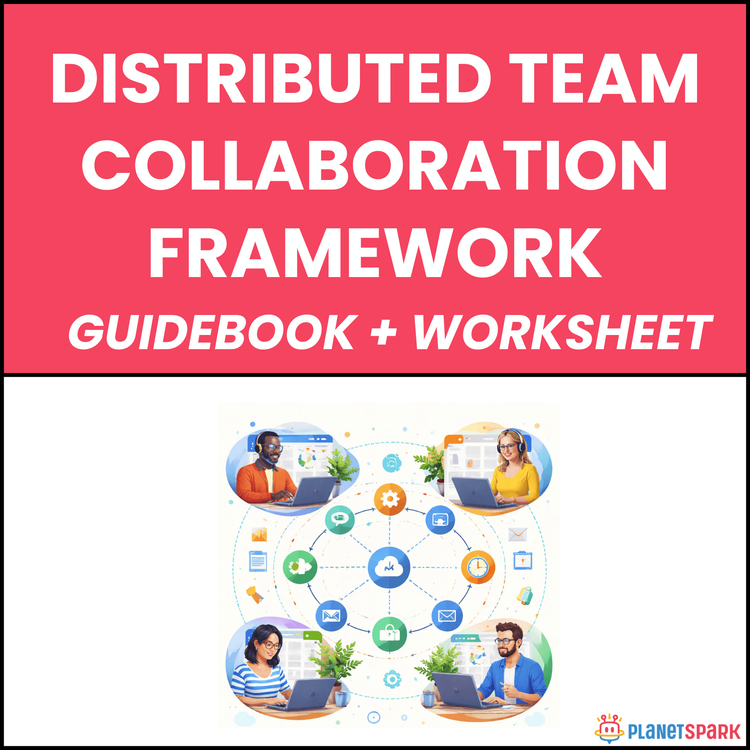
Distributed Team Collaboration Framework
Distributed Team Collaboration with This Essential Framework
Remote work and distributed teams have become the new norm. Whether you're leading a team across time zones, working as a consultant with remote stakeholders, or transitioning to a remote-first role, you need effective collaboration strategies. This resource, the Distributed Team Collaboration Framework, gives you a clear, actionable guide to collaborating with clarity, confidence, and measurable results, no matter where your team members are located.
Who Is This Resource For?
This framework is designed for:
- Career switchers entering remote-first roles
- Early-to-mid career professionals working in distributed teams
- Managers leading teams across time zones
- Consultants coordinating with remote stakeholders
- Anyone frustrated by collaboration friction
If you are time-poor and outcome-oriented, this guide is built for you. Whether you prefer skimming for quick wins or reading deeply for lasting change, the resource fits your needs.
What Does This Resource Contain?
The framework provides a comprehensive guide to overcoming collaboration challenges in distributed teams. Here’s what you will find:
- Why Distributed Collaboration Matters Now — Understanding the shift to remote and why collaboration systems matter more than ever.
- Meeting Best Practices — Transform your meetings with an async-first approach to reduce meeting fatigue and increase productivity.
- The 5-Pillar Framework for Distributed Teams — Focus on key areas like clarity, communication, connection, coordination, and continuous improvement to boost team effectiveness.
- Pillar Strategies — Deep dives into each of the five pillars, with actionable strategies to implement immediately.
- Worksheets and Templates — Tools to audit clarity, improve communication protocols, and standardize handoffs for smoother collaboration.
- Real-World Application — Case studies showing how teams implemented these pillars to transform their collaboration outcomes.
- Common Mistakes and How to Fix Them — Identifying and addressing common collaboration pitfalls like meeting overload and tool sprawl.
- Action Plans — Step-by-step guides to make immediate improvements and create a high-performing distributed team.
Summary of the Resource:
The Distributed Team Collaboration Framework provides a structured approach to building a cohesive and productive distributed team. It covers everything from establishing clear goals and roles (Pillar 1: Clarity) to creating an async-first communication culture (Pillar 2: Communication), fostering trust and connection (Pillar 3: Connection), ensuring smooth workflows and handoffs (Pillar 4: Coordination), and continuously improving through feedback (Pillar 5: Continuous Improvement). With worksheets, templates, and real-world examples, this resource equips you with everything you need to elevate your team’s performance.
How Will This Resource Be Useful?
By applying the strategies in this framework, you will:
- Gain clarity on your team’s goals, roles, and expectations, reducing confusion and increasing accountability.
- Improve communication by shifting to an async-first approach, which increases productivity and respects time zones.
- Strengthen connection by building trust, fostering a sense of belonging, and promoting psychological safety within your team.
- Enhance coordination by streamlining workflows and ensuring smooth handoffs with the right tools and protocols.
- Drive continuous improvement by regularly reflecting on team performance, addressing friction points, and adapting workflows.
How Should You Use This Resource?
To get the best results, apply the framework step-by-step:
1. Week 1: Clarity Sprint — Run a Clarity Audit with your team. Define your top priorities and assign clear ownership using a RACI framework.
2. Week 2: Communication Reset — Introduce your async-first policy. Audit your recurring meetings and cancel or shorten at least two.
3. Week 3: Connection Rituals — Launch a new connection ritual like a weekly check-in opener or a virtual coffee roulette.
4. Week 4: Coordination Overhaul + First Retro — Implement the Handoff Template for all active projects and run your first team retrospective.
Action Steps:
1. Run the Clarity Audit with your team to assess goal alignment and role ownership.
2. Audit your communication to ensure that async-first protocols are in place and meetings are reserved for when they’re truly needed.
3. Launch a team-building ritual to strengthen connections and build trust within the team.
4. Implement the Handoff Template for all active projects to ensure smooth coordination and proper documentation.