
Energy Management vs Time Management Framework

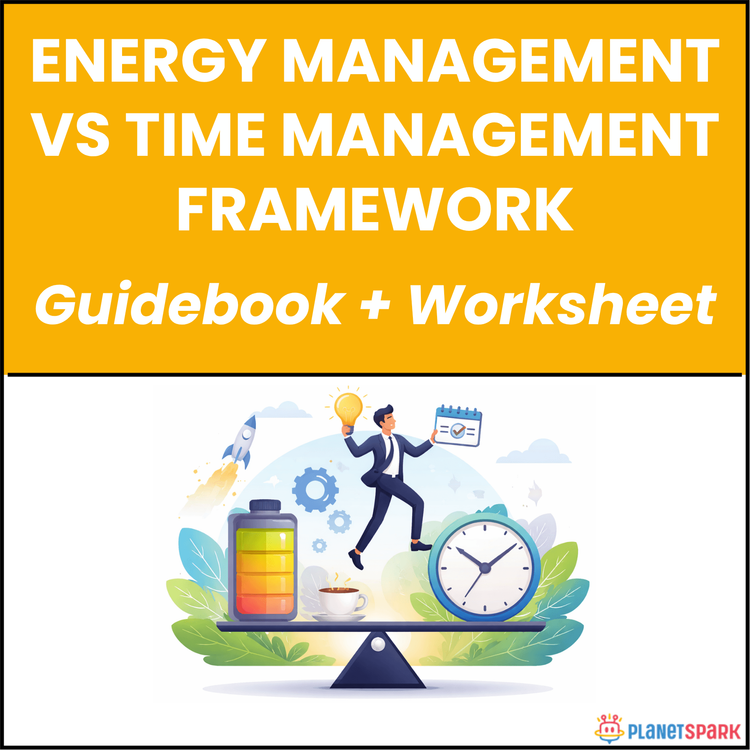
Energy Management vs Time Management Framework
Optimising the Productivity by Managing Energy, Not Just Time
If your calendar is full but your output still feels inconsistent, you’re not alone. Many working professionals meticulously plan their days—blocking hours, managing tasks, and optimising schedules—yet still end the week feeling drained, unproductive, and behind.
The problem isn’t a lack of time. It’s a lack of energy.
That’s exactly why the resource “Energy Management vs Time Management Framework” exists. It helps you shift from simply managing your hours to strategically managing your energy—so you can perform at your best without burning out.
This guide is built for professionals who want sustainable productivity, not just longer workdays.
Who Is This Resource For?
This resource is especially useful if you are:
- A working professional with 0–15 years of experience
- A manager, consultant, or individual contributor juggling multiple responsibilities
- A career switcher trying to build consistency and focus
- Someone who feels constantly busy but not truly productive
- A professional experiencing burnout, fatigue, or mental overload
- Someone looking to improve performance without working longer hours
If you want to stop running on empty and start working with clarity and control, this framework is designed for you.
What Does This Resource Contain?
This is not a generic productivity guide. It is a structured, science-backed system designed for immediate application.
Inside the resource, you’ll find:
- A clear distinction between time management and energy management
- The concept of four energy dimensions: physical, emotional, mental, and spiritual
- An Energy Audit worksheet to assess your current energy patterns
- A 3-day Energy Mapping exercise to identify peak, trough, and recovery periods
- A deep explanation of ultradian cycles and chronotypes
- The Energy Investment Matrix to align tasks with energy levels
- The stress–recovery cycle framework for sustainable performance
- A step-by-step system to build your personal energy management routine
- Real-world case study of a working professional transformation
- A guide to identifying personal energy drains and energy gains
- A template to design your Ideal Energy Week
- Common mistakes professionals make—and how to fix them
- A monthly self-evaluation sheet to track progress
- A one-page Energy Management Cheat Sheet for daily use
Everything is designed to move you from awareness to action.
Summary of the Resource
“Energy Management vs Time Management Framework” is a practical guide that helps you understand how your energy actually works—and how to use that understanding to improve performance.
Instead of forcing productivity through discipline and long hours, this resource teaches you how to align your work with your natural energy patterns. The result is better focus, higher-quality output, and sustainable productivity over time.
If you apply even a part of this system, you will see a measurable difference in how you work and how you feel.
How Will This Resource Be Useful?
This resource helps you shift from reactive work habits to intentional performance.
You’ll gain:
- Clear awareness of your personal energy patterns
- The ability to identify your peak productivity windows
- Better focus and deeper work during high-energy periods
- Reduced burnout through structured recovery
- Improved decision-making and mental clarity
- A system to prioritise high-value work effectively
- Greater consistency in performance across the week
Most importantly, it helps you stop confusing busyness with productivity—and start producing meaningful results.
How Should You Use This Resource?
To get the best results, follow a structured approach:
First, read through the entire guide once. This will help you understand the full framework and how each part connects.
Next, complete the Energy Audit to assess your current state. Be honest—this step builds the foundation for everything that follows.
Then, move to the 3-day Energy Mapping exercise. Track your energy levels throughout the day to identify patterns.
Once you understand your energy rhythm, apply the Energy Investment Matrix to align your tasks with your energy levels.
After that, begin building your system step by step:
- Protect your peak hours
- Redesign your schedule
- Introduce recovery rituals
Finally, use the weekly review and monthly self-evaluation to refine and improve your system over time.
This is not a one-time read—it’s a working tool you should revisit regularly.
Action Steps
After accessing this resource, take these steps immediately:
1. Block 2–3 hours this week to go through the guide
2. Complete the Energy Audit (10 minutes)
3. Track your energy for 3 days using the mapping worksheet
4. Identify your peak and low-energy periods
5. Schedule one 90-minute deep work session in your peak window
6. Introduce at least one deliberate recovery break into your day
7. Use the Energy Investment Matrix to plan your upcoming week
Start small—but start immediately.
Most professionals try to solve productivity problems by managing time better. But real performance comes from managing energy.
When you align your work with how your body and mind actually function, everything changes—your focus improves, your output increases, and your stress decreases.
This framework is not about doing more. It’s about doing what matters, at the right time, with the right energy.
Use it to redesign not just your schedule—but your entire approach to work.
Book your free session today!