
Framework for Problem Analysis

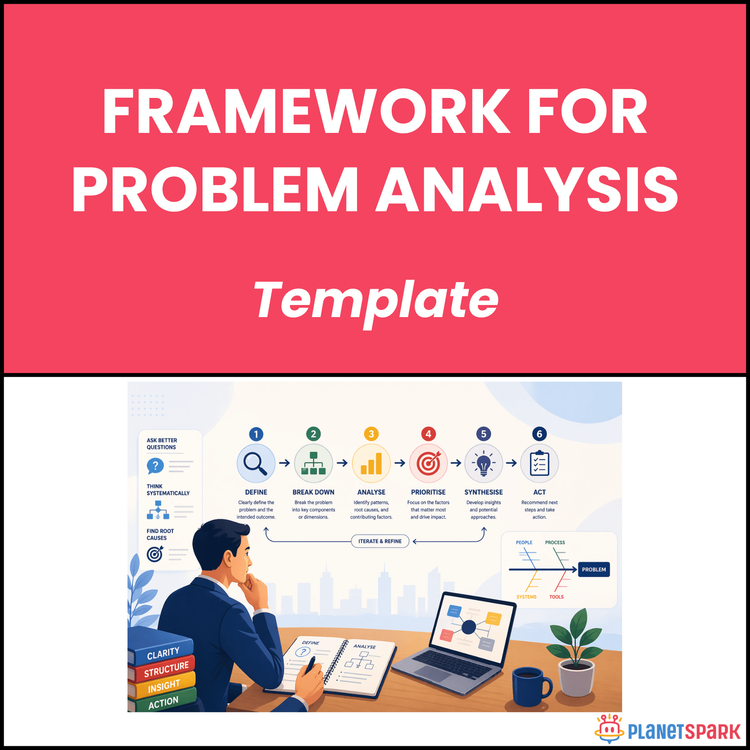
Framework for Problem Analysis
Problem Analysis Framework: A Step-by-Step Guide to Diagnose Problems Faster and Make Better Decisions at Work
If you’ve ever found yourself stuck in endless meetings, jumping from one solution to another—only to realise the problem still isn’t fixed—you’re not alone. Most working professionals are trained to solve problems quickly, but not to analyse them correctly.
The result? Time wasted on the wrong fixes, recurring issues, and decisions that don’t hold up under pressure.
That’s exactly why the “Framework for Problem Analysis” exists. It’s designed to help you slow down just enough to think clearly—so you can act faster, smarter, and with confidence. Instead of reacting to problems, this playbook gives you a structured system to diagnose root causes, make better decisions, and avoid costly mistakes.
Who Is This Resource For?
This resource is especially valuable if you are:
- A working professional (0–15 years experience) dealing with complex or ambiguous problems
- A manager or team lead responsible for making decisions under pressure
- A consultant or analyst who needs structured thinking to solve client problems
- A career switcher entering a new domain and needing a reliable thinking framework
- Someone who feels overwhelmed when problems are unclear or constantly changing
If you want to move from reactive problem-solving to strategic thinking, this playbook is built for you.
What Does This Resource Contain?
This is not just theory—it’s a practical, application-focused playbook designed for real workplace challenges.
Inside the resource, you’ll find:
- A complete 5-phase Problem Analysis Framework (Define, Decompose, Diagnose, Decide, Document)
- Clear guiding questions for each phase to structure your thinking
- Practical tools like Issue Trees and the 5 Whys technique
- A structured approach to identifying and validating root causes
- Decision-making frameworks to evaluate and select the best solution
- A documentation system to build long-term problem-solving capability
- Ready-to-use worksheets, including:
- Problem Definition Worksheet
- Root Cause Hypothesis Tracker
- Pre-Solution Checklist
- A real-world case example (Revenue Drop scenario) showing the framework in action
- Common problem-analysis mistakes—and how to fix them
- A quick-reference system for applying the framework in meetings
Everything is designed to be used actively during real problems—not just read once and forgotten.
Summary of the Resource
“Framework for Problem Analysis” is a structured, repeatable system that helps professionals break down complex problems, identify root causes, and make clear, confident decisions.
Instead of relying on instinct or guesswork, it gives you a step-by-step thinking process you can apply across any situation—whether it’s a business challenge, team issue, or strategic decision.
How Will This Resource Be Useful?
This resource helps you move from confusion to clarity—and from reaction to control.
You’ll gain:
- The ability to define problems precisely instead of vaguely
- A structured way to break down complex situations into manageable parts
- Confidence in identifying true root causes (not just symptoms)
- Faster and more effective decision-making under pressure
- A consistent approach you can use across teams and projects
- Improved credibility as a structured, strategic thinker
Most importantly, it helps you avoid one of the costliest professional mistakes: solving the wrong problem.
How Should You Use This Resource?
To get the best results, use this playbook in a practical, repeatable way:
Start by reading the full guide once to understand the overall framework and flow. This builds your mental model.
Next, apply the framework to a real problem you’re currently facing. Begin with the Problem Definition Worksheet and avoid jumping ahead.
Work phase by phase:
- Define the problem clearly (without assuming causes)
- Decompose it into smaller components
- Diagnose root causes using hypotheses and evidence
- Decide on the best course of action
- Document the process for future use
Use the worksheets during meetings to bring structure to discussions and reduce confusion.
Finally, revisit the framework after solving a problem to refine your thinking and improve your approach over time.
Action Steps
After accessing this resource, take these steps immediately:
1. Identify one real problem you are currently facing at work
2. Block 30–60 minutes for focused analysis
3. Complete the Problem Definition Worksheet (no assumptions)
4. Break the problem into at least 3 components using decomposition
5. Generate 2–3 root cause hypotheses and test them with evidence
6. Decide on a clear action with defined success metrics
7. Document the outcome for future reference
Consistent use of this process will quickly improve both your thinking and your results.
In fast-moving work environments, the professionals who stand out are not the ones who react the fastest—but the ones who think the clearest. Problem analysis is not about slowing down your work; it’s about eliminating wasted effort and making every action count.
When you learn to define problems precisely, test assumptions rigorously, and act based on evidence, you build a skill that compounds across your entire career.
Use this framework not just to solve problems—but to become the person others trust when problems get complex.