
Handling Passive-Aggressive Behavior at Work

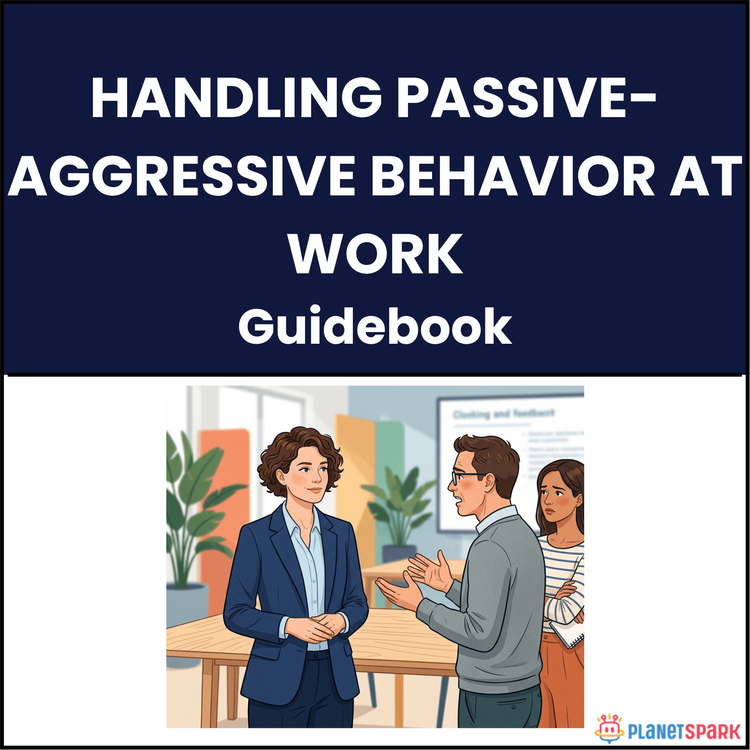
Handling Passive-Aggressive Behavior at Work
Managing Hidden Conflict at Work: A Practical Guide to Identifying and Resolving Passive-Aggressive Behaviour
You are in a meeting. Someone agrees with you—but later delays the work. A colleague makes a comment that sounds like praise but feels like a jab. Emails go unanswered, information is “forgotten,” and suddenly your work becomes harder for reasons no one openly acknowledges.
This is one of the most frustrating workplace experiences—and one of the least discussed.
Passive-aggressive behavior operates in the grey zone. It is not direct enough to confront easily, but impactful enough to drain your time, confidence, and productivity. Most professionals sense it, but struggle to name it, let alone handle it effectively.
That’s exactly why the resource “Handling Passive-Aggressive Behaviour at Work” exists. It is a practical, structured guide designed to help you recognise these patterns clearly, respond professionally, and protect your credibility—without escalating conflict or losing control.
Who Is This Resource For?
This resource is especially valuable if you are:
- A working professional (0–15 years of experience) navigating team dynamics
- Someone dealing with difficult colleagues, unclear communication, or hidden conflict
- A manager handling team friction or underperformance that is hard to address directly
- A professional who wants to communicate assertively without sounding aggressive
- Someone who often second-guesses interactions or replays conversations later
- A high-performer whose productivity is being affected by indirect workplace behaviors
If you want clarity, control, and practical tools—not vague advice—this guide is built for you.
What Does This Resource Contain?
This is not a theory-heavy communication guide. It is a highly practical playbook designed for real workplace situations.
Inside the resource, you’ll find:
- A clear breakdown of what passive-aggressive behavior actually looks like in professional settings (e.g., missed deadlines, sarcasm, silence, information withholding)
- A framework to distinguish between one-off behavior and chronic patterns
- Self-regulation tools like the 90-second rule and emotional labeling to manage reactions in real time
- A structured response model: the CALM Framework (Clarify, Acknowledge, Listen, Move) for handling conversations effectively
- Ready-to-use scripts for common workplace scenarios (meetings, emails, deadlines, escalation)
- A reflection worksheet (“Trigger Map”) to build awareness of your own responses
- A pre-conversation checklist to prepare for difficult discussions
- Strategies tailored to different contexts:
- When the person is your manager
- When it’s a peer or cross-functional colleague
- When you are the manager
- A documentation protocol to handle repeated patterns professionally
- Boundary-setting frameworks that are firm yet non-confrontational
- A real-world case study showing how these tools work in practice
- Common mistakes professionals make—and how to correct them
- A self-evaluation to identify if you may unintentionally be contributing to the pattern
- A one-page quick reference guide for real-time use
- A 7-day action plan to apply learning immediately
Everything is designed for application—not just understanding.
Summary of the Resource
“Handling Passive-Aggressive Behaviour at Work” is a practical, structured guide that helps you identify indirect conflict, regulate your reactions, and respond with clarity and professionalism.
It gives you the language, frameworks, and scripts needed to handle difficult interactions without escalation—so you can protect your work, your reputation, and your mental bandwidth.
If you’ve ever felt confused, drained, or stuck after workplace interactions, this resource helps you move from uncertainty to control.
How Will This Resource Be Useful?
This resource helps you shift from reaction to strategy.
You’ll gain:
- The ability to clearly recognise passive-aggressive patterns instead of second-guessing yourself
- Emotional control in high-friction situations through practical regulation techniques
- Confidence in addressing difficult behavior without sounding defensive or aggressive
- Structured communication tools that reduce ambiguity and increase accountability
- Stronger professional credibility by staying composed and direct
- Better working relationships through clearer expectations and boundaries
- Reduced mental fatigue from overthinking workplace interactions
Most importantly, it helps you stop absorbing the impact silently—and start addressing it effectively.
How Should You Use This Resource?
To get maximum value, follow a phased approach:
First, read the guide end-to-end to understand the full framework. This builds clarity on how passive-aggressive behavior operates and why certain responses work better than others.
Next, focus on awareness. Use the examples and patterns to identify real situations in your own workplace.
Then, apply the self-regulation tools. Practice techniques like the 90-second pause and emotional labeling to manage your immediate reactions.
After that, start using the CALM framework for conversations. Begin with one situation and use the provided scripts to guide your communication.
If the behavior is repeated, move to documentation and boundary-setting. Use the structured templates to track patterns and create accountability.
Finally, revisit the guide regularly. Use it as a reference tool whenever you face a difficult interaction, prepare for a conversation, or need to reset your approach.
Action Steps
After accessing this resource, take these steps immediately:
1. Identify one recent situation that felt unclear or frustrating
2. Write down the observable behavior (not your interpretation)
3. Use the Trigger Map worksheet to reflect on your reaction
4. Decide if it is a one-off incident or a recurring pattern
5. Plan one conversation using the CALM framework
6. Use one script from the guide to structure your response
7. Follow up with a clear written summary if needed
Small, deliberate actions here can significantly improve how you handle workplace dynamics.
Passive-aggressive behavior thrives in ambiguity, silence, and avoidance. The moment you bring clarity, structure, and calm communication into the situation, the dynamic begins to shift.
This is not about confrontation—it is about professional control.
When you learn to name what is happening, regulate your response, and communicate with precision, you protect not just your work—but your confidence and long-term career growth.
Use this resource not just to handle difficult people, but to strengthen how you show up in every professional interaction.
Book your free session today!